Thursday, 10 December 2020

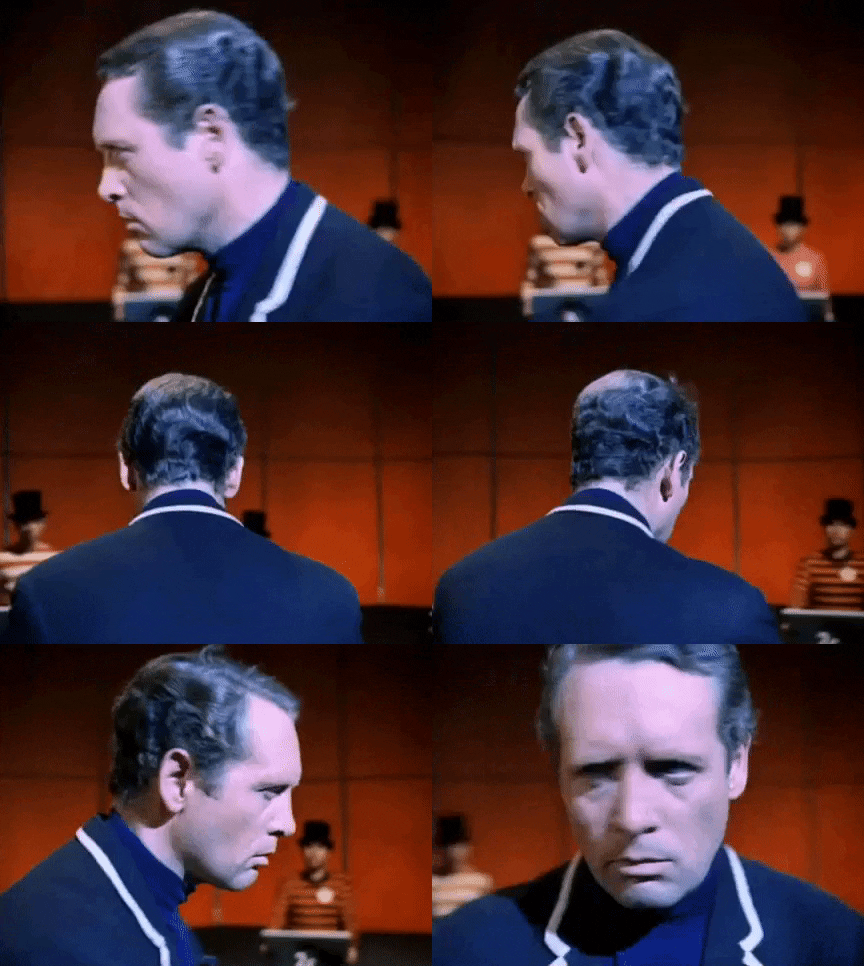
Maintain Propriety


FROM THE DE-BRIEFING OF RAKO BEY, LEADER OF THE VOLUNTEER FORCE TO QUELLEZA, TAKEN 10 OCTOBER   

Q. And what led you to the house in the first place? 

A. Nothing, sir. Grodd was related to the blind man who lived there, but then he is related to most of the village. Nothing led us there, Colonel. It was Fate. 

Q. Maintain propriety.


Vlora shuddered. The room seemed colder. Who would have the need or even think of the need to conceal the telltale vaccination other than a formidable enemy agent on a mission of power and unthinkable menace? 

Vlora brooded on the blind man’s eerie report and the perfectly flawed Albanian dentistry; on the strangled dog in the wood and the spectral, unsettling Selca Decani. 

If the Prisoner wasn’t a foreign agent, Vlora concluded, then he must be a devil. “Or both,” he murmured. 

He’d once heard of such a legendary agent from Hell. That night Vlora slept with the demons. Then events took a turn that was wholly confounding. 

Early on the morning of April 3rd, cutting short his visit to an ailing father, there returned to Tirana from Beijing at Vlora’s urgent and imperative summons, a tall, gaunt Chinese Army medical officer, Major Liu Ng Tsu, a drug-hypnosis interrogation expert assigned as an adviser to Central Security. 

On the third and the fourth, Vlora briefed him and allowed him to study the written record. 

On the fifth there was action. The Prisoner, kept sleepless for thirty-six hours and deprived of water for twenty-four, was placed on his back atop a gurney cart, strapped down with leather restraints, and wheeled to a narrow, white-tiled room. 

Immaculately clean and brightly lit by surgical spotlights affixed to the ceiling, this was the so-called “Magic Room.” 
 
Here tricks could be played on top of tricks. First Sodium Pentothal was injected. 
 
After that the hypnosis began and the illusions: “Your hand is beginning to feel very warm,” recalcitrant subjects had often been told; this to convince them they had entered the hypnotic state and that further attempts at resistance were useless, when in fact the subject’s hand was responding to the current from a hidden diathermy machine. 
 
Or concealed holographic projectors were invoked: 
“Do you see the solid wall there in front of you?” 
 
“Yes.”

“Look through it. You’ll see roses that are floating in midair.” 
 
These were the games. When they were done, methamphetamine was injected to create an irresistible, driving urge to pour out speech, ideas, and memories, giving the subject no time to think; and then there sometimes came forth, at the end of it all, a bruised and slurry thing called Truth. 

“Come, begin! What’s the problem?” 
 
Exhausted and driven, impatient, consumed, Vlora glared in consternation at Tsu, who was standing across from him at the gurney. Leaning down to inject the Pentothal, he had inexplicably hesitated: the syringe held poised in midair, he stood motionless, studying the Prisoner’s face. 
 
Vlora looked worried. “What is it?


“What’s wrong?” 

Tsu shook his head, remained still, then said, “Nothing.” 

He bent lower and administered the injection. 

“For a moment I thought I might have seen this man before.” 

A polygraph expert shuffled into the room. Short and middle-aged with close-set eyes, he wore a threadbare suit several sizes too large so that the trousers bagged in folds at his feet. 

“I’m here,” he muttered sourly in greeting. 
 
Pulled away from his breakfast, sullen and begrudging, he noisily unfolded a metal table and chair and banged each of them down near the head of the gurney. After setting his polygraph machine on the table, he wired the Prisoner to the device, then settled into the chair looking wounded and abused. Snuffling, he slipped on his earphones and nodded, as he murmured in a tone of patient suffering, “I’m ready.” 
 
“If you will help us just a little, you may drink this.” Tsu held a frost-covered glass of iced water to the Prisoner’s cheek. 

“Fresh water from a spring,” he told the Prisoner amiably. “If you obey my next command you may drink it. All right? Nothing onerous. Just open your eyes.” 
 
Vlora shook his head. “This will not work,” he said. “It won’t work.” 
 
Staring intently at the Prisoner’s face, an incredible and chilling suspicion had just occurred to him concerning the enigma’s identity. The Prisoner opened his eyes. Vlora took a quick step back from the gurney. Propping up the Prisoner’s head with his hand, Tsu held the water to his lips with the other. “Just a sip or two for now,” he cautioned gently. 
 
Then he made a quiet promise: “More later.” 

The Prisoner spoke. He said, “Thank you.” 

Startled, Vlora flinched while Tsu met his look of amazement with a smile. 
 
And so began the series of steps and events that would lead to the belief that the Prisoner had weakened, an impression that would finally come to be viewed, when the annals of the “Magic Room” were completed, as surely its most incredible and lethal illusion. 
 
All of the early moves were routine: the lights were dimmed down to a ghostly murk, the usual “road hypnosis” begun: the application of a steady, repetitive rhythm, in this instance an illuminated metronome blade which the Prisoner watched as it tocked back and forth. 
 
Such had always been shown to be highly effective against the desire not to be hypnotized and to retain one’s alertness of will. Then the favorite tricks of the room were invoked, and when persuaded that the spell had at last taken hold, Tsu followed by injecting the methamphetamine in a larger than usual dosage — 6.4 milligrams per kilogram of body weight — needed for introverted neurotics. 
 
And then, in an ordinary, nondescript voice, and with flawless inflection of the language of the north, the Prisoner not only spoke but also answered all queries. It might have been better for his captors had he not. 
 
Under questioning, the Prisoner repeated his claim to be Selca Decani, the peddler of cheese and the lover of Morna Altamori, explaining that, in fact, he had never died but had simply vanished, fled away to the West, the reports of his death a deliberate fiction contrived to protect Decani’s family from certain harassment by The State. His return to Albania had been prompted by his fear of the imminent death of his ailing mother. 
 
This, fundamentally, was Story Number One. There were others. Enemy agents of the deadlier class had been known to use drugs and hypnosis defensively with nefarious “pentothal blocks” so that the subject, under torture or if questioned by this method, would repeat a hypnotically programmed recitation. 
 
In the event that his questioners probed even deeper by attacking the block with more drugs and hypnosis, underneath the first story they might turn up a second, which, just as the first, had been scripted and implanted. 
 
A third such block had been found, it was rumored, in a rare if not mythical number of cases. Thus everything seemed to be running to form, every paranoid fear and suspicion confirmed when, under much deeper interrogation, the Prisoner’s story drastically changed. While retaining the carpentry of the first it differed in subtle but significant ways. 
 
This time the Prisoner admitted that Selca Decani indeed was dead, and that he himself was named Sabri Melcani and had years ago fled to Yugoslavia, and from there moved on to Greece, to escape a murder charge that had arisen from his actions in the course of pursuing a blood feud: hearing that the man he thought he’d killed had recovered and was happily walking the earth, Melcani felt compelled — “by the sting of conscience,” he said — to return and try again. 
 
This, in essence, was Story Number Two which, if left at that, might not have proved so upsetting, except that there were also Story Three, Story Four, and Story Five, while Story Six, to the fury and utter consternation of all, was a faithful repetition of Story Number One, thus announcing — provided the Prisoner could live through the added injections of the dangerous drugs — the prospect of an endless and fruitless cycle. 
 
Which was not, as it happened, the most appalling thing at all. This honor was reserved for the polygraph machine. It corroborated all of the Prisoner’s stories. 
 
At this juncture it was difficult to know where to turn, and so the natural direction, by default, and to the immense relief of anyone harboring a longing for the familiar, was directly and immediately into chaos as, desperate, Vlora embraced a new tactic that was neither in his nature nor his power to control. From beginning to end the scenario was Tsu’s. It began very calmly. In fact, rather pleasantly. 
 
The Prisoner was taken to comfortable quarters where, after receiving medical attention, for seven days he was able to bathe, given food and drink and clean clothes, and was permitted to sleep in a downy bed undisturbed until he naturally awakened. In the meantime, Major Tsu had given strict instructions that no one in contact with the Prisoner was ever to speak while in his presence, either to him or to anyone else. On day eight, a Monday, action resumed. The Prisoner was escorted by four armed guards to the room with the T-shaped table where Vlora alone sat waiting for him. The black velvet drapes had been drawn aside from the great high windows along the east wall so that sunlight shattered down in smoky columns, trapping particles of dust and fear in their swirl. 
 
The Prisoner was placed near the bottom of the table by two of the guards, all of whom then exited the room and left him standing alone at the bottom of the T with his head bowed down and his hands held clasped in front of him as if gripped by invisible manacles. Music played softly through speakers in the walls and all the windows stood open so that one could hear traffic from the street far below. Now and then a child’s shout or silly laugh floated up. 
 
“So here we are,” began Vlora in an ordinary way. “New surroundings are refreshing at times, a great tonic; they can pry us from our ruts, our fixed habits of thinking. By the way, do sit down if you like. Please be comfortable. Really. Never mind, then. Just as you wish. 
 
Incidentally, is the music to your liking? We can change it. Should I change it? It is Strauss. Very well, then, we shall leave it. 
 
In the meantime, let me tell you what is happening here. 
First, we thank you for those fascinating stories that you told us. 
 
I myself am a lover and avid admirer of any great work of the imagination. I’ve translated many of them into Albanian: Shakespeare’s Macbeth, and his Hamlet and Othello. Also Lady Inger of Ostrat by Ibsen. Don Quixote. 
Do you find that surprising? Yes, I did the work personally, it was when I was a teacher at college. They awarded me the “Partisan Star.” 
Well, never mind. I’ve been garrulous. 
Why is it that we always feel this gnawing necessity to justify ourselves to every stranger that we meet? 
Do you know what I’m talking about? Perhaps not. 
 
Well, that’s enough of that now. Back to business. Listen here, I want to tell you what we’ve come to. All right? We want to have a new relationship with you. The old one, you’ll admit, was unrewarding.” 
 
Vlora gestured down the length of the table to a tan wicker basket that was crammed with fresh fruit. “Incidentally, try an apricot,” he offered. “They’re in season.” 
 
Into the room now strode three torturers, all brutes of powerful build, including “Laugher,” who led them in. He was gripping a briefcase made of shining blue leather and the arm of a club-footed ten-year-old boy who was dressed in the olive drab denim of a prisoner. The boy’s hands had been tied in front of him and his arms were trussed to his sides. 
 
Arriving at a point that was midway along the table, Vlora’s son pushed the boy forward until he was captured, wincing and blinking, in a column of sunlight. 
 
“Well now, yes, we’re all here,” began Vlora. “Very well, then, let’s not waste any time. This boy is a Gypsy, deformed from birth. In addition to the problem with his foot he has a paralyzed arm, the left, which is numb and completely insensitive to pain. He is also retarded, a mental defective, as well as being dumb and unable to speak. 
 
He murdered his parents in their sleep, an understandable action but not his prerogative. One could argue he is better off dead. But we aren’t going to kill him. No, not for us to judge. 
 
We may not do anything at all to him, in fact. 
It’s really all up to you.” 
 
At a signal from Vlora, “Laugher” lifted the briefcase onto the table, snapped its locks, and withdrew from it a clear and colorless plastic bag at whose bottom was a drawstring made of leather. 
 
The boy’s eyes widened with fear and bewilderment as the bag was slipped over his head. Vlora glanced at his watch as if checking the time until his next appointment. 
 
“Suffocation is a horrible death,” he said casually. “Worse yet is to die in this manner many times; in fact over and over again without limit. Until you reveal your True Name and your mission, plus the data that is needed to verify both, we intend to repeatedly bring this boy to the brink of death by suffocation. His fate is in your hands. But do not feel any pressure. By all means, take your time. As I said to you before, you have suffered enough.” 
 
One torturer tightened the drawstring and knotted it. Another put his arms around the boy and held him still, so that he stayed within the compass of the column of light as he wildly thrashed, his eyes bulging in terror and his mouth gaping open in a soundless shriek while through the speakers rasped the lilts of The Blue Danube. 
 
“This is truly regrettable,” Vlora uttered sadly. “Yes, it is. It truly is. But the danger to thousands outweighs the pain of one.” 
 
He stood up, walked over to a door, and pulled it open. 
 
“Come!” he commanded into the shadows of a dimly lit ante-room, summoning Major Tsu and the creaking old doctor with the black valise. The doctor moved quickly to the nearest corner, while Tsu took Vlora’s seat at the table. “Major Tsu will take my place from here out,” announced Vlora. He was staring at the Prisoner with fatherly patience. 
 
“You have clearly grown too used to me. Yes. Much too comfortable. That’s very clear. Major Tsu will resharpen your interest. In the meantime, do not think that this boy is an actor. He is not. Should you doubt that, I now give you proof.” 
 
With a lift of his chin Vlora gestured toward the boy, and instantly “Laugher” plucked a knife from his pocket, unclasped it, and sliced off the screaming boy’s little finger, lazily tossing it onto the table in front of the Prisoner. 
 
It landed by the basket of fruit. 
 
The Interrogator glared at his son with fury. “Damn you!” he flung at him, seething. “Damn you!” 
 
Against his orders that the finger be cut from the boy’s numb hand, Vlora’s son had cut the finger from the hand that had feeling. Vlora turned and strode angrily out of the chamber, fleetingly assailed, as he was from time to time, by a stabbing flash of doubt that surcease from pain for thousands could ever be purchased with the torment of one. Vlora’s habit was to bludgeon and strangle such thoughts. This time he did not. 
 
What happened after that would be carefully analyzed but never quite understood; after all, the incontestable facts were so few: As he exited, Vlora had been hastily saluted by the two armed guards who were posted at the door. From there he had proceeded directly to his office, passing many other guards in the halls along the way. 
 
But after thirty-seven minutes Vlora suddenly decided to terminate Tsu’s experiment and, bursting from his office in search of a quarrel, he strode rapidly back to the questioning room. 

 
The two armed guards were not at their posts. 
 
Vlora found them inside, both of them stripped of their uniform and weapons. They were unconscious, concussed and drugged with hypnotics that had come from the doctor’s medical bag, while the old man himself, although not touched, had apparently suffered a fatal heart attack, and inasmuch as the boy was discovered alive, this meant that the number of those who had been killed totaled only four, not five as originally thought, and included a torturer who had died from a powerful blow with the heel of a hand that had instantaneously crushed his windpipe, and another whose spine had been broken by a single smash to the nape of his neck, while the back of Tsu’s skull had cracked wide open from the force of his body being slammed against a wall. 
 
The other torturer, “Laugher,” Vlora’s son, greeted death without a noticeable change of expression except for his eyes, in which frozen forever was a faint odd glimmer of something that no one could properly identify, but more than anything resembled surprise. 
 
His neck had been broken. 
 
The two guards who survived could tell their questioners little. On hearing a “scratching sound” on the door, one said, he had entered the chamber alone, caught a glimpse of the Prisoner for “only a flash” before feeling his hands around his throat and being rendered immediately unconscious by “something, some pressure that he put on my nerves.” The other guard, who’d gone into the chamber moments later, related an identical encounter, as did four other guards on other floors. 
 
As to why the Prisoner had spared their lives, they could offer no opinion, nor could anyone else. There were searches, questionings, crime team reports, but in the end they illuminated nothing, and as night and whispers and paranoid terrors filled the mazes of The State Security Building, no heart there beat regularly. 
 
The Prisoner had escaped. 
 
Three days later, on the evening of Sunday, 17 May, and beginning at precisely forty minutes after sundown, seven young men came together in a straw-strewn barn in the high craggy village of Domni, just as they had gathered every Sunday before at precisely this time for hopeless months. 
 
Rough-hewn peasants in their early twenties, they spoke little and in guarded whispers lest the dreaded Sigurimi discover their presence. 
 
When they first began to meet they were excited by their mission, at their breath-holding peril in these secret watches, but the hammer of time had blunted their edge and they felt only tedium now, the grip of habit, as they huddled in darkness on the earthen barn floor and waited for a man who never came. “And so what do you think?” The husky whisper pierced the silence. 
 
“Do you think he’s been captured?” continued the speaker, a brawny smith from the village of Drishti. “Is he dead?” 
 
“I am happy to find you all well.” 
 
The men were startled. The voice was unfamiliar. Not one of theirs. They scrambled to their feet with sudden fear. This someone in the darkness, this stranger: Who was he? Where had he come from? They had seen and heard nothing: No creak of a door. No movement. No step. 
 
The young smith from Drishti recovered his poise. “God may have brought you here,” he ventured in a quietly probing, hopeful voice. 

He felt the pulsing of a vein in his temple as he added the words that could trigger The Password: “Tell us, did you come by the road less traveled?”


The Prisoner stepped forward and uttered the countersign: “‘All of creation waits with longing.’ ” 
 
The smith took in a quick little breath of realization. “The Bishop! It’s you! You have come!” 
 
The next moment the young men were kneeling all in a row on the earthen barn floor with their heads bowed down while the Prisoner moved swiftly and silently forward and, cupping his hands atop the head of the smith, began to recite with urgent speed a Catholic formula of prayer: “‘We ask you, All-Powerful Father . . .” he began.


The ritual completed in less than a minute, the Prisoner moved to the next of the men, laying on his hands and repeating the prayer until, by the end of the seventh repetition, his rich, firm voice had begun to quaver and his hands, lacking fingernails, to tremble, as he sank to his knees and wept convulsively while the newly made priests looked on. 
 
Standing, breathing above his desk in the haunted darkness of his office, Vlora inhaled the ghosts of flowers, withered and dry and dead in their glass; heard the crisp, rough click of the metal switch as he turned on the crooknecked khaki lamp and held under its beam the puzzling object, the mysterious token, whole and unmarked, found crammed into the mouth of his murdered son. It was a golden-skinned apricot. 
 
“Dimiter,” Vlora murmured numbly. It was the name of the agent from Hell. Would the code of the bessa take him even that far? 


The Prisoner stepped forward and uttered the countersign: “‘All of creation waits with longing.’ ” 

The smith took in a quick little breath of realization. “The Bishop! It’s you! You have come!”

Metron


Metron was Kirby’s avatar of ruthless, questing intellect, whose Mobius Chair twisted through time and space to make him the god of couch potatoes, surfing channels, gathering information, without ever leaving the comfort of his armchair. Metron’s magic furniture seems less a wonder of supertechnology than a fact of daily life. As Kirby tried to tell us in his book of the same name, We are The New Gods, just as We are The Old Ones, too.


SKIP:  
That's what The Kid was •designed• for.

LORNE: (chuckles) 
To sleep with mother love?

ANGEL: 
To Create a Vessel.

SKIP: 
Look out. 
The Monkey's thinking again.

ANGEL: 
Being inside A Human makes it VULNERABLE, doesn't it?

That's why it had to stay hidden. 

Why it needed to create something STRONGER to pour itself INTO.

GUNN : 
Wait. So the big nasty inside of Cordy is going to give birth... to itself?

SKIP : 
Circle of Life. It's a Beautiful Thing.


“So I began to think more and more about The Individual, and I looked into what that actually meant


And what it was, was a structure that was pretty much created… The Ego structure was created out of what Julian Jaynes calls The Bicameral Mind becoming One Mind.

And apparently – according to him – he says that back in the old days of the Greeks, and the earliest writing of the world, people didn’t have self-consciousness in the way that we have. 
 

They didn’t have Egos. They didn’t understand themselves as “I” in the same way that we do. Because the corpus callosum – that connects the two hemispheres of the brain – wasn’t connected.


So if you heard A Voice, That Voice was God. 

And Homer, and all those guys, you’ve got plenty of examples of people hearing The Voice of God, and acting on that. 

Alexander constantly acted on The Voice of God.

Julian Jaynes suggests that it wasn’t The Voice of God – it was The Voice of The Left Hemisphere of The Brain communicating with The Right Hemisphere of The Brain, interpreted AS a God.


So okay : now we’ve got the two things joined together. We’ve got This Beautiful Bridge in The Middle that links The Two.  
 
But we have The Ego Structure – which was created when those things linked.


Suddenly we’re like: “Oh fuck. I am I. I am the I Am. This is my.. my god is this. I am separate; I am one.”

We made This Idea that we’re somehow separated from Nature.

No we’re not. Bullshit!


Marlon & Johann

Johnny Depp on Marlon Brando

John, how many movies would you say you make per year, usually?

I don’t know, maybe 2 or 3 on average.

Hm. That’s too much.

Why Do You Say That?

Because — We Only Have So Many Faces in Our Pocket.


The Time of Your Life
preface by 
William Saroyan

In the time of your life, live - so that in that good time there shall be no ugliness of death for yourself or any life your life touches. Seek goodness everywhere, and when it is found, bring it out of its hiding-place and let it be free and unashamed. Place in matter and in flesh the least of the values, for these are the things that hold death and must pass away. Discover in all things that which shines and is beyond corruption. Encourage virtue in whatever heart it may have been driven into secrecy and sorrow by the shame and terror of the world. Ignore the obvious, for it is unworthy of the clear eye and the kindly heart. Be the inferior of no man, nor of any man be the superior. Remember that every man is the variation of yourself. No man’s guilt is not yours, nor is any man’s innocence a thing apart. Despise evil and ungodliness, but not men of ungodliness or evil. These, understand. Have no shame in being kindly and gentle, but if the time comes in the time of your life to kill, kill and have no regret. In the time of your life, live - so that in that wonderous time you shall not add to the misery and sorrow of the world, but shall smile to the infinite delight and mystery of it.

Wednesday, 9 December 2020

Nixon Extempore


"That's what I love about Illusions; they're right up there in front of you but somehow you don't see them... until suddenly you do."


 " And as I advise parents to think nothing more important than The Education of their children, so I maintain that it must be a sound and healthy education, and that 
Our Sons must be kept as far 
as possible from vulgar twaddle

For what pleases The Vulgar 
displeases The Wise. 

I am borne out by the lines of Euripides, 
"Unskilled am I in the oratory that pleases The Mob; but amongst the few that are my equals I am reckoned rather wise. 

For those who are little thought of by The Wise, seem to hit the taste of The Vulgar."

And I have myself noticed that those who practise to Speak Acceptably and to the gratification of The Masses promiscuously, for the most part become also profligate and lovers of pleasure in their lives.

Naturally enough.

For if in giving pleasure to others they neglect The Noble, they would be hardly likely to put the lofty and sound above a life of luxury and pleasure, and to prefer moderation to delights. 

Yet what better advice could we give our sons than to follow this? or to what could we better exhort them to accustom themselves? 

For Perfection is only attained by neither speaking nor acting at random—as the proverb says, 
Perfection is only attained by practice.


Whereas extempore oratory is easy and facile, mere windbag, having neither beginning nor end. 
And besides their other shortcomings extempore speakers fall into great disproportion and repetition, whereas a well considered speech preserves its due proportions. 

It is recorded by Tradition that Pericles, when called on by the people for A Speech, frequently refused on the plea that he was unprepared

Similarly Demosthenes, his state-rival, when the Athenians called upon him for his advice, refused to give it, saying, 

"I am not prepared." 

But this you will say, perhaps, is mere Tradition without Authority

But in his speech against Midias he plainly sets forth the utility of preparation, for he says, 
"I do not deny, men of Athens, that I have prepared this speech to the best of my ability: for I should have been a poor creature if, after suffering so much at his hands, and even still suffering, I had neglected how to plead my case."

Not that I would altogether reject extempore oratory, or its use in critical cases, but it should be used only as one would take medicine.

Up, indeed, to Man's Estate 
I would have no extempore speaking, 
but when anyone's Powers of Speech are rooted and grounded, then, as emergencies call for it, I would allow his words to flow freely. 

For as those who have been for a long time in fetters stumble if unloosed, not being able to walk from being long used to their fetters, so those who for a long time have used compression in their words, if they are suddenly called upon to Speak off-hand, retain the same character of expression. 

But to let mere lads speak extempore is to give rise to the acme of Foolish Talk. 

A wretched painter once showed Apelles, they say, A Picture, and said, 
"I have just done it." 

Apelles replied, 
"Without your telling me, I should know it was painted quickly; I only wonder you haven't painted more such in the time." 

As then (for I now return from my digression), I advise to avoid stilted and bombastic language, so again do I urge to avoid a finical and petty style of speech; for tall talk is unpopular, and petty language makes no impression. 

And as The Body ought to be not only sound but in good condition, so Speech ought to be not only not feeble but vigorous

For a safe mediocrity is indeed praised, but a bold venturesomeness is also admired. 

I am also of the same opinion with regard to the disposition of the soul, which ought to be neither audacious nor timid and easily dejected: for the one ends in impudence and the other in servility; but to keep in all things the mean between extremes is artistic and proper. 

And, while I am still on this topic, I wish to give my opinion, that I regard a monotonous speech first as no small proof of want of taste, next as likely to generate disdain, and certain not to please long. 

For to harp on one string is always tiresome and brings satiety; whereas variety is pleasant always whether to the ear or eye. "

-- Plutarch, 
Moralia, On Education


Richard Nixon Delivers His Farewell Address to Administration Staffers

Members of the Cabinet, members of the White House staff, all of our friends here. I think the record should show that this is one of those spontaneous things that we always arrange whenever the President comes in to speak. And it will be so reported in the press and we don't mind because they've got to call it as they see it.

But in our part, believe me, it spontaneous. 
You are here to say goodbye to us. 
And we don't have a good word for it in English. 
The best is au revoir
We'll see you again.

I just met with the members of the White House staff, you know, those that serve here in the White House, day in and day out, and I asked them to do what I asked all of you to do to the extent that you can and are, of course, are requested to do so, to serve our next President as you have served me and previous Presidents because many of you have been here for many years with devotion and dedication because this office—as great as it is—can only be as great as the men and women who work for and with The President.

This House, for example, I was thinking of it as we walked down this hall and I was comparing it to some of The Great Houses of The World that I've been in.

This isn't The Biggest House. 
Many and most in even smaller countries are much bigger.

This isn't the Finest House. 
Many in Europe, particularly in China, Asia, have paintings of great, great value, things that we just don't have here and probably will never have until we are a thousand years old or older.

But this is The Best House. 
It's The Best House because it has something more important than numbers of people who serve, far more important than numbers of rooms or how big it is, far more important than numbers of magnificent pieces of art.

I was rather sorry they didn't come down. We said good‐by to them upstairs. But they're really great. And I recall after so many times I've made speeches — some of them pretty tough — you'll always come back or after hard day — and my days usually have run rather long — I'd always get a lift from them because I might be a little down, but they always smiled.

And so it is with you. I look around here and I see so many of this staff that, you know, I should have been by your offices and shaking hands and I'd love to have talked to you and found out how to run the world. Everybody wants to tell The President What To Do.
And boy he needs to be told many times. 
But I just haven't had the time.

But I want to know—I want you to know that each and every one of you, I know, is indispensable to this Government.

I'm proud of this Cabinet. I'm proud of our — all the members who have served in our Cabinet. I'm proud of our sub‐Cabinet, I'm proud of our White House staff.

As I pointed out last night, I'm sure we've done some things wrong in this Administration. And the top man always takes the responsibility and I've never ducked it. But I want to say one thing. We can be proud of you—five and a half years. No man or no woman came into this Administration and left it with more of this world's goods than when he came in. No man or no woman ever profited at the public expense or the public till.

That tells something about you. 
Mistakes yes, but for personal gain, never
You did what you believed in, sometimes right, sometimes wrong, and I only wish that I were a wealthy man. 
At the present time I've got to find a way to pay my taxes. 
(laughter)
And if I were, I'd like to recompense you for the sacrifices that all of you have made to serve in Government.

But you are getting something in government. And I want you to tell this to your children and I hope the nation's children will hear it too. Something in government service that is far more important than money.

It's a cause bigger than yourself. It's the cause of making this the greatest nation in the world, the leader of the world, because without our leadership the world will know nothing but war, possibly starvation or worse in the years ahead.

Strength From Sacrifice

With our leadership, it will know peace, it will know plenty. We have been generous and we will be more generous in the future as were able to. But most important, we must be strong here, strong in our hearts, strong in our souls, strong in our belief and strong in our willingness to sacrifice as you have been willing to sacrifice in a pecuniary way, to serve in government.

There's something else I'd like for you to tell your young people. You know, people often come in and say, what'll I tell my kids. You know, they look at government. It's sort of a rugged life and they see the mistakes that are made. They get the impression that everybody is here for the purpose of feathering his nest. That's why I made this earlier point. Not in this Administration. Not one single man or woman.

And I say to them there are many fine careers. This country needs good farmers, good businessmen, good plumbers, good carpenters. I remember My Old Man. I think that they would have called him sort of a — sort of a little man, common man. He didn't consider himself that way. You know what he was?

He was streetcar motorman first and then he was a farmer and then he had a lemon ranch — it was the poorest lemon ranch in California, I can assure you —he sold it before they found oil on it. 
And then he was a grocer. 
But He was a Great Man because he Did His Job and every job counts up to the hilt regardless of What Happens.

Nobody will ever write a book probably about My Mother. 
Well, I guess all of you would say this about Your Mother. 
My Mother was A Saint. 
And I think of her — two boys dying of tuberculosis — nursing four others in order that she could take care of my older brother for three years in Arizona and seeing each of them die and when they died it was like one of her own.

Yes, she will have no books written about her. 
But She Was A Saint.

On Looking Ahead

Now, however, we look to The Future.

Had a little quote in the speech last night from T.R. 
As you know, I kind of like to read books. 
I'm not educated, but I do read books. 
And the T.R. quote was a pretty good one.

There's another one I found as I was reading my last night in the White House. And this quote is about a Young Man. He was a young lawyer in New York. He'd married a beautiful girl. And they had a lovely daughter. And then suddenly she died and this is what he wrote. This was in his diary. He said:

She was beautiful in face and form and lovelier still in spirit. As a flower she grew and as a fair young flower she died. Her life had been always in the sunshine. There had never come to her a single great sorrow. None ever knew her who did not love and revere her for her bright and sunny temper and her saintly unselfishness.

“Fair, pure and joyous to the maiden. Loving, tender and happy as a young wife when she had just become a mother, when her life seemed to be just begun and then the years seemed so bright before her. Then by a strange and terrible, fate, death came to her.

“And when my heart's dearest died, the light went from my life forever.”

That was T.R. in his twenties. He thought The Light had gone from his life forever but he went on. And he not only became President but as an ex‐President, he served his country always in the arena, tempestuous, strong, sometimes wrong, sometimes right. But he was A Man. And as I leave let me say that's an example I think all of us should remember.

We think sometimes when things happen that don't go the right way, we think that when you don't pass the bar exam the first time—I happened to but I was lucky. I mean my writing was so poor the bar examiner said we just gotta let the guy through.

We think that when someone dear to us dies, we think that when we lose an election, we think that when we suffer a defeat that all has ended. We think, as T.R. said, that The Light had left his forever. Not True. It's only A Beginning always.

The Young must know it. The Old must know it. It must always sustain us because The Greatness comes not when things go always good for you, but The Greatness comes and you're really tested, when you take some knocks, some disappointments, when sadness conies because only if you've been in The Deepest Valley can you ever know how magnificent it is to be on The Highest Mountain.

And so I say to you on this occasion we leave, we leave proud of the people who have stood by us and worked for us and served this country.

We want you to be proud of what you've done. We want you to continue to serve in government if that is your wish. Always give your best. Never get discouraged. Never be petty. Always remember others may hate you but those who hate you don't win unless you hate them. And then you destroy yourself.

And so we leave with high hopes, in good spirits and with deep humility and with very much gratefulness in our hearts.

I can only say to each and every one of you, we come from many faiths. We pray, perhaps, to different gods, but really the same God in a sense. But I'll have to say for each and every one of you, not only will we always remember you, not only will we always be grateful to you, but always you will be in our hearts and you will be in our prayers.

Thank you very much.

Tuesday, 8 December 2020

THE SON OF THE DRAGON


Auguries of Innocence
BY WILLIAM BLAKE

To see a World in a Grain of Sand 
And a Heaven in a Wild Flower 
Hold Infinity in the palm of your hand 
And Eternity in an hour
A Robin Red breast in a Cage 
Puts all Heaven in a Rage 
A Dove house filld with Doves & Pigeons 
Shudders Hell thr' all its regions 
A dog starvd at his Masters Gate 
Predicts the ruin of the State 
A Horse misusd upon the Road 
Calls to Heaven for Human blood 
Each outcry of the hunted Hare 
A fibre from the Brain does tear 
A Skylark wounded in the wing 
A Cherubim does cease to sing 
The Game Cock clipd & armd for fight 
Does the Rising Sun affright 
Every Wolfs & Lions howl 
Raises from Hell a Human Soul 
The wild deer, wandring here & there 
Keeps the Human Soul from Care 
The Lamb misusd breeds Public Strife 
And yet forgives the Butchers knife 
The Bat that flits at close of Eve 
Has left the Brain that wont Believe
The Owl that calls upon the Night 
Speaks the Unbelievers fright
He who shall hurt the little Wren 
Shall never be belovd by Men 
He who the Ox to wrath has movd 
Shall never be by Woman lovd
The wanton Boy that kills the Fly 
Shall feel the Spiders enmity 
He who torments the Chafers Sprite 
Weaves a Bower in endless Night 
The Catterpiller on the Leaf 
Repeats to thee thy Mothers grief 
Kill not the Moth nor Butterfly 
For the Last Judgment draweth nigh 
He who shall train the Horse to War 
Shall never pass the Polar Bar 
The Beggars Dog & Widows Cat 
Feed them & thou wilt grow fat 
The Gnat that sings his Summers Song 
Poison gets from Slanders tongue 
The poison of the Snake & Newt 
Is the sweat of Envys Foot 
The poison of the Honey Bee 
Is the Artists Jealousy
The Princes Robes & Beggars Rags 
Are Toadstools on the Misers Bags 
A Truth thats told with bad intent 
Beats all the Lies you can invent 
It is right it should be so 
Man was made for Joy & Woe 
And when this we rightly know 
Thro the World we safely go 
Joy & Woe are woven fine 
A Clothing for the soul divine 
Under every grief & pine 
Runs a joy with silken twine 
The Babe is more than swadling Bands
Throughout all these Human Lands 
Tools were made & Born were hands 
Every Farmer Understands
Every Tear from Every Eye 
Becomes a Babe in Eternity 
This is caught by Females bright 
And returnd to its own delight 
The Bleat the Bark Bellow & Roar 
Are Waves that Beat on Heavens Shore 
The Babe that weeps the Rod beneath 
Writes Revenge in realms of Death 
The Beggars Rags fluttering in Air
Does to Rags the Heavens tear 
The Soldier armd with Sword & Gun 
Palsied strikes the Summers Sun
The poor Mans Farthing is worth more 
Than all the Gold on Africs Shore
One Mite wrung from the Labrers hands 
Shall buy & sell the Misers Lands 
Or if protected from on high 
Does that whole Nation sell & buy 
He who mocks the Infants Faith 
Shall be mockd in Age & Death 
He who shall teach the Child to Doubt 
The rotting Grave shall neer get out 
He who respects the Infants faith 
Triumphs over Hell & Death 
The Childs Toys & the Old Mans Reasons 
Are the Fruits of the Two seasons 
The Questioner who sits so sly 
Shall never know how to Reply 
He who replies to words of Doubt 
Doth put the Light of Knowledge out 
The Strongest Poison ever known 
Came from Caesars Laurel Crown 
Nought can Deform the Human Race 
Like to the Armours iron brace 
When Gold & Gems adorn the Plow 
To peaceful Arts shall Envy Bow 
A Riddle or the Crickets Cry 
Is to Doubt a fit Reply 
The Emmets Inch & Eagles Mile 
Make Lame Philosophy to smile 
He who Doubts from what he sees 
Will neer Believe do what you Please 
If the Sun & Moon should Doubt 
Theyd immediately Go out 
To be in a Passion you Good may Do 
But no Good if a Passion is in you 
The Whore & Gambler by the State 
Licencd build that Nations Fate 
The Harlots cry from Street to Street 
Shall weave Old Englands winding Sheet 
The Winners Shout the Losers Curse 
Dance before dead Englands Hearse 
Every Night & every Morn 
Some to Misery are Born 
Every Morn and every Night 
Some are Born to sweet delight 
Some are Born to Endless Night 
We are led to Believe a Lie 
When we see not Thro the Eye 
Which was Born in a Night to perish in a Night 
When the Soul Slept in Beams of Light 
God Appears & God is Light 
To those poor Souls who dwell in Night 
But does a Human Form Display 
To those who Dwell in Realms of day

RoboCain and Able


DATA’S DAUGHTER : Father, what is The Significance of Laughter? 

DATA: It is a human physiological response to humour. 

DATA’S DAUGHTER : Then judging from their laughter, the children at school found my remarks humorous. 

So without understanding humour, I have somehow mastered it. 

•proud stance•

•Data looks REALLY sad•

DATA: Deck fifteen. Lal. 

DATA’S DAUGHTER : Yes, Father? 

DATA: The Children were not laughing WITH you — They were laughing AT you. 

DATA’S DAUGHTER : Explain. 

DATA: One is Meant Kindly; The Other is Not.

DATA’S DAUGHTER : Why would they wish to be Unkind? 

DATA : Because You are Different. 

Differences sometimes scare people. 

I have learned that some of them use Humour to hide Their Fear. 

DATA’S DAUGHTER : ....I Do Not Want to Be Different.

With A Word, She Can Get What She Came For


The Scene :
The Snug Bar of The Cloven Hoof Pub, Devils End, Wilts.
2 Minutes to Midnight :

The Established Dandy : 
Is nobody here capable of answering a perfectly simple enquiry?! 
What's the matter with you all? 

Mr.
WINSTANLEY, The Squire : 
You're The One Making All The Fuss, Old Man. 

The Established Dandy :
FUSS? I've never heard such balderdash in all —

Auntie Josephine Grant : 
Doctor. Look, could you •please• tell us The Way? 

WINSTANLEY: 
.....Yes, certainly. 

Straight past The Green outside, fork left, 
straight up The Rise and you can't miss it. 


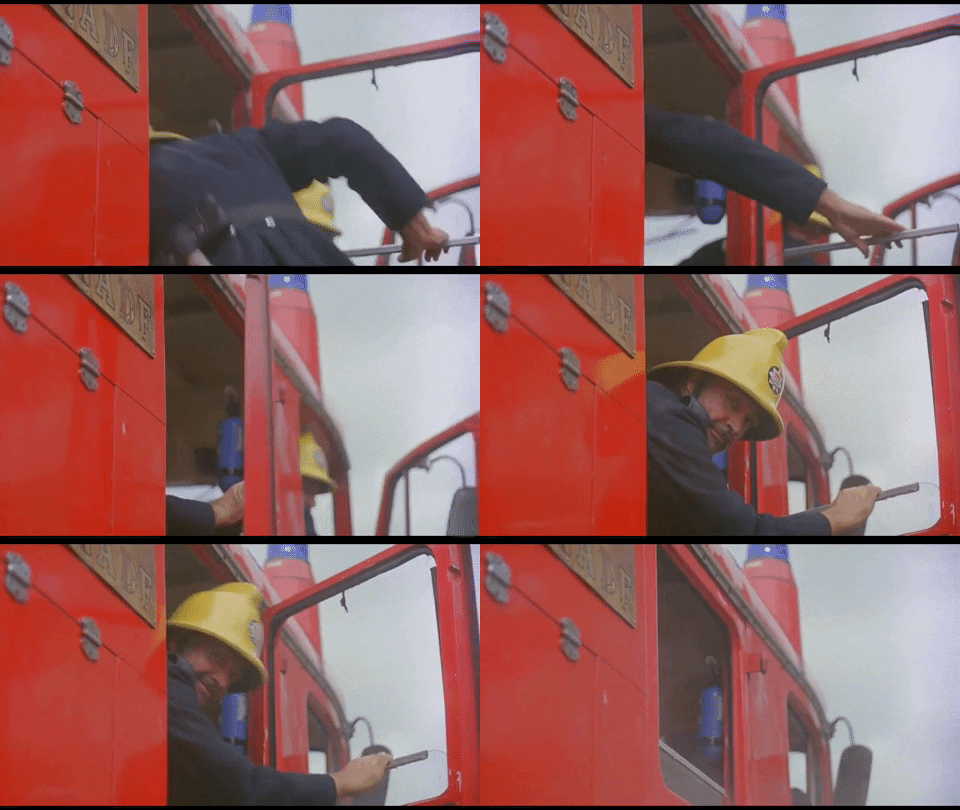
FIREMAN


‘Coz You Know, Sometimes Words Have Two Meanings.....

In the Mundane World, A Fireman is someone who extinguishes blazes, preserves  flammable things and Saves People.


In Fahrenheit-451, A Fireman is someone who burns books, destroys forbidden knowledge and extinguishes The Past.

Pirates are The Men of Fire, The Pyrates

and in The World of Twin Peaks, The Fireman is God.


Loki walks in the sky with shoes that fly, and he can transform his shape so he looks like other people, or change into animal form, but his real weapon is his mind. He is more cunning, subtler, trickier than any god or giant. Not even Odin is as cunning as Loki. 


Loki is Odin’s blood brother. The other gods DO NOT KNOW when Loki came to Asgard, or how

He is Thor’s friend and Thor’s betrayer. 

He is tolerated by the gods, perhaps because his stratagems and plans save them as often as they get them into trouble. 


Loki makes The World more interesting but Less Safe. He is the father of monsters, the author of woes, the sly god.

Every Child Born Carries into The World The Possibility of Salvation - or Slaughter


Lilah walks through a dingy, half-empty bar to a table where Wesley sits staring at the beer and shot glasses on the table in front of him. 

Lilah: 
Mind if I join you?

Wes: 
On many levels and with great intensity.

Wes pours a shot into his beer. Lilah sits down: 
How's your throat? Need a lozenge? 
Life's something, huh? 
One day you're a pivotal figure in the big battle, next thing you know, you're thrown out on your lonesome. 
No one even cares what you think any more. 
Well - I care.

Wes: 
You care.

Lilah: 
As one human being to another. 

(Smiles and raises an eyebrow at Wes) 
Just kidding. I care that your great big brain is going to waste. 
Correct me if I'm wrong, isn't Angel Jr. a thing without precedent in human history?

Wes: 
You're wrong. 
(Takes a sip of his beer) 
Mesopotamian, Greek, Hindi, Celtic myth, the bible, even Darwin, all support the coming of something that wasn't possible before.

Lilah: 
Okay. - The impossible is here. But what does it mean? 
Is it the herald of a new age, better things to come or - 
the mass-destruction of everything we hold dear?

Wes staring straight ahead: 
Yes. 
Every child born carries into the world the possibility of salvation - or slaughter.

Lilah: 
And one born to two vampires carries it in spades. 
Now, my people will be rooting - for slaughter. 
And your people... sorry - your *former* people, they won't know what to do if things turn sour.

Wes looks down: 
No. Lilah: 
So, if the kid's the next Stalin, do you kill him? 
You can't! He's Angel's son. 
But on the other hand, if you just watch while he up and kills Angel or somebody else - that cure girl from Texas, say? 
Wow, times like this? Glad I don't have a conscience.

Wes: 
I think you should leave now.

Lilah puts a hand up to her throat: 
"What was it like? When she cut you?

Wes grabs her by the throat: 
You terribly anxious to find out?


You know you could be reconstructed by The Hole you've left.


C-DOCTOR: 
There. That was easy. 
The Game has just started. 
Doctor, why is there no record of you anywhere in the databanks of the Cyberiad? 

Oh, you're good. 
Oh, you've been eliminating yourself from History. 

You know you could be reconstructed by The Hole you've left. 

DOCTOR: 
Good point. 
I'll do something about that.


Watching John with The 
Machine, it was suddenly so clear. 

The Terminator, would never stop. 

It would never leave him, and it would never hurt him, never shout at him, or get drunk and hit him, or say it was too busy to spend time with him. 

It would always be there. 
And it would die, to protect him. 

Of all the would-be fathers who came and went over the years, this thing, This Machine, was the only one who measured up. 

In an insane world, it was the sanest choice. 


“IT IS NOT TOO FAR-FETCHED TO PREDICT THAT SOME DAY OUR VERY OWN PLANET MAY BE PEOPLED ENTIRELY BY SUPERMEN!” 


Joe Shuster assured us back in 1938, but comic-book reality predicts developments in our own in many other ways.


  What we construct in our imaginations, we have a knack of building or discovering. 

We may not have flying men or invulnerable women racing among us, but we now have access to supertechnologies that once existed only in comic-book stories.


  “Mother Boxes,” empathic personal computers like the ones in Jack Kirby’s Fourth World story cycle, are already here in embryonic form. 

Is the soothing contact offered by the Mother Box so different from the instant connection that a cell phone provides? 


Twenty-four-hour access to friends, family, and the buzz of constant social exchange can make us feel cocooned and safe in a reportedly hostile world. 


In many cases, Mother herself can be summoned on The Box.


Every Monster Has a Story


FLAMES WHOOSH

VAN HELSING: 
This isn't real.
This is a dream.

DRACULA: 
Of course it is.

VAN HELSING: 
You're drinking my blood.
And my blood is deadly to you.

DRACULA: 
Yes.

VAN HELSING: 
So you'll die.

DRACULA: 
So will you.
After all this time....
did you think I'd let it hurt...?

FLAMES CRACKLE