Showing posts with label Truth. Show all posts

Saturday, 27 September 2025

The Book of Lies : 1984 as Taoist Holy Scripture

"You Don't Exist, Winston."

Richard Burton in 
a Blue Boiler Suit 
- 1984 (1984)


He doesn't exist! He's a fictional character!!
Listen to Richard Burton!
He Knows So Much About These Things
And stop calling him "O'Brien"

"Throughout his entire life,right up until the time of his, Crowley always steadfastly and consistently maintained that The Book of The Law was a genuinely revealed text, received and channeled through are receptive medium in Cairo in 1904 [ Crowley's mistress] direct from The Secret Chiefs,
Transcribed verbatim.

The Book of Lies is a lot funnier."

 - Robert Anton Wilson


At Last! - The 1948 Show (aka The Ur-Python)


Masks of the Illuminati
Sir John picked out a Crowley volume entitled, with Brazen effrontery, The Book of Lies. 
Opening it, he found the title page:

THE BOOK OF LIES 
WHICH IS ALSO FALSELY CALLED 
BREAKS 
THE WANDERINGS OR FALSIFICATIONS 
OF THE ONE THOUGHT OF 
FRATER PERDURABO 
WHICH THOUGHT IS ITSELF 
UNTRUE

Despite himself, Sir John grinned. This was a variation on the Empedoclean paradox in
logic, which consists of the question: "Empedocles, the Cretan, says that everything Cretans say is a
lie; is Empedocles telling the truth?" Of course, if Empedocles is telling the truth, then -- since his
statement "everything Cretans say is a lie" is the truth -- he must also be lying. On the other hand, if
Empedocles is lying, then everything Cretans say is not a lie, and he might be telling the truth.
Crowley's title page was even more deliberately perverse: if the book is "also falsely called Breaks,"
then (because of the "also") the original title is false, too, and it is not a book of lies at all. But, on
the other hand, since it is the "falsifications. . . of the one thought. . . which is itself untrue," it is the
negation of the untrue and, therefore, true. Or was it?

Sir John turned to the first chapter and found it consisted of a single symbol, the question
mark:

?

Well, compared with the title, that was at least brief. Sir John turned the page to the second
chapter and found equal brevity:

!

What kind of a joke was this? Sir John turned to Chapter 3, and his head spun:

Nothing is.
Nothing becomes.
Nothing is not.

The first two statements were the ultimate in nihilism; but the third sentence, carrying
nihilism one step further, brought in the Empedoclean paradox again, for it contradicted itself. If
"nothing is not," then something is. . . .

What else was in this remarkable tome? Sir John started flipping pages and abruptly found
himself facing, at Chapter 77, a photograph of Lola Levine. It was captioned "L.A.Y.L.A.H." The
photo and the caption made up the entire chapter. Lola was seen from the waist up and was
shamelessly naked, although as a concession to English morality her hair hung down to cover most
of her breasts.

Sir John, on a hunch, counted cabalistically. Lamed was 30, plus Aleph is 1, plus Yod is 10,
plus second Lamed is 30, plus second Aleph is 1 again, plus He is 5; total, 77, the number of the
chapter. And Laylah was not just a loose transliteration of Lola; it was the Arabic word for "night."
And 77 was the value of the curious Hebrew word which meant either "courage" or "goat": Oz. The
simple photo and caption were saying, to the skilled Cabalist, that Lola was the priestess incarnating
the Night of Pan, the dissolution of the ego into void. . .

Sir John decided to buy The Book of Lies; it would be interesting, and perhaps profitable, to
gain further insight into the mind of the Enemy, however paradoxical and perverse might be its
expressions. He approached the counter, and found with discomfort that the clerk seated there was
Lola Levine herself. Since he had just been looking at a photo of her, naked from the waist up, he
blushed and stammered as he said, "I'd like to buy this."

"One pound six, sir," Lola said, with no more flicker of expression than any other clerk. Sir
John realized that it had been nearly three years since the one occasion on which they had met on the
Earth-plane; she had no reason to remember him. Then, was it possible that all the astral visions in
which she tormented and attempted to seduce him were the product of his own impure imagination?
Or were those visions as real as they seemed, and was she merely a consummate actress and
hypocrite? It was the metaphysical equivalent of the Empedoclean paradox.

A stout, elderly woman with a Cornish accent asked Lola, "I'm planning to stay for the
lecture. Is it pronounced Crouly or Crowley?"

"It is pronounced Crowly," said a voice from the door. "To remind you that I'm holy. But my
enemies say Crouly, in wish to treat me foully."

Sir John turned and saw Aleister Crowley, bowing politely to the Cornish woman as he
completed his jingle. Crowley was a man of medium height, dressed in a conservative pinstripe suit
jarringly offset by a gaudy blue scarf in place of the tie and with a green Borsalino hat worn at a
rakish angle. It was the outfit an artist on the Left Bank might wear, to show that he had become
successful; it was definitely eccentric for London.

The Cornish woman stared. "Are you really the Great Magician, as people say?"

"No," said Crowley at once. "I am the most dedicated enemy of the Great Magician." And he
swept past imperiously.

The Cornish lady gasped. "What did he mean by that?" she asked nobody in particular.

Sir John understood, but wasted no time trying to explain. Crowley was heading for the
lecture room and Sir John followed him closely, wanting a seat up front where he could observe the
Master of the M.M.M. most closely. The paradox had been typical of Crowley's style: he referred,
obviously, to the Gnostic teaching that the sensory universe was a delusion, created by the Devil, to
prevent humanity from seeing the Undivided Light of Divinity itself. A strange joke to come from a
Satanist; but, of course, some Gnostics had taught that Jehovah, creator of the material universe, was
the Devil, the Great Magician. The Bible begins with Beth, according to this teaching, because Beth
is the letter of the Magician in the Tarot, the Lord of the Abyss of Hallucinations. . .

The lecture room was filling rapidly and Sir John scampered into a front-row seat. He
noticed that Crowley had lowered his head and closed his eyes, obviously preparing himself for the
lecture by some method of invocation or meditation. Behind him on the wall was a large silver star
with an eye in its center, a symbol associated (Sir John knew) with both the goddess Isis and the
Dog Star, Sirius.

"Do what thou wilt shall be the whole of the law," Crowley intoned suddenly, without
raising his head. Then he looked about the room whimsically.

"It is traditional in the great Order which I humbly represent," he went on, "to begin all
ceremonies and lectures with that phrase. Like Shakespeare's Ducdame, it is a great banishing ritual
against fools, most of whom leave the room at once on hearing it uttered. Observing no stampede to
the doors I can only wonder if a miracle is occurring tonight and I am speaking, for once, to an
English audience that does not consist mostly of fools."

Sir John smiled in spite of himself.

"My topic tonight," Crowley went on, "is the soldier and the hunchback. Those are poetic
terms I regularly employ to designate the two most interesting punctuation marks in general use
throughout Europe -- the exclamation point and the question mark. Please do not look for
profundities at this point. I call the exclamation point 'the soldier' only out of poetic whimsy,
because it stands there, erect, like a soldier on guard duty. The question mark I call the 'hunchback,'
similarly, only because of its shape. I repeat again: there is no profundity intended, yet."

Sir John found himself thinking of the first two chapters of The Book of Lies, which said
only "?" and "!"

The question mark or hunchback, Crowley went on, appeared in all the basic philosophical
problems that haunt mankind: Why are we here? Who or what put us here? What if anything can we
do about it? How do we get started? Where shall wisdom be found? Why was I born? Who am I?
"Unless you are confronted with immediate survival problems, due to poverty or to the deliberate
choice of an adventurous life, these hunchbacks will arise in your mind several times in an ordinary
hour," Crowley said. "They are generally pacified or banished by reciting the official answers of the
tribe into which you were born, or simply deciding that they are unanswerable." Some however,
Crowley went on, cannot rest in either blind tradition or resigned agnosticism, and must seek
answers for themselves, based on experience. Ordinary people, he said, are in a sense totally asleep
and do not even know it; those who persist in asking the questions can be described as struggling
toward wakefulness.

The soldier, or exclamation point, he continued, represents the moment of insight or intuition
in which a question is answered, as in the expressions "Aha!" or "Eureka!"

"I now present you, gratis, two of the nastiest hunchbacks I know," Crowley said, smiling
wickedly. "These two are presented to every candidate who comes to our Order seeking the Light.
Here they are:

"Number One: Why, of all the mystical and occult teachers in the world, did you come to
me?

"Number Two: Why, of all the days in your life, on this particular day?

"That is all you need to know," Crowley said. "I might as well leave the platform now, since,
if you can answer those questions, you are already Illuminated; and if you cannot, you are such
dunces that further words are wasted on you. But I will take mercy on you and give you the rest of
the lecture, anyway."

Crowley went on to define the state of modern philosophy (post-David Hume) as "an
assembly of hunchbacks." Everything has been called into question; every axiom has been
challenged -- "including Euclid's geometry among modern mathematicians"; nothing is certain
anymore. On all sides, Crowley said, we see only more hunchbacks -- questions, questions,
questions.

Traditional mysticism, Crowley continued, is a regiment of soldiers. The mystic, he said,
having attained an "Aha!" or "Eureka!" experience -- a sudden intuitive insight into the invisible
reality behind the subjective deceptions of the senses -- is apt to be so delighted with himself that he
never asks another question and stops thinking entirely. Out of this error, Crowley warned, flows
dogmatic religion, "a force almost as dangerous to true mysticism as it is to scientific or political
freedom."

The path of true Illumination, Crowley proceeded, walking to a blackboard at the right of the
room, does not consist of one intuitive insight after another. It is not a parade of soldiers, "like this,"
he said, writing on the board:

!!!!!!!!!!!!!!!!!!!!!!!!!!!!

"Anybody in that state is an imbecile or a catatonic, however blissful his lunacy may be,"
Crowley said sternly.

The true path of the Illuminati, Crowley stated more emphatically, is a series of soldiers and
hunchbacks in ever-accelerating series, which he sketched as:

?. . . . !. . . .?. . . !. . . ?. . !. . ?. !. ?
!?!?!?!?!?!?!?! etc.

"To rest at any point, either in intuitive certainty or doubtful questioning," he said flatly, "is
to stagnate. Always seek the higher vision, whatever states of ecstatic insight you may have reached.
Always ask the next harder question, whatever questions you may have answered. The Light you are
seeking is quite correctly called ain soph auer in Cabala -- the limitless light -- and it has, quite
literally, the characteristics mathematicians such as Cantor have demonstrated belong to Infinity. As
the Upanishads say, 'You can empty infinity from it, and infinity still remains.' However deep your
union with the Light, it can become deeper, whether you call it Christ or Buddha or Brahm or Pan.
Since I am, thank God," he said the last two words with great piety, "an Atheist, I prefer to call it
Nothing -- since anything we say about it is finite and limited, whereas it is infinite and unlimited."

Crowley proceeded to discourse on the infinite with great detail, summarizing mathematical
theories on the subject with remarkable erudition and felicity. "But all this," he ended, "is not the
true infinite. It is only what our little monkey-minds have been able to comprehend so far. Ask the
next question. Seek the higher vision. That is the path that unites mysticism and rationalism, and
transcends both of them. As a great Poet has written:

We place no reliance
On Virgin or Pigeon;
Our method is Science,
Our aim is Religion.

Those blessed words!" he said raptly. "Holy be the name of the sage who wrote them!"

At this point Sir John was far from sure whether he had been listening to the highest wisdom
or the most pretentious mumbo jumbo he had ever heard. The Divine No-Thing was much like
certain concepts in Buddhism and Taoism, but it was also a nice way of seeming to utter
profundities while actually talking nonsense. But then, of course, Crowley's whole point had been
that anything said about infinity was itself Nothing in comparison with infinity itself. . .

With a start, Sir John realized that the lecture was over. The audience was applauding,
somewhat tentatively, most of them as confused by what they had heard as Sir John himself.

"You may now," Crowley said carelessly, "unburden yourselves of the thoughts with which
you passed the time while pretending to listen attentively to me; but in accord with English decorum
and the rituals of the public lecture, you must phrase these remarks in the form of questions."

There was a nervous laugh.

"What about Christ?" The speaker was a redfaced man with a walrus mustache; he seemed
more irritated by what he had heard than the rest of the audience. "You didn't say nuthin' about
Christ," he added aggrievedly.

"A lamentable oversight," Crowley said unctuously. "What about Christ, indeed? Personally,
I hold the man blameless for the religion that has been foisted upon him posthumously. Next
question -- the lady in the back row?"

"Is socialism inevitable?"

Sir John found himself wondering when Crowley would become aware of the Talisman and
attempt to cajole him into surrendering it. With horror he realized that such overwhelming of his
mind was possible: Crowley did possess charm, magnetism and charisma, like many servants of the
Demon. What was it Pope had written about Vice? A creature of such hideous mein/That to be hated
needs but be seen/But something something something/We first pity, then endure, then embrace. . .
"Many things are inevitable," Crowley was saying. "The tides. The seasons. The fact that the
questions after a lecture seldom have anything to do with the content of the lecture. . ." What do you
seek? The Light. The limitless light: ain soph auer. And the darkness knew it not. . .

"What about the Magick Will?" Sir John asked suddenly, during a pause.

"Ah," Crowley said. "That is a Significant Question." Somehow he conveyed the mocking
capitals by his intonation. "Such questions deserve to be answered with demonstrations, not with
mere windy words. Laylah," he called to the back of the room. "Could you bring the
psychoboulometer?"

Lola approached the podium with something that looked hideously like a medieval thumb-
screw.

"There is firstly conscious will," Crowley was saying, looking directly at Sir John. "We all
attempt to exercise this every day. 'I will give up smoking.' 'I will be true to my wife.' Ninety-nine
times out of a hundred such resolutions fail, because they are in conflict with the force that really
controls us, Unconscious Will, which can not be frustrated. Indeed, even the profane psychologists
have rediscovered what the mystics always knew: Unconscious Will, if prevented from acting,
returns in the night to haunt our dreams. And sometimes it returns in the daytime, too, in the form of
irrational behaviors which we cannot understand. Magick Will should not be confused with either of
these, because it includes both and is greater than both. To perform an act of Magick Will is to
achieve the Great Work, I might say. The holiest of all holy books says in this connection, 'Thou
hast no right but to do thy will.' Alas, if you think you are doing your true Will, without magickal
training, you are almost always deluding yourself. . . But I am engaging in the windy verbiage I
promised to avoid, and here is the implement of demonstration. Would anybody care to give us an
exhibit of what they can accomplish by conscious Will?"

"I think I shall give it a try," Sir John said, wondering at his own daring. "That's only fair
since I asked the question," he added, feeling inane.

"Well, then, good! Come up here, sir," Crowley said with a grin that was beginning to look a
bit sinister to Sir John. "We have here," he went on, holding the ugly thumb-screw so that everybody
could get a good view, "one of the implements once used by the Dominican Order to enforce the
religion which, as I said, has been foisted on Christ." He set the torture device on the podium. "They
used it as an instrument of torture, but we shall use it as a measure of Will."

Sir John was now standing beside Crowley, looking uneasily at the thumb-screw. "Just insert
your thumb, sir," Crowley said easily.

"What???" Sir John could hardly believe his ears.

"Just insert your thumb, down here," Crowley went on blandly, "and then turn the handle
which tightens the vise. The needle on the boulometer -- my own addition to this toy -- will register
how far you are able to withstand pain by sheer Will; 10 is a good score, and 0 means you are a
mere jellyfish. How far do you think you can go?"

Sir John felt every eye in the room upon him. He wanted to cry, "I am not such a fool as to
torture myself for your amusement," but -- he was even more afraid of appearing a public coward. Is
that why people go into armies? he asked himself grimly. . . "Very well," he said coldly, inserting
his thumb.

And Abraham rose up early in the morning, and saddled his ass, and took two of his young men with him, and Isaac his son, and clave the wood for the burnt offering, and rose up, and went unto the place of which God had told him.

And it was about the sixth hour, and there was darkness over all the earth until the ninth hour.

And the sun was darkened, and the veil of the temple was rent in the midst.

And Abraham took the wood of the burnt offering, and laid it upon Isaac his son; and he took the fire in his hand, and a knife; and they went both of them together.

And when Jesus had cried with a loud voice, he said, Father, unto thy hands I commend my spirit; and having said thus, he gave up the ghost.
"You've only reached two in the boulometer," Crowley said. "The audience will think you're
not trying, sir."

"Damn you!" Sir John whispered, perspiration cold on his back. "I am done with this cruel
joke. Let us see how much better your Magick Will can do!"

"Certainly," Crowley said calmly. He inserted his thumb into the cruel mechanism, and
began turning the vise with slow deliberation. Not a muscle moved in his face. (Sir John suspected
that he had gone into a trance.) The needle on the boulometer crept slowly, accompanied by gasps
from the audience, all the way to 10.

"That," said Crowley gently, "might pass for an elementary demonstration of Magick Will."

There was a burst of spontaneous applause.

"It will also do," Crowley said, "as an illustration of our thesis about the soldier and the
hunchback. The first rule of our Magick is: never believe anything you hear and doubt most of what
you see." He turned the "psycho-boulometer" around, revealing that he had disengaged the screw
and had been turning the handle without actually tightening the vise. There was an angry gasp.

"Oh," Crowley said, "are you feeling cheated? Remember this, then: you are cheated the
same way every time emotional turmoil or fixed ideas distort your perception of what is actually
before your eyes. And remember to look for the hunchback behind every soldier."

The audience began to file out, muttering and chattering as excitedly as a group of
chimpanzees who had just found a mirror.

And then Sir John realized that Crowley had descended from the podium and was
approaching him.

"Sir John Babcock," Crowley said warmly, "did you ever hear the story of the man with a
mongoose in his basket?"

At least, unlike Lola, Crowley wasn't pretending not to recognize Sir John. "What
mongoose?" Babcock asked carefully.

"It was on a train," Crowley said. "This chap had a basket under his seat and another
passenger asked him what was in it. 'A mongoose,' he said. 'A mongoose!' said the other. 'What on
earth do you want with a mongoose?' 'Well,' said our hero, 'my brother drinks a great deal more than
is good for him, and sometimes he sees snakes. So I turn the mongoose on them.' The other
passenger was baffled by this logic. 'But those are imaginary snakes!' he exclaimed. 'Aha!' said our
hero. 'Do you think I don't know that? But this is an imaginary mongoose!'

Sir John laughed nervously.

"That's the way it is with talismans," Crowley said. "When a phantom climbs, the ghost of a
ladder serves him. But do keep that pentacle in your vest if it makes you feel better. I must go now.
We shall meet again."

And Sir John stared as Crowley made his way to the back of the room, where he greeted
Lola with a kiss. He whispered something; they both turned and looked back at Sir John; they waved

cheerfully. And then they were gone. 

Tuesday, 26 January 2021

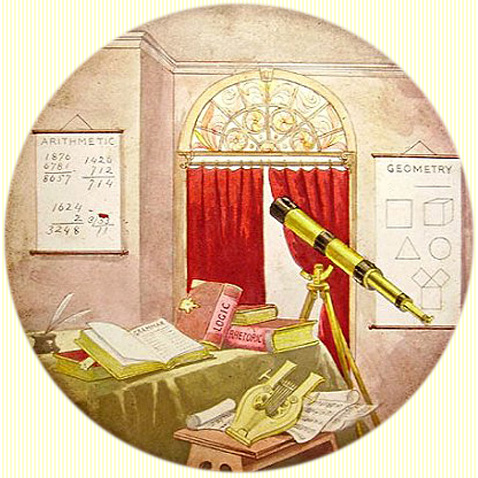
Seven Virtues, Seven Noble Arts, Seven Champions of Justice

Magic lantern slide c. 1880.
Seven.
Albert G. Mackey, in his Encyclopaedia of Freemasonry writes two pages on the number seven, claiming : "Seven is a sacred number in Masonic symbolism."1
But the point must be stressed that The Number 7 is not a "sacred" number in masonic ritual, it is a "significant" number.

The sacredness or importance of the number seven in many belief systems, mythologies and cultures is recognised by knowledgeable freemasons but the number itself is not specifically masonic.
Geometry was considered one of The Seven Noble or Liberal Arts and Sciences, the others being Grammar, Rhetoric, Logic, Arithmetic, Music and Astronomy.

In ancient Kemet, or Egypt, the number seven represented completion.

Creation
took place in seven time periods. There are seven colours in the rainbow, seven notes in a musical scale, seven days in a week, &c.
In Ancient Kemet, there were also Seven Cardinal Principles/Virtues of The Goddess Ma'at to achieve human perfectibility. These principles are Truth, Justice, Balance, Order, Compassion, Harmony, and Reciprocity.
In Freemasonry Seven Brethren are required to Open or Work a Lodge: 3 Master Masons, 2 Fellowcraft and 2 Entered apprentice.

While those fascinated by numerology will make much of the two rows of seven tassels found on most Master Mason aprons, this was an aesthetic choice made by regalia makers and has no masonic significance.


The Number 7 was said to be 'Perfect' because it contained the numbers 3 and 4 — 3 and 4, The Triangle and The Square, the Perfect Figures — and was itself indivisible and could not be created by multiplication.
Some freemasons will claim that together the seven officers represent how human consciousness works. They represent the co-ordinated parts connecting Man's outer nature with his inmost Divine Principle. They provide the necessary channels for the various spiritual and material levels to maintain contact. This, like much hermetic and sacred teachings, is not fundamental to masonic teachings but should be of interest to all students of Freemasonry.

1. See : phoenixmasonry.org for full text.
Image : Magic lantern slide 18 "The Seven Liberal Arts." c. 1880. Unknown provenance.

Friday, 20 November 2020

THE AEON OF MA'AT


If The Wise Man,
The Old Man of The Mountain is a Monk, then -- 
The Wise Woman of The Mountain must be a Nun.

A Hidden Princess.

A Dark Sheriff.


A Secret Sister.


Clarisse
fem. proper name, often a diminutive of Clara and its relatives. Also, "a nun of the order of St. Clare" (1790s); the Franciscan order also known as the Poor Clares (c. 1600).


The Word “Remember” is extremely important....

Almost Famous - "Starway to Heaven" Deleted Scene


“Lenina Crowne has a really hard time in the book , as she is always being slapped around by a sociopathic, Shakespeare-quoting, sex-negative John the Savage. 


So, the notion was — let’s do something more modern and radical. 

In terms of my magical practice, this ties Brave New World to my thoughts about the Aeon of Ma’at, the Goddess of Truth, Balance and Harmony.


In the book, Lenina is treated quiet badly and comes to a grim end, so I thought let’s make her the central character of this new version. 


The Savage Lands depicts a childlike level of society; John is tied to his mother and has very little agency. 


The World State has progressed to teenage; with its non-stop music and parties and strict social demarcation into easily-identifiable ‘Tribes’


The idea was to have Lenina begin to work with the Indra to build a truly ‘adult’ Utopia… which would lead us into season 2…

I’ve seen critics complain about the Brave New World sex scenes not being sexy but that was the point we were making! 


There’s even a major scene of intimacy between John and Lenina that deliberately exists in contrast to the shallow hedonism of the orgies. 

In This World, sex is more like a social duty, or it’s like Sport. 

It doesn’t involve the Guilt and the excitement, the Transgression and the Passion that we associate with sex at all.


Speaking of this new myth and ethos, for a few years now you have been speaking about the Aeon of Ma’at. Is this the strongest current you see in humanity these days?

GM: It’s still a subcurrent at the moment, as the patriarchal Aeon of Osiris bows out kicking and screaming but I think it’s the only one that gives us any chance of Survival right now. It’s not like this is the dawning of the age of Aquarius. 

For me these ideas are interesting metaphors; they’re filters, and I find that if I apply this particular filter suggested by Kenneth Grant and Crowley it allows me to see things in a different relationship, which is very creatively rewarding if nothing else.  

Viewing The World through the filter of these Thelemic notions, what’s happening right now all around us suddenly becomes not only obvious but almost predictable.  

It’s important to emphasize that this is not something to ‘believe’ in. This is a metaphor and not a belief system. 

But new metaphors can change whole cultures as we know from Our History.


Crowley said that the general tenor of the last six thousand years of human civilization could be summed up by the personalities of a family of Egyptian gods. 

And the first two thousand years up to the birth of Christ, this was the Age of Isis, The Mother Goddess, where people were hunter/gatherers or early agrarians living off The Land, relying on ‘Mother Earth’, the seasons and the tides. 


So, the next Aeon from Christ onward is The Aeon of Osiris, The Dying and Resurrected God. Osiris is also The Law Giver and He brings with Him The Written Word, so now Ideas can be enshrined in books and books can outlast generations and they take on the aura of Gods Themselves.

God Himself is present in the works of The Bible. 

God Himself is present in The Quran. 

So certainly, there’s this programming code language, the instructional Dad Language, which can take people over just from reading a book and turn them into Agents of The Dad God’s Expansionist, Controlling Agenda. 


This is when Nature goes from Provider to something that exists to be tamed and exploited. That’s The Aeon of Osiris.


Following Osiris, comes this fiery breakdown, the child Horus is the son of Osiris and he’s every jihadi, every warrior, every rock star reformer, every young man who sees as his sacred mission the tearing down of structures, the questioning of rules. It’s punk rock, “I gotta tear it all down.” But running in tandem with that, according to Kenneth Grant, is the shadow Aeon of Ma’at, Horus’ sister and she’s the goddess of truth and balance and harmony and all that Wonder Woman stuff.

For me, having gone through the Abyss of Da’ath in the Thelema structure of initiation — having undergone that in a really experiential and exhausting way, I found myself in the Qabbalistic sphere of Binah, and The Entire World suddenly looked very different and made sense in different configurations which re-energized the work I’d been doing.  

So, I decided to accept that The Aeon of Ma’at was coming down fast and I tried to align all my thinking with that, which provided me with a new bunch of metaphors and ways of framing the world. 

Imagine all this division and deconstruction was just a corridor we’re passing through. All the fractioning and separation —that’s typical of Horus. We can see the hand of Horus in the modern-day tearing down of monuments and statues. He’s kicking The Fuck out of formerly stable systems all around the world. That’s exactly what you would expect of this spirit that Crowley said manifested first in 1913. But for me, I think he made his presence felt quite clearly on 9/11.


You can easily organize The Evidence to suggest that there is an Aeon of Horus occurring now. Where Systems are being taken-down, where everything’s being Questioned and Audited, and The Past is subject to Major Revision. 


So, there’s also some fun to be had in thinking “Ok, if this is actually playing out in some symbolic fashion, then what might the Aeon of Ma’at look like, artistically?’

And to me it looks like the rise of marginalized voices, it looks like more women coming into the discourse. It looks like trans people coming into the discourse. It looks like all the opportunities for groups who were disempowered by the Patriarchy, who couldn’t speak before to have their say.

Ma’atWhat would her signature disease be? Well it might be a distributed network, a viral malady that could attack All of Humanity. What would happen if She emptied The Houses of The Old Gods as a Show of Possibility? 

You remember at the height of the first lockdown, all the churches were empty, all the sports stadiums were empty, all the mosques were empty, all the temples were empty. So, the Dad god had nowhere to go.


In Britain, I know, and I’m sure in America, there was a strange uprising of praise for care workers. People would go out every Thursday here and bang on pots and pans and basically thank the nurturing spirt, this caring spirit, for its very existence. It was a very religious, ritualistic thing that we were all doing. That’s Ma’at right there. 


Then there’s Mother Nature with hurricanes tearing down borders, storms ravaging everyone’s homes. It all suddenly makes sense in a new context if you use the filter of Ma’at to look at The World. 

For me, I’ve found some creative applications for it, like in Brave New World and the Wonder Woman comic that I’ve done.


Let’s talk about Magick. How does one get better at it?

GM: By doing it on a regular basis! It’s like a martial art or a musical talent. 

If you dedicate yourself to Learning and Practice, if you read other magician’s accounts, if you Pay Attention, then you start to notice details that the less engaged will miss and this allows you to do things that other people may regard as magical or even supernatural. 


Just like a stage conjurer, or a great guitarist, or a gifted actor or artist can do. It’s just about really paying attention and Doing The Work to see What Happens. 

It’s just a way of looking at things in a fresh light and then working with this augmented version of reality in ways that can appear supernatural. 


One of Magic’s main attractions involves bringing things Into Being, from the conception or thought all the way to solid materiality. 

Making The Insubstantial tangible.


But there’s also a whole other thing. Magic is about deliberately inducing unusual states of consciousness. Some of these states of consciousness have been called Gods because they feel Super Organized and Positive, and some of them can be called Demons because they feel Chaotic, Violent, Hateful and Perverted or whatever. 

That’s part of Magic. 

It’s as simple as how can you create different states of consciousness? 

Magic uses spells or rituals, some developed over many centuries, to stimulate specific focused states of consciousness, whether demonic or angelic or god like. 

Psychedelics and hallucinogens have been used by shamans for the same purpose.


And the written word along with the expression of it are all magic. In the sense that words themselves hold such tremendous power.

GM: If you can limit the language you can reduce the scope of a conjuror. George Orwell warns us about that in the appendices to 1984. 


If you restrict the language, if you make it impossible to express abstract ideas, then you put boundaries on people’s ability to think creatively or communicate certain concepts. 

It Does Work. Words shouldn’t have the kind of power and meaning that we attribute to them but most of us grew up in The Aeon of Osiris, where words have been really important and fundamental to human progress. 

Words mean The Law, words mean The Bible, or The Constitution, words define The Divine Rules by which we abide. The 10 Commandments.


As any writer can tell you; words are just things that dance around when you play with them. They can mean all kinds of different things. 

They bring with them the distortions of interpretation where the words of Christ – ‘love your enemies’ – can be twisted to motivate bloody genocidal Crusades. I think Wilson was trying to undermine people’s fear of the perceived authority and power of words as things in themselves.


For sure. There are some big words that have been added to the dictionary over the last 20 years, specifically Beyonce’s ‘bootylicious.’

GM: Well exactly, there you go man. But still I don’t exactly know what it’s describing, but I can almost taste it!

Adding on the to the notion of words and symbols being charged with magic, they have also been charged through the increasing amounts of propaganda over the course of the 20th Century and into today. Isn’t that something that RAW is constantly reminding readers, that propaganda is real, and lots of it feeds off your base emotions, like anger and fear. Most people don’t recognize that cuz they haven’t seen the FNORDS!

GM: It’s more like people’s sense of the immense energy compressed into certain words. It’s not the word itself – as Wilson reminds us ‘fuck’ is a ‘bad’ word but it doesn’t sound much different from ‘folk’, a ‘good’ word, and it means the same as ‘coitus’, another ‘good’ word. So where exactly does the wickedness and dirtiness of ‘fuck’ reside?

Words become fetishized for reasons good or bad and the more fetishized they are, the more taboo they become, which confers an aura of outlaw sexiness that attracts some people to them.

Lenny Bruce, George Carlin, Bob Wilson himself, all made a point of saying that words should not be given this kind of power because once they have this power, they can become fetishized and weaponized. If you de-power a word then it can’t be used to trigger other people in the same reliable way, but we’re just not in that phase, with the dislocated politics of culture right now. I think people got it right to take down some of these structures right now and perhaps it’s okay to retire certain radioactive, abusive terms as long as we make sure we’re creating new words in other areas.

As a for instance, when I was a kid there were no words to describe certain aspects of my own experience. I’ve been non-binary, cross-dressing, ‘gender queer’ since I was 10 years old, but the available terms for what I was doing and how I felt were few and far between. We had ‘transsexual’ and ‘transvestite’ both of which sounded like DSM classifications rather than lifestyle choices! I didn’t want to be labelled as medical aberration because that’s not how it felt, nor was it something cut-and-dried and done. I didn’t want to ‘transition’ or embody my ‘female’ side exclusively, so I had no idea where I fit in.

Terms like ‘genderqueer’ and ‘non-binary’ only came into vogue in the mid-90s. So kids like me had very limited ways of describing our attraction to drag and sexual ambiguity. Nowadays there’s this whole new vocabulary, allowing kids to figure out exactly where they sit on the ‘color wheel’ of gender and sexuality, so I think it’s OK to lose a few contentious words when you are creating new ones that offer a more finely-grained approach to experience.

When we make the jump to a non-Roman-alphabet-based emoji language for purposes of radio telepathic communication, things will change once more.

This conversation of neutralizing the charge from taboo words is also a premise of RAW’s Ishtar Rising, which you wrote the introduction of the newest reprinting of the book by Hilaritas Press. Also, in that book, Wilson explores the mythical trope of the underground journey, something explored and unpacked in nearly all his books.

Joseph Campbell has some cool stuff to say about the Underground Journey, mainly that in all his studies of world myths he had observed two types of underground journey stories. One type was when the underground swallows up a poor soul like the whale did to Jonah. When this happens, the sole purpose of the seeker is to just survive the ordeal and return to the surface in one piece. The second type of journey through the underground occurs when the hero or heroine must descend into the depths and kill a monster. Campbell mentions one myth where the hero must slay a dragon then drink its blood to gain its power and move on and continue their quest. Campbell associates this killing of the dragon and drinking its blood as an integration of our shadows into our psyches. By integrating these elements of ourselves we then gain the sort of personal power needed to live a joyful and energetically engaged life.


GM: Yeah, and the story of the underground journey in Britain often involves someone finding a cave where he sees all of King Arthur’s knights asleep just waiting for the time of England’s greatest need when they will have to rise up and fight the final battle against evil. So that’s a more passive version of the story. Someone goes in and finds these sleeping warriors. That’s the personal power, that’s the higher self that will arise when you need it most.

Wilson has a dark side version of this exact legend at the end of Illuminatus with the undead Nazi battalions awaiting their orders to rise from Lake Totenkopf and reclaim the world!

What advice do you have for the magicians out there who have a story to tell and want to storm the reality studio?

GM: Tell a different story. Tell a fresh story that speaks to its times and the people around you. A story that offers possibilities, exit strategies, rather than apocalypse and ruin. I can’t see that there’s anything else…

In the Wonder Woman book I’m doing, for instance, I’ve actively avoided writing the boy hero story that’s so ubiquitous as to seem inescapable —  the familiar story of the One, the champion, the Joseph Campbell monomyth thing that drives so many Hollywood movies and YA stories. We’ve seen it. The Lion King. The callow youth loses mom or dad, or his comfortable place in the tribe, and he has to fight his way back to save the kingdom from its corrupt old leader, before claiming the captive princess and becoming the new king and… ad infinitum. The Circle of Life if it only applied to boys. I thought, where is the mythic heroine’s story? In Ishtar Rising, Wilson talks about the myth of Inanna, and how she goes down into Hell and has to give up everything of herself to gain the wisdom and experience she can bring back to her tribe. Privileging the network rather than the sovereign individual.

And so, as I thought about the differences between the hero’s and the heroine’s journey, it gave me a bunch of different modes to work in. Finding ways to avoid telling the boy hero story again was quite liberating. It just gave me a bunch of new ideas, an interesting new way of telling stories that didn’t rely on the framework of the hero’s journey that Campbell talks about.

Playing the devil’s advocate here. Today there is a lot of fervor around identity, and there is one strong of thought that people can never truly understand what it is like walking in the shoes of others. Some may ask why a white man would seek to tell the story of a woman, from her perspective, instead of just sticking to what he knows, being a man.

How authentically real is that character or story, etc.?


GM: It’s important to air these feelings for debate. I must admit, with all respect, that I completely disagree with the idea that we cannot understand one another.

Firstly, there’s a major obvious problem about coming at things from this perspective — if fundamentally, we cannot truly know or have any meaningful opinion on what it feels like to be X, then we may as well stop listening to anything anyone else has to say about their personal experience, on the basis that it can only be irrelevant to our specific lives!

If I can never truly understand you without walking in your shoes and vice versa, what’s the point of listening or talking to anyone about our experience? What’s the point of writing stories, or protesting, or making art if experience cannot by its nature be communicated and understood by anyone who has not shared the experience of the artist, or the writer?

I think we all know it doesn’t really work that way in the real world. We don’t need to be a thing to have some understanding of how it operates. People can be great veterinarians without personally experiencing the day-to-day inner lives of dogs and cats. I can read Solzhenitsyn and shed empathic tears for the inmates of the Gulag without having to reprise their exact experience.

To think otherwise might be, I suspect, a symptom of narcissism painted into its inevitable corner, its private echo chamber – destructive, divided, atomized, individualistic to the point of self-abnegation – and indicative of late stage Osiris pathology.

And you know, we actually do understand one another in so many ways. We can imagine what it’s like to live someone else’s life –— or we can have our imaginations enflamed by well-told tales of other people’s lives and thrill to the ways they resonate exactly with our own lived experience. As a writer, I know this to be true.

We’ve been observing one another’s behavior and drawing conclusions since the dawn of humanity. People aren’t so complicated or new that the basic functions remain a mystery. All our plays, poems, songs and stories are a record of our attempts to understand ourselves and one another. The fact that Greek drama or Shakespeare still speaks to us is evidence that basic human nature has remained fairly consistent for thousands of years.

We figured one another out a long, long time ago.

And ultimately, I’ll say again, we are all the same organism. What we’re seeing is ring fingers fighting with thumbs, eyelashes screaming that eyebrows can never understand them! To point that out is probably an anathema in this current time of narcissistic inflation but it will be understood as a fact of nature in the end.

Maybe I’m wrong and we’re all fucked because humans are a kind of cancer-creature and our only purpose is to destroy each other and all other lifeforms on our planet… there’s still time for Agent Smith to be proved right!

I think everyone should have to imagine what it’s like to be someone else. We can all learn from one other but that means communicating; that means starting with the assumption we do have a common basis for genuine understanding even if our specific circumstances can never be repeated or totally understood by anyone other than ourselves. We all hurt, we all feel joy, we all get turned on, or scared. We all experience loss, and lack of self-worth and feel badly treated by the world at times.

And I understand why everyone should talk and tell stories from their own position you know but it’s also very useful – and a major human talent –  to imagine how other people feel and consider how the world might look through their eyes.  

And you do that by staying informed, listening to voices even when you disagree with them –—and by employing empathy and imagination to put yourself in their place as best as you’re able.

These are difficult times. I’m not a guru. I don’t know what to say to make it all better. There’s seven in a half billion people and it often seems they all fucking hate each other! Yet they all want everyone else to agree with their tiny, restricted, localized points of view. And they’ve all got a piece of ground to defend against perceived foes. I get it, but ultimately, we’re all one thing, one massive organism that’s going through difficult growing pains at the moment, so maybe we need to start thinking about what makes us alike, rather than different.

I hope so

GM: Well, this is part of the boiling process. Capitalist consumer culture has clearly reached its limits and we either advance to a more efficient, stable, less suicidal and aggressive engagement with other people and our environment or we go extinct as a species, taking all the whales and tigers and gorillas with us, before we even figured out how to talk to them and hear their stories! There are few options remaining.

The current questioning, the judgmental audit of where we are and how we got here, is a Horus thing. We can only hope we sublimate from here via Ma’at into something more nurturing and sustainable.

It is a hot moment. Temperatures are rising, Artic ice caps are melting at an alarming rate, and people may be unconsciously registering all that, and doing a horrible job at it. Instead of dealing with one’s own sense of panic, constriction, and fear it looks like many people are just running hot.

GM: I feel like every word we say is now a potential indictment, you know. The last malignant thrashing of the passing Aeon of Osiris. The echoes of the Inquisition, accusations of ‘wrongthink’, the return of Original Sin, the demonic glee taken in any stumble or falter from the approved path seems almost mediaeval. It’s terrifying. The potential for misunderstanding is almost infinite and its almost fated that we will struggle to abide by rules that grow ever more authoritarian and specific every day. Again, all that feels to me like the last ferocious attempts at asserting its fading power by the Osiris energy of the last 2000 years, now gone rotten and unsustainable but trying harder to keep everything and everybody under increasingly deranged levels of control in every area of our lives.

Writers and artists can find more reasons to stop their expression than ever before it seems. The voice of criticism and judgement is easier to find these days, just doom scroll through various social media sites and it’s all over the place.

GM: I regard it all as new input. As tough as it is, there’s an excitement. It’s making me think, it’s making me question myself and my assumptions, it’s making me write different things. I love ideas that challenge my thinking — even if I don’t agree with them in the end.


What are your thoughts on Simulation Theory these days?

GM: I was reading New Scientist recently and one of the correspondents on the letters page threw out this random idea that really resonated with me.  The writer was saying that if we live in a simulation then perhaps the world in the past was not as detailed or as high fidelity as it we experience it now! There have been upgrades, developments. In computer game terms, think of the difference between Space Invaders and Red Dead Redemption 2!

And I thought, wow, wouldn’t that be funny if, you know, those medieval painters with the flat landscapes and no perspective, what if they were accurately representing an earlier, more simplistic iteration of our simulated reality? What if they were simply portraying what the world actually looked like in the early stages of the simulation! What if these artists were recording what they saw and that’s how it looked?

Suddenly I saw the history of art in a whole new light! I thought how cool it would be if the cave paintings at Lascaux represented caveman reality perfectly – that’s how the simulated world really looked in an early development of the simulation when we were all just stick figures with antlers and the animals were sketchy semi-abstracts…

I love that idea; that the simulation is becoming more complex and well-rendered as it goes along – and we can see where it’s been.

It almost seems like it will become harder to break the Matrix as it becomes more refined, nuanced and easier to mistake for reality. It is interesting looking at the Simulation theory with the idea of calling it a metaphor for the same thing that the Gnostics came up with.

GM: Yeah, the idea that the universe is a counterfeit created not by god but by some sort of underling of god… that was the gnostic idea. It’s not so much about breaking the Matrix, I feel it’s more about learning to work with it. In the movie, once Neo figures out how it works, he becomes a magician, a superhero. The counterfeit world in the movie seems much more fun than the real one.

 Can magic be a useful tool for navigating VR and AR in IRL?


GM: Yeah, because magic is just about adding meaning or enchantment to the environment and to your life. Magic spices up everything; it’s like hot sauce! Once you add magic, the universe comes to life and starts to dance with you. If you choose to be an exploiter, a black magician, it’s more like a lap dance but otherwise it’s a tango! As I’ve said before, it’s easy to add magic to things. If you decide a certain stone could use some magic power, then carry it with you long enough and it will become first a good luck talisman and will finally accrue the significance and meaning of a Holy Grail if it’s given enough time and attention. So, the more meaning you can add to experience, the more magical it will seem. It’s not difficult or ‘occult’ at all. Magic makes everything more exciting, rich and alive and that’s its job. The more magic you can create around something the more special your interaction with it will feel.

Wednesday, 24 July 2019

The Majors Tom : GoatBoy


On December 16, 1961, The World turned upside down and inside out, and I was born, screaming, in America.

CUT: Tower Bridge – The Horse and Rider cross The Bridge, approaching the camera

It was the end of the American Dream, just before we lost our innocence irrevocably, 
and the TV Eye brought the horror of our lives 
into our homes for all to see.


CUT: The rider dismounts upon a cobblestoned street, and leads his horse past the burning shells of televisions.

FX: howling wolves

I was told when I grew up, 
I could be anything I wanted – 
A Fireman, a Policeman, a Doctor. 
Even President, it seemed. 

And for the first time in The History of Mankind, something new called 
an 'Astronaut.'

But like many kids growing up on a steady diet of Westerns, 
I always wanted to be The Cowboy Hero :– 

That Lone Voice in The Wilderness 
fighting Corruption and Evil wherever I found it, 
and standing for Freedom, Truth and Justice.


CUT: The Dark Rider throws a lighted match into an oil drum full of newspapers.


And in my Heart of Hearts, 
I still track the remnants of That Dream, 
wherever I go, 
on my never-ending ride 
into The Setting Sun.

Friday, 29 June 2018

That's The Tyler


The Mouth of Sauron 
 is what emerges from The Black Gate
when you approach, 
To Talk You Out of Coming in.


"That's Not Your Opinion."

"You Don't Really Believe That."

"You Don’t Really Know What You’re Talking About."

"That Isn't True."


I started to pay very careful attention to what I was saying

I don’t know if that happened voluntarily or involuntarily, but I could feel a sort of split developing in my psyche. 

I’ve actually had students tell me that the same thing has happened to them after they’ve listened to some of the material that I’ve been describing to all of you. 

But I split into two, let’s say. 

One part was the old me that was talking a lot, that liked to argue, and that liked ideas. 

There was another part that was watching that part, just with its eyes opened, and neutrally judging. 

The Part that was Neutrally Judging was watching The Part That was Talking, and going,

that wasn’t your idea; 
you don’t really believe that; 

You Don’t really know what you’re talking about; 

That Isn’t True. 

I thought, 
"Hm! That’s really interesting!" 

That was happening to like 95 percent of what I was saying, and then I didn’t really know What to Do. 

I thought, 
"Okay, This is Strange. Maybe I fragmented, and that’s just Not a Good Thing, at all." 

It’s not like I was hearing voices, or anything like that. 

It wasn’t like that. 

People have multiple parts. 

So then I had this weird conundrum: 

"Which of These Two Things are Me?
Is it The Part That’s Listening and Saying --

'No, that’s rubbish'
'That’s a lie'
'You’re doing that to impress People'
'You’re just trying to Win The Argument.' 

Was that me?

Or was I the part that was going about its normal, verbal business? 

I didn’t know, but I decided that 
I would go with The Critic. 

And then what I tried to do 
— what I learned to do, I think — 
was to 
Stop Saying Things that Made Me Weak.

 I mean, I’m still trying to do that. 

I’m always feeling, when I talk, whether or not the words that I am saying are making me align or making me come apart. 

I really do think that the alignment is the right way to conceptualize it, because if you say things as true as you can say them, then they come out of The Depths inside of you. 

We don’t know where thoughts come from. 

We don’t know how far down into your substructure the thoughts emerge. 

We don’t know what process of physiological alignment is necessary for you to speak from the core of your being. 
We don’t understand any of that — we don’t even conceptualize that. 

But I believe that you can feel that. 

I learned some of that by reading Carl Rogers, who’s a great clinician. 

He talked about mental health, in part, as the coherence between the spiritual —
or the abstract — and the physical —
that the two things were aligned

There’s a lot of ideas of alignment in Psychoanalytic and Clinical Thinking. 

But, anyways, I decided that I would start practicing not saying things that would make me weak. 

What happened was that I had to stop saying almost everything that I was saying —
95 percent of it. 

That’s a hell of a shock — this was over a few months — to wake up and realize that you’re mostly DEAD WOOD. 

It’s a shock. 

You might think, well, 
"Do You Really Want All of That to Burn Off? 

Well, there’s nothing left but a little husk — 5 percent of you.

Well, if that 5 percent is SOLID, then maybe that’s exactly what you want to have happen.


Thursday, 28 June 2018

Guts Is Enough


If You Hide Your Ignorance, 
No-One Will Hit You

and 

You Will NEVER LEARN.


Gunnery Sergeant Hartman: 
Private Joker, do you believe in the Virgin Mary?

Private Joker: 
Sir, no, sir!

Gunnery Sergeant Hartman: 
Well, well, Private Joker, 
I don't believe I heard you correctly!

Private Joker: 
Sir, the private said "no, sir," sir!

Gunnery Sergeant Hartman: 
Why you little maggot, you make me want to vomit!

[slaps Joker]

Gunnery Sergeant Hartman: 
You Goddamn communist heathen, you had best sound off that you love the Virgin Mary, or I'm gonna stomp your guts out! 
Now you DO love the Virgin Mary, don't ya?

Private Joker: 
Sir, NEGATIVE, sir!

Gunnery Sergeant Hartman:
Private Joker, 
are you trying to offend me?

Private Joker: 
Sir, NEGATIVE, sir! 
Sir, the private belives any answer he gives will be wrong 
and the Senior Drill Instructor will only beat him harder if he reverses himself, SIR!

Gunnery Sergeant Hartman: 
Who's your squad leader, scumbag?

Private Joker: 
Sir, the squad leader is Private Snowball, sir!

Gunnery Sergeant Hartman: 
Private Snowball!

Private Snowball: 
Sir, Private Snowball reporting as ordered, sir!

Gunnery Sergeant Hartman: 
Private Snowball, you're fired. 
Private Joker's promoted to squad leader.

Private Snowball: 
Sir, aye-aye, sir!

Gunnery Sergeant Hartman: 
Disappear, scumbag!

Private Snowball: 
Sir, aye-aye, sir!

Gunnery Sergeant Hartman: 
Private Pyle!

Private Gomer Pyle: 
Private Pyle reporting as ordered, sir!

Gunnery Sergeant Hartman: 
Private Pyle, Private Joker is your new squad leader, and you will bunk with him! 
He'll teach you everything, he'll teach you how to pee!

Private Gomer Pyle: 
Sir, yes, sir!

Gunnery Sergeant Hartman: 
Private Joker is silly and ignorant, 
but he's got guts, 
and guts is enough.


"I am My Mother's Son."


On that same plantation, there was the field Negro. The field Negro -- those were the masses. There were always more Negroes in the field than there was Negroes in the house. The Negro in the field caught hell. He ate leftovers. In the house they ate high up on the hog. The Negro in the field didn't get nothing but what was left of the insides of the hog. They call 'em "chitt'lings" nowadays. In those days they called them what they were: guts. That's what you were -- a gut-eater. And some of you all still gut-eaters.