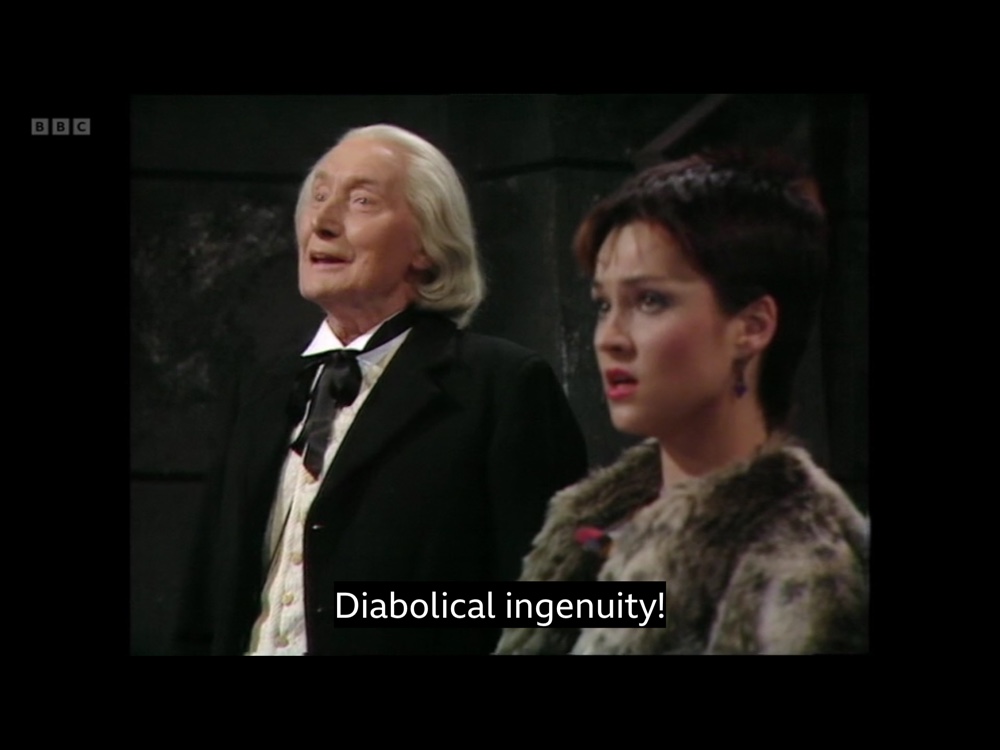
[ Coughing ]
[ Gasps ]
Ripley :
DON'T come any closer —
The Fool :
Wait. They're Here to Help.
Ripley :
STAY Where You are!
The Not-Bishop :
Ripley....
Ripley :
-- Bishop.
The Not-Bishop :
I'm Here to Help You.
Ripley :
NO MORE BULLSHIT.
I just felt it MOVE.
The Not-Bishop :
You know Who I am?
Ripley :
You're A Droid --
Same Model as Bishop.
Sent by The f*cking Company.
The Not-Bishop :
No. I'm not the Bishop-android.
I Designed it. I'm very Human.
The Company sent me here to show You
a friendly face, to demonstrate
How important you are to us, to me.
Ripley :
You just want to take it back.
The Not-Bishop :
We want to k*ll it and take you home.
Ripley :
Bullshit.
The Not-Bishop :
You're wrong. We want to help.
Ripley :
What does that mean?
The Not-Bishop :
We're gonna take that out of you.
And keep it.
The Not-Bishop :
CAN'T Allow it to LIVE....
Everything We KNOW would be in jeopardy.
You don't want to take it back?
Ripley, Time is important.
Let us deal with The Malignancy.
We've got a surgical bay
set up on the rescue ship.
Come with me. It's very quick.
Painless. A couple of incisions.
You'll be out for two hours.
And then it's over.
You still can have
a life, children-
And most important,
You'll know it's dead.
Let me help you.
What guarantee do I have...
Oonce you've taken it out, you'll destroy it?
You have to trust me.
Please? Trust me?
No.
What's this gonna achieve?
[ Screams ]
Stop! Ow! Oh, Jesus!
[ Groaning ] Morse.
Will you help me?
What do you want me to do?
It was a mistake!
There was no need for any of it!
f*cking android!
I'm not a droid!
Ripley, think of all we could learn from it.
It's the chance of a lifetime!
You must let me have it!
It's a magnificent specimen!
Oh, Jesus!
No pictures!
You're crazy.
What are you doing?
No!
[ Grunts ] [ Chuckles ]
Come on, you. Get going.
Morse :
Oh, f*ck you!
[ Static ]
[ Ripley's Voice ]
….Ash, Captain Dallas are Dead.
Cargo and Ship Destroyed.
I should reach The Frontier in about six weeks.
With a little luck, The Network will pick me up.
This is Ripley, last survivor of
the Nostromo, signing off.
[ Beeping ]
quicken (v.)
c. 1300, quikenen, "come to life, receive life," also transitive, "give life to," also "return to life from the dead;" see quick (adj.) + -en (1). The earlier verb was simply quick (c. 1200, from late Old English gecwician, and compare Old Norse kvikna).
The sense of "hasten, accelerate, impart speed to" is from 1620s. The intransitive meaning "become faster or more active" is by 1805. Also, of a woman, "enter that state of pregnancy in which the child gives indications of life;" of a child, "begin to manifest signs of life in the womb" (usually about the 18th week of pregnancy); probably originally in reference to the child but reversed and also used of the mother.
Related: Quickened; quickening.
5 entries found.
quicken(v.)
c. 1300, quikenen, "come to life, receive life," also transitive, "give life to," also "return to life from the dead;" see quick (adj.) + -en (1). The earlier verb was simply quick (c. 1200, from late Old English gecwician, and compare Old Norse kvikna).
The sense of "hasten, accelerate, impart speed to" is from 1620s. The intransitive meaning "become faster or more active" is by 1805. Also, of a woman, "enter that state of pregnancy in which the child gives indications of life;" of a child, "begin to manifest signs of life in the womb" (usually about the 18th week of pregnancy); probably originally in reference to the child but reversed and also used of the mother.
Related: Quickened; quickening.
vegetation (n.)
1560s, "act of vegetating," from French végétation and directly from Medieval Latin vegetationem (nominative vegetatio) "a quickening, action of growing," from past-participle stem of vegetare "grow, quicken" (see vegetable (adj.)). The meaning "plant life, plants collectively" is recorded by 1727.
Related entries & more
speeder(n.)
c. 1400, speder (early 13c. as a surname), "one who furthers or assists another," agent noun from speed (v.). As "one who advances rapidly or attains success," 1570s. Both the older senses are archaic or obsolete. By 1847 as "mechanical contrivance for quickening." As "one who drives fast or moves with great swiftness" by 1891.
Related entries & more
alive (adj.)
c. 1200, "in life, living," contraction of Old English on life "in living, not dead," from a- (1) + dative of lif "life" (see life). The full form on live was still current 17c. Of abstract things (love, lawsuits, etc.) "in a state of operation, unextinguished," c. 1600. From 1709 as "active, lively;" 1732 as "attentive, open" (usually with to). Used emphatically, especially with man (n.); as in:
[A]bout a thousand gentlemen having bought his almanacks for this year, merely to find what he said against me, at every line they read they would lift up their eyes, and cry out betwixt rage and laughter, "they were sure no man alive ever writ such damned stuff as this."
—Jonathan Swift, "Bickerstaff's Vindication," 1709]
Thus it was abstracted as an expletive, man alive! (1845). Alive and kicking "alert, vigorous," attested from 1823; Farmer says "The allusion is to a child in the womb after quickening," but kicking in the sense "lively and active" is recorded from 1550s (e.g. "the wanton or kicking flesh of yong maydes," "Lives of Women Saints," c. 1610).
abortion(n.)
1540s, "the expulsion of the fetus before it is viable," originally of deliberate as well as unintended miscarriages; from Latin abortionem (nominative abortio) "miscarriage; abortion, procuring of an untimely birth," noun of action from past-participle stem of aboriri "to miscarry, be aborted, fail, disappear, pass away," a compound word used in Latin for deaths, miscarriages, sunsets, etc., which according to OED is from ab, here as "amiss" (see ab-), + stem of oriri "appear, be born, arise" (see origin).
Meaning "product of an untimely birth" is from 1630s; earlier in this sense was abortive (early 14c.). Another earlier noun in English for "miscarriage" was abort (early 15c.). In the Middle English translation of Guy de Chauliac's "Grande Chirurgie" (early 15c.) Latin aborsum is used for "stillbirth, forced abortion." Abortment is attested from c. 1600; aborsement from 1530s, both archaic. Aborticide (1875) is illogical. Compare miscarriage.
In 19c. some effort was made to distinguish abortion "expulsion of the fetus between 6 weeks and 6 months" from miscarriage (the same within 6 weeks of conception) and premature labor (delivery after 6 months but before due time). The deliberate miscarriage was criminal abortion. This broke down late 19c. as abortion came to be used principally for intentional miscarriages, probably via phrases such as procure an abortion.
Criminal abortion is premeditated or intentional abortion procured, at any of pregnancy, by artificial means, and solely for the purpose of preventing the birth of a living child : feticide. At common law the criminality depended on the abortion being caused after quickening. [Century Dictionary, 1899]
Foeticide (n.) appears 1823 as a forensic medical term for deliberate premature fatal expulsion of the fetus; also compare prolicide. Another 19c. medical term for it was embryoctony, with second element from a Latinized form of Greek kteinein "to destroy." Abortion was a taboo word for much of early 20c., disguised in print as criminal operation (U.S.) or illegal operation (U.K.), and replaced by miscarriage in film versions of novels. Abortium "hospital specializing in abortions," is from 1934, in a Soviet Union context.


No comments:
Post a Comment