Monday, 18 November 2024

Change and Power.


Authority and orthodoxy 


Worrying about witchcraft did not cause the decline of the Roman Empire, any more than it caused the Protestant Reformation, European wars of religion, English civil war, or the rise of African independence movements. And yet each of these events was accompanied by increased persecution of witches, a livid symptom of social and political turmoil. 


This is partly what makes witchcraft such a good peephole for historians and anthropologists. Far from being an end in itself, the study of witchcraft is a means to get at something else, something hidden or intangible. Some witchcraft scholars are interested in The State : not just polities and institutions, but dynamic relationships between households, communities, councils, and courts – micro and macro in urgent and endless reciprocity. From here they can survey the changing reality of Power, and witchcraft is all about Change and Power. 


The centrifugal pull of Government maintains its integrity : the regulation of conduct upholds authority and keeps order. Religion has long been of utmost importance here; orthodoxy and loyalty go hand in hand. (Secular-minded readers in the UK take note: blasphemy was not fully decriminalized until July 2008, and the monarch remains ‘Defender of The Faith’.) 


The Greeks and Romans condemned religious error, called deisidaimonia by the former and superstitio by the latter. Both cultures suppressed excessive fear of spirits and consequent devotion to unorthodox (e.g. Egyptian) gods and cults. 


The fact that the power of daimones, to use the Greek term, might be directed against personal enemies intensified official hostility. Such practices were not only antisocial : they usurped the right of The State to settle disputes and inflict punishment


This concern formed a template adapted and applied repeatedly in the Christian era, most famously in Europe between the 16th and 18th centuries amid intense political and legal centralisation


The advance of respectable magic – what we might call ‘science’ – accentuated the contrast between orthodox and unorthodox practices. At first, political and judicial authorities permitted sages to communicate with higher powers, while suppressing magical mayhem stirred up by vengeful plebs. 


But the distinction grew fainter, legal intolerance of magic more pronounced. 


According to the historian Livy, in the 2nd century BC some 5,000 Romans were executed for the crime of veneficium, the literal meaning of which – poisoning – had moved closer to maleficium : inflicting harm using magic. Then, in 33 BC, a nervous Senate banished all sorcerers and necromancers to protect public virtue and the viability of the state. Magic, specifically the fear of magic, raised vexing questions that remained unanswered in later periods. 


What was the relationship between magician and spirit? Was it some kind of pact, and, if so, did this constitute a false allegiance or, worse, heresy or treason? Should magic itself be punished, or only its destructive effects? How might one distinguish natural from preternatural phenomena? Were daimones good and bad, as Socrates had implied, or just bad – the opposite of gods? 


Imperialism tests political strength. The periphery can threaten The Centre, destabilising national identity and undermining confidence. By encapsulating the ‘other, witches help to ground vague fears and foster unity


Romans came to see witches as ruthless and lawless criminals, blaspheming, murdering, and messing with nature. Horace told of witches lurking in graveyards, offering libations to ghosts, and concocting a potion from a young boy’s liver – horror stories that struck a chord in a nervous society (although the poet himself was sceptical). 


Colonisation also brought Romans face to face with terrifying magic. Like English settlers shocked by ‘devil-worshippers’ in 17th-century America, legionaries on campaign swapped tales about their enemies’ maleficent blood-rites. Tacitus describes the assault in AD 60 on the Isle of Anglesey, where British warriors and their witch-like women made a last stand. As the Romans crossed the water, they saw ranks of druids ‘lifting up their hands to heaven, and pouring forth horrible imprecations’. Momentarily the troops froze but pushed on to lay waste the sacred groves where, it was alleged, human sacrifices were performed. 


Ahead of Wittgenstein, the Victorian novelist Samuel Butler called wordsan attempt to grip or dissect that which in ultimate essence is as ungrippable as a shadow’. 


Witchcraft is particularly shadowy, maddeningly ungrippable. Its definitions are varied, its meanings relative. Our separation of religion and magic would have meant little to the ancients. Instead, they observed a distinction between, on the one hand, their own orthodox religion and magic, and distasteful foreign equivalents on the other. 


But the Roman definition was constantly changing, and by the late imperial period (3rd to 5th century AD), the threat posed by superstitiofashionable but false religion – to civil society was fusing with the image of the nocturnal hag, and with the concept of maleficium, as reflected in a legal code of 297. 


The philosophers, priests, and legislators of the Christian era inherited these ideas, and were to complicate and muddle things up even more.”

Sometimes Boys Die.


'Winston, Winston!' his mother called after him. 'Come back! Give your sister back her chocolate!'

He stopped, but did not come back. His mother's anxious eyes were fixed on his face. Even now he was thinking about the thing, he did not know what it was that was on the point of happening. His sister, conscious of having been robbed of something, had set up a feeble wail. His mother drew her arm round the child and pressed its face against her breast. Something in the gesture told him that his sister was dying. He turned and fled down the stairs, with the chocolate growing sticky in his hand.

He never saw his mother again. 


'Do you know,' he said, 'that until this moment I believed I had murdered my mother?'

'Why did you murder her?' said Julia, almost asleep.

'I didn't murder her. Not physically.'

In the dream he had remembered his last glimpse of his mother, and within a few moments of waking the cluster of small events surrounding it had all come back. It was a memory that he must have deliberately pushed out of his consciousness over many years. He was not certain of the date, but he could not have been less than ten years old, possibly twelve, when it had happened.

His father had disappeared some time earlier, how much earlier he could not remember. He remembered better the rackety, uneasy circumstances of the time: the periodical panics about air-raids and the sheltering in Tube stations, the piles of rubble everywhere, the unintelligible proclamations posted at street corners, the gangs of youths in shirts all the same colour, the enormous queues outside the bakeries, the intermittent machine-gun fire in the distance -- above all, the fact that there was never enough to eat. He remembered long afternoons spent with other boys in scrounging round dustbins and rubbish heaps, picking out the ribs of cabbage leaves, potato peelings, sometimes even scraps of stale breadcrust from which they carefully scraped away the cinders; and also in waiting for the passing of trucks which travelled over a certain route and were known to carry cattle feed, and which, when they jolted over the bad patches in the road, sometimes spilt a few fragments of oil-cake.

When his father disappeared, his mother did not show any surprise or any violent grief, but a sudden change came over her. She seemed to have become completely spiritless. It was evident even to Winston that she was waiting for something that she knew must happen. She did everything that was needed--cooked, washed, mended, made the bed, swept the floor, dusted the mantelpiece--always very slowly and with a curious lack of superfluous motion, like an artist's lay-figure moving of its own accord. Her large shapely body seemed to relapse naturally into stillness. For hours at a time she would sit almost immobile on the bed, nursing his young sister, a tiny, ailing, very silent child of two or three, with a face made simian by thinness. Very occasionally she would take Winston in her arms and press him against her for a long time without saying anything. He was aware, in spite of his youthfulness and selfishness, that this was somehow connected with the never-mentioned thing that was about to happen.

He remembered the room where they lived, a dark, close-smelling room that seemed half filled by a bed with a white counterpane. There was a gas ring in the fender, and a shelf where food was kept, and on the landing outside there was a brown earthenware sink, common to several rooms. He remembered his mother's statuesque body bending over the gas ring to stir at something in a saucepan. Above all he remembered his continuous hunger, and the fierce sordid battles at mealtimes. He would ask his mother naggingly, over and over again, why there was not more food, he would shout and storm at her (he even remembered the tones of his voice, which was beginning to break prematurely and sometimes boomed in a peculiar way), or he would attempt a snivelling note of pathos in his efforts to get more than his share. His mother was quite ready to give him more than his share. She took it for granted that he, 'The Boy', should have the biggest portion; but however much she gave him he invariably demanded more. At every meal she would beseech him not to be selfish and to remember that his little sister was sick and also needed food, but it was no use. He would cry out with rage when she stopped ladling, he would try to wrench the saucepan and spoon out of her hands, he would grab bits from his sister's plate. He knew that he was starving the other two, but he could not help it; he even felt that he had a right to do it. The clamorous hunger in his belly seemed to justify him. Between meals, if his mother did not stand guard, he was constantly pilfering at the wretched store of food on the shelf.

One day a chocolate ration was issued. There had been no such issue for weeks or months past. He remembered quite clearly that precious little morsel of chocolate. It was a two-ounce slab (they still talked about ounces in those days) between the three of them. It was obvious that it ought to be divided into three equal parts. Suddenly, as though he were listening to somebody else, Winston heard himself demanding in a loud booming voice that he should be given the whole piece. His mother told him not to be greedy. There was a long, nagging argument that went round and round, with shouts, whines, tears, remonstrances, bargainings. His tiny sister, clinging to her mother with both hands, exactly like a baby monkey, sat looking over her shoulder at him with large, mournful eyes. In the end his mother broke off three-quarters of the chocolate and gave it to Winston, giving the other quarter to his sister. The little girl took hold of it and looked at it dully, perhaps not knowing what it was. Winston stood watching her for a moment. Then with a sudden swift spring he had snatched the piece of chocolate out of his sister's hand and was fleeing for the door.

'Winston, Winston!' his mother called after him. 'Come back! Give your sister back her chocolate!'

He stopped, but did not come back. His mother's anxious eyes were fixed on his face. Even now he was thinking about the thing, he did not know what it was that was on the point of happening. His sister, conscious of having been robbed of something, had set up a feeble wail. His mother drew her arm round the child and pressed its face against her breast. Something in the gesture told him that his sister was dying. He turned and fled down the stairs, with the chocolate growing sticky in his hand.

He never saw his mother again. After he had devoured the chocolate he felt somewhat ashamed of himself and hung about in the streets for several hours, until hunger drove him home. When he came back his mother had disappeared. This was already becoming normal at that time. Nothing was gone from the room except his mother and his sister. They had not taken any clothes, not even his mother's overcoat. To this day he did not know with any certainty that his mother was dead. It was perfectly possible that she had merely been sent to a forced-labour camp. As for his sister, she might have been removed, like Winston himself, to one of the colonies for homeless children (Reclamation Centres, they were called) which had grown up as a result of the civil war, or she might have been sent to the labour camp along with his mother, or simply left somewhere or other to die.

The dream was still vivid in his mind, especially the enveloping protecting gesture of the arm in which its whole meaning seemed to be contained. His mind went back to another dream of two months ago. Exactly as his mother had sat on the dingy white-quilted bed, with the child clinging to her, so she had sat in the sunken ship, far underneath him, and drowning deeper every minute, but still looking up at him through the darkening water.

He told Julia the story of his mother's disappearance. Without opening her eyes she rolled over and settled herself into a more comfortable position.

'I expect you were a beastly little swine in those days,' she said indistinctly. 'All children are swine.'

'Yes. But the real point of the story----'


All You Have to Do is Stand Up — Sometimes, The Princess Will Rescue Herself


WSJ
There’s been some debate recently about 
whether there should be no more merchandise 
with you in the “Return of the Jedi” bikini.

Fisher
I think that’s Stupid.

WSJ
To stop making 
the merchandise?

Fisher
The Father who flipped out about it, 
'What am I going to tell my kid 
about why she’s in that outfit?' 

Tell them that A Giant Slug captured me 
and forced me to wear that STUPID outfit, 
and then I killed him because I didn’t like it. 

And then I took it off
Backstage."


So there you have it. If you're not sure how to explain Princess Leia's golden bikini to your kids, tell them a giant slug captured her and forced her to wear it, and then she killed him.

“This could be Integral.”


“The Fair occupies Space, and there’s no shortage of space in downstate IL. 

The Fairgrounds take up 300+ acres on the east side of Springfield, a depressed capital of 109,000 where you can’t spit without hitting some sort of Lincoln-site plaque. The Fair spreads itself out, and visually so. The Main Gate’s on a rise, and through the two sagged halves of cut ribbon you get a great specular vantage on the whole thing—virgin and sun-glittered, even the tents looking fresh-painted. It seems garish and innocent and endless and aggressively Special. Kids are having like little like epileptic fits all around us, frenzied with a need to somehow take in everything at once. I suspect that part of the self-conscious-community thing here has to do with space. Rural Midwesterners live surrounded by unpopulated land, marooned in a space whose emptiness starts to become both physical and spiritual. 



It is not just people you get lonely for. You’re alienated from the very space around you, in a way, because out here the land’s less an environment than a commodity. The land’s basically a factory. You live in the same factory you work in. You spend an enormous amount of time with the land, but you’re still alienated from it in some way. It’s probably hard to feel any sort of Romantic spiritual connection to nature when you have to make your living from it. (Is this line of thinking somehow Marxist? Not when so many IL farmers still own their own land, I guess. This is a whole different kind of alienation.) But so I theorize to Native Companion (who worked detassling summer corn with me in high school) that the Illinois State Fair’s animating thesis involves some kind of structured interval of communion with both neighbor and space—the sheer fact of the land is to be celebrated here, its yields ogled and stock groomed and paraded, everything on decorative display. That what’s Special here is the offer of a vacation from alienation, a chance for a moment to love what real life out here can’t let you love. Native Companion, rummaging for her lighter, is about as interested in this stuff as she was about the child-as-empiricist-God-delusion horseshit back in the car, she apprises me. 08/13/ 1040h. The livestock venues are at full occupancy animal-wise, but we seem to be the only Fairgoers who’ve come right over from the Opening Ceremony to tour them. You can now tell which barns are for which animals with your eyes closed. The horses are in their own individual stalls, with half-height doors and owners and grooms on stools by the doors, a lot of them dozing. The horses stand in hay. Billy Ray Cyrus plays loudly on some stableboy’s boom box. The horses have tight hides and apple-sized eyes that are set on the sides of their heads, like fish. I’ve rarely been this close to fine livestock. The horses’ faces are long and somehow suggestive of coffins. The racers are lanky, velvet over bone. The draft and show horses are mammoth and spotlessly groomed and more or less odorless—the acrid smell in here is just the horses’ pee. All their muscles are beautiful; the hides enhance them. Their tails whip around in sophisticated double-jointed ways, keeping the flies from mounting any kind of coordinated attack. (There really is such a thing as a horsefly.) The horses all make farty noises when they sigh, heads hanging over the short doors. They’re not for petting, though. When you come close they flatten their ears and show big teeth. The grooms laugh to themselves as we jump back. These are special competitive horses, intricately bred, w/ high-strung artistic temperaments. I wish I’d brought carrots: animals can be bought, emotionally. Stall after stall of horses. Standard horse-type colors. They eat the same hay they stand in. Occasional feedbags look like gas masks. A sudden clattering spray-sound like somebody hosing down siding turns out to be a glossy chocolate stallion, peeing. He’s at the back of his stall getting combed, and the door’s wide open, and we watch him pee. The stream’s an inch in diameter and throws up dust and hay and little chips of wood from the floor. We hunker down and have a look upward, and I suddenly for the first time understand a certain expression describing certain human males, an expression I’d heard but never truly understood till just now, prone and gazing upward in some blend of horror and awe. You can hear the cows all the way from the Horse Complex. The cow stalls are all doorless and open to view. I don’t guess a cow presents much of an escape risk. The cows in here are white-spotted dun or black, or else white with big continents of dun or black. They have no lips and their tongues are wide. Their eyes roll and they have huge nostrils. I’d always thought of swine as the really nostrily barnyard animal, but cows have some serious nostrils going on, gaping and wet and pink or black. One cow has a sort of mohawk. Cow manure smells wonderful—warm and herbal and blameless—but cows themselves stink in a special sort of rich biotic way, rather like a wet boot. Some of the owners are scrubbing down their entries for the upcoming Beef Show over at the Coliseum (I have a detailed Media Guide, courtesy of Wal-Mart). These cows stand immobilized in webs of canvas straps inside a steel frame while ag-professionals scrub them down with a hose-and-brush thing that also oozes soap. The cows do not like this one bit. One cow we watch getting scrubbed for a while—whose face seems eerily reminiscent of former British P.M. Winston Churchill’s face—trembles and shudders in its straps and makes the whole frame rock and clank, lowing, its eyes rolled almost to the whites. Native Companion and I cringe and make soft appalled noises. This cow’s lowing starts all the other cows lowing, or maybe they just see what they’re in for. The cow’s legs keep half-buckling, and the owner kicks at them (the legs). The owner’s face is intent but expressionless. White mucus hangs from the cow’s snout. Other ominous dripping and gushings from elsewhere. It almost tips the steel frame over at one point, and the owner punches the cow in the ribs. Swine have fur! I never thought of pigs as having fur. I’ve actually never been very close to a pig before, for olfactory reasons. Growing up over near Urbana, the hot days when the wind blew from the U. of I. Swine Barns just southwest of our neighborhood were very grim days indeed. The U. of I. Swine Barns were actually what made my father finally knuckle under and let us get central AC. Swine smell, Native Companion reports her own father saying, “like Death his very own self is takin’ a shit.” The swine in here at the State Fair Swine Barn are show hogs, a breed called Poland China, their thin fur a kind of white crewcut over pink skin. A lot of the swine are down on their sides, stuporous and throbbing in the Barn’s heat. The awake ones grunt. They stand and lie on very clean large-curd sawdust in low-fenced pens. A couple of barrows are eating both the sawdust and their own excrement. Again, we’re the only tourists here. It also occurs to me that I didn’t see a single farmer or ag-professional at the Opening Ceremony. It’s like there are two different Fairs, different populations. A bullhorn on a wall announces that the Junior Pygmy Goat judging is under way over at the Goat Barn. Pigs are in fact fat, and a lot of these swine are frankly huge—say ⅓ the size of a Volkswagen. Every once in a while you hear about farmers getting mauled or killed by swine. No teeth in view here, though the swine’s hoofs look maul-capable—they’re cloven and pink and kind of obscene. I’m not sure whether they’re called hoofs or feet on swine. Rural Midwesterners learn by like second grade that there’s no such word as “hooves.” Some of the swine have large standing fans going in front of their pens, and twelve big ceiling-fans roar, but it’s still stifling in here. The smell is both vomity and excremental, like some hideous digestive disorder on a grand scale. Maybe a cholera ward would come close. The owners and swineherds all have on rubber boots nothing like L. L. Bean East-Coast boots. Some of the standing swine commune through the bars of their pens, snouts almost touching. The sleeping swine thrash in dreams, their hind legs working. Unless they’re in distress, swine grunt at a low constant pitch. It’s a pleasant sound. But now one butterscotch-colored swine is screaming. Distressed swine scream. The sound is both human and inhuman enough to make your hair stand. You can hear this one distressed swine all the way across the Barn. The professional swinemen ignore the pig, but we fuss on over, Native Companion making concerned baby-talk sounds until I shush her. The pig’s sides are heaving; it’s sitting up like a dog with its front legs quivering, screaming horribly. This pig’s keeper is nowhere in sight. A small sign on its pen says it’s a Hampshire Swine. It’s having respiratory trouble, clearly: I’m guessing it inhaled either sawdust or excrement. Or else maybe it’s just had it with the smell in here. Its front legs now buckle so it’s on its side spasming. Whenever it can get enough breath together it screams. It’s unendurable, but none of the ag-professionals comes vaulting over the pens to administer aid or anything. Native Companion and I are literally wringing our hands in sympathy. We both make plangent little noises at the pig. Native Companion tells me to go get somebody instead of standing there with my thumb up my butt. I feel enormous stress—nauseous smells, impotent sympathy, plus we’re behind schedule: we are currently missing the Jr. Pygmy Goats, Philatelic Judging at the Expo Building, a 4-H Dog Show at something called Club Mickey D’s, the Semifinals of the Midwest Arm-Wrestling Championships at the Lincoln Stage, a Ladies Camping Seminar, and the opening rounds of the Speed Casting Tournament over at the mysterious Conservation World. A swineherd kicks her Poland China sow awake so she can add more sawdust to its pen; Native Companion utters a pained sound. There are clearly exactly two Animal Rights advocates in this Swine Barn. We both can observe a kind of sullen, callous expertise in the demeanor of the ag-pros in here. A prime example of spiritual-alienation-from-land-as-factory, I posit. Except why take all the trouble to breed and train and care for a special animal and bring it all the way to the IL State Fair if you don’t care anything about it? Then it occurs to me that I had bacon yesterday and am even now looking forward to my first corn dog of the Fair. I’m standing here wringing my hands over a distressed swine and then I’m going to go pound down a corn dog. This is connected to my reluctance to charge over to a swine-pro and demand emergency resuscitative care for this agonized Hampshire. I can sort of picture the look the farmer would give me. Not that it’s profound, but I’m struck, amid the pig’s screams and wheezes, by the fact that these agricultural pros do not see their stock as pets or friends. They are just in the agribusiness of weight and meat. They are unconnected even at the Fair, this self-consciously Special occasion of connection. And why not, maybe?—even at the Fair, their products continue to drool and smell and ingest their own excrement and scream, and the work just goes on and on. I can imagine what the ag-pros must think of us, cooing at the swine: we Fairgoers don’t have to deal with the business of breeding and feeding our meat; our meat simply materializes at the corn-dog stand, allowing us to separate our healthy appetites from fur and screams and rolling eyes. We tourists get to indulge our tender Animal Rights feelings with our tummies full of bacon. I don’t know how keen these sullen farmers’ sense of irony is, but mine’s been honed East-Coast keen, and I feel like a bit of a schmuck in the Swine Barn. 08/13/ 1150h. Since Native Companion was lured here for the day by the promise of free access to sphincter-loosening high-velocity rides, we make a quick descent into Happy Hollow. Most of the rides aren’t even twirling hellishly yet. Guys with ratchet wrenches are still cranking away at the Ring of Fire. The giant Gondola Ferris Wheel is only half-assembled, and its seat-draped lower half resembles a hideous molary grin. It’s over 100° in the sun, easy. The Happy Hollow Carnival area’s a kind of rectangular basin that extends east-west from near the Main Gate out to the steep pathless hillside just below Livestock. The Midway is made of dirt and flanked by carnival-game booths and ticket booths and rides. There’s a merry-go-round and a couple of sane-paced kids’ rides, but most of the rides down here look like genuine Near-Death Experiences. On this first morning the Hollow seems to be open only technically, and the ticket booths are unmanned, though heartbreaking little streams of AC’d air are blowing out through money-slots in the booths’ glass. Attendance is sparse, and I notice none of the ag-pros or farm people are anywhere in sight down here. What there are are carnies. A lot of them slouch and slump in awnings’ shade. Every one of them seems to chain-smoke. The Tilt-a-Whirl operator’s got his boots up on his control panel reading a motorcycle-and-naked-lady magazine while two guys attach enormous rubber hoses to the ride’s guts. We sidle over for a chat. The operator’s 24 and from Bee Branch Arkansas, and has an earring and a huge tattoo of a motorcycle w/ naked lady on his triceps. He’s way more interested in chatting with Native Companion than with me. He’s been at this gig five years, touring with this one here same company here. Couldn’t rightly say if he liked it or not, the gig: like as compared to what? Broke in the trade on the Toss-a-Quarter-Onto-the-Plates game and got, like, transferred over to the Tilt-a-Whirl in ’91. He smokes Marlboro 100’s but wears a cap that says WINSTON. He wants to know if Native Companion’d like to take a quick walk back across the Hollow and see something way out of the usual range of what she’s used to. All around us are booths for various carny-type games. All the carny-game barkers have headset microphones; some are saying “Testing” and reciting their pitches’ lines in tentative warm-up ways. A lot of the pitches seem frankly sexual: “You got to get it up to get it in”; “Take it out and lay’er down, only a dollar”; “Make it stand up. Two dollars five chances. Make it stand up.” In the booths, rows of stuffed animals hang by their feet like game put out to cure. One barker’s testing his mike by saying “Testes” instead of “Testing.” It smells like machine grease and hair tonic down here, and there’s already a spoiled, garbagey smell. My Media Guide says 1993’s Happy Hollow is contracted to “… one of the largest owners of amusement attractions in the country,” one Blomsness and Thebault All-Star Amusement Enterprises of Crystal Lake IL, up near Chicago. But the carnies themselves all seem to be from the middle South—Tennessee, Arkansas, Oklahoma. They are visibly unimpressed by the Press Credentials clipped to my shirt. They tend to look at Native Companion like she’s food, which she ignores. There’s very little of that childhood sense of all the games and rides being Special and For-Me, I have to say. I promptly lose $4.00 trying to “get it up and in” by tossing miniature basketballs into angled straw baskets in such a way that they don’t bounce back out. The game’s barker can toss the balls behind his back and get them to stay in, but he’s right up next to the baskets. My shots carom out from eight feet away—the straw baskets look soft, but their bottoms make a suspicious steely sound when the balls hit. It’s so hot that we move in quick staggered vectors between areas of shade. I decline to take my shirt off because there’d be no way to display my Credentials. We zigzag gradually westward across the Hollow. I am keen to hit the Junior Beef Show which starts at 1300h. Then there are, of course, the Dessert Competition tents. One of the fully assembled rides near the Hollow’s west end is something called The Zipper. It’s riderless but in furious motion, a kind of Ferris Wheel on amphetamines. Individual caged cars are hinged to spin on their own axes as they go around in a tight vertical ellipse. The machine looks less like a zipper than the head of a chain saw. Its off-white paint is chipped, and it sounds like a shimmying V-12, and in general it’s something I’d run a mile in tight shoes to avoid riding. But Native Companion starts clapping and hopping around excitedly as we approach The Zipper. (This is a person who bungee jumps, to give you an idea.) And the operator at the controls sees her, waves back, and shouts down to Git on over and git some if she’s a mind to. He claims they want to test The Zipper somehow. He’s up on a kind of steel platform, elbowing a colleague next to him in a way I don’t much like. We have no tickets, I point out, and none of the cash-for-ticket booths are manned. By now we’re somehow at the base of the stairway up to the platform and control panel. The operator says without looking at me that the matter of tickets this early on Opening Day “Ain’t no sweat off my balls.” The operator’s colleague conducts Native Companion up the waffled-steel steps and straps her into a cage, upping a thumb at the operator, who gives a sort of Rebel Yell and pulls a lever. Native C.’s cage begins to ascend. Pathetic little fingers appear in the cage’s mesh. The Zipper operator is ageless and burnt-brown and has a mustache waxed to wicked points like steers’ horns, rolling a Drum cigarette with one hand as he nudges levers upward and the ellipse speeds up and the individual cages start to spin independently on their hinges. Native Companion is a blur of color inside her cage, but the operator and colleague (whose jeans have worked down his hips to the point where the top of his butt-crack is clearly visible) watch studiously as her spinning cage and the clanking empty cages circle the ellipse approx. once a second. I have a particular longstanding fear of things that spin independently inside a larger spin. I can barely even watch this. The Zipper is the color of unbrushed teeth, with big scabs of rust. The operator and colleague sit on a little steel bench before a panel full of black-knobbed levers. Do testicles themselves sweat? They’re supposed to be very temperature-sensitive. The colleague spits Skoal into a can he holds and tells the operator to “Well then take her to Eight then you pussy.” The Zipper begins to whine and the thing to spin so fast that a detached car would surely be hurled into orbit. The colleague has a small American flag folded into a bandanna around his head. The empty cages shudder and clank as they whirl, spinning independently. One long scream, wobbled by Doppler, is coming from Native C.’s cage, which is going around and around on its hinges while a shape inside tumbles like stuff in a dryer. My particular neurological makeup (extremely sensitive: carsick, airsick, heightsick; my sister likes to say I’m “lifesick”) makes even just watching this an act of enormous personal courage. The scream goes on and on; it’s nothing like a swine’s. Then the operator stops the ride abruptly with Native C.’s car at the top, so she’s hanging upside down inside the cage. I call up Is she OK, but the response is just high-pitched noises. I see the two carnies gazing upward very intently, shading their eyes. The operator’s stroking his mustache contemplatively. The cage’s inversion has made Native Companion’s dress fall up. They’re ogling her nethers, obviously. As they laugh, the sound literally sounds like “Tee hee hee hee.” A less sensitive neurological specimen probably would have stepped in at this point and stopped the whole grotesque exercise. My own makeup leans more toward disassociation when under stress. A mother in shorts is trying to get a stroller up the steps of the Funhouse. A kid in a Jurassic Park T-shirt is licking an enormous flat lollipop with a hypnotic spiral on it. A sign at a gas station we passed on Sangamon Avenue was hand-lettered and said “BLU-BLOCK SUNGLASSES—Like Seen On TV.” A Shell station off I-55 near Elkhart sold cans of snuff out of a vending machine. 15% of the female Fairgoers here have their hair in curlers. 25% are clinically fat. Midwestern fat people have no compunction about wearing shorts or halter-tops. A radio reporter had held his recorder’s mike up too close to a speaker during Governor E.’s opening remarks, causing hellacious feedback. Now the operator’s joggling the choke-lever so The Zipper stutters back and forth, forward and backward, making N.C.’s top car spin around and around on its hinges. His colleague’s T-shirt has a stoned Ninja Turtle on it, toking on a joint. There’s a distended A# scream from the whirling cage, as if Native C.’s getting slow-roasted. I summon saliva to step in and really say something stern, but at this point they start bringing her down. The operator is deft at his panel; the car’s descent is almost fluffy. His hands on the levers are a kind of parody of tender care. The descent takes forever—ominous silence from Native Companion’s car. The two carnies are laughing and slapping their knee. I clear my throat twice. There’s a trundly sound as Native Companion’s car gets locked down at the platform. Jiggles of movement in the cage, and the door’s latch slowly turns. I expect whatever husk of a human being emerges from the car to be hunched and sheet-white, dribbling fluids. Instead she sort of bounds out: “That was fucking great. Joo see that? Son bitch spun that car sixteen times, joo see it?” This woman is native Midwestern, from my hometown. My prom date a dozen years ago. Now married, with three children, teaches water-aerobics to the obese and infirm. Her color is high. Her dress looks like the world’s worst case of static cling. She’s still got her chewing gum in, for God’s sake. She turns to the carnies: “You sons bitches that was fucking great. Assholes.” The colleague is half-draped over the operator; they’re roaring with laughter. Native Companion has her hands on her hips sternly, but she’s grinning. Am I the only one who was in touch with the manifestly overt sexual-harassment element in this whole episode? She takes the steel stairs down three at a time and starts up the hillside toward the food booths. There is no sanctioned path up the incredibly steep hill on the Hollow’s western side. Behind us the operator calls out: “They don’t call me King of The Zipper for nuthin’, sweet thang.” She snorts and calls back over her shoulder “Oh you and whose fucking platoon?” and there’s more laughter behind us. I’m having a hard time keeping up on the slope. “Did you hear that?” I ask her. “Jesus I thought I bought it for sure at the end that was so great. Fucking cornholers. But’d you see that one spin up top at the end, though?” “Did you hear that Zipper King comment?” I say. She has her hand around my elbow and is helping me up the hillside’s slick grass. “Did you sense something kind of sexual-harassmentish going on through that whole little sick exercise?” “Oh for fuck’s sake Slug it was fun” (Ignore the nickname.) “Son of a bitch spun that car eighteen times.” “They were looking up your dress. You couldn’t see them, maybe. They hung you upside down at a great height and made your dress fall up and ogled you. They shaded their eyes and made comments to each other. I saw the whole thing.” 

“Oh for fuck’s sake.” I slip a little bit and she catches my arm. 

“So this doesn’t bother you? As a Midwesterner, you’re unbothered? Or did you just not have an accurate sense of what was going on back there?” 

“So if I noticed or I didn’t, why does it have to be my deal? What, because there’s assholes in the world I don’t get to ride on The Zipper? I don’t get to ever spin? Maybe I shouldn’t ever go to the pool or ever get all girled up, just out of fear of assholes?” Her color is still high. 

“So I’m curious, then, about what it would have taken back there, say, to have gotten you to lodge some sort of complaint with the Fair’s management.” 

“You’re so fucking innocent, Slug,” she says. (The nickname’s a long story; ignore it.) “Assholes are just assholes. 

What’s getting hot and bothered going to do about it except keep me from getting to have fun?” 

She has her hand on my elbow this whole time—the hillside’s a bitch. 

This is potentially key,” I’m saying. “This may be just the sort of regional politico-sexual contrast the swanky East-Coast magazine is keen for. The core value informing a kind of willed politico-sexual stoicism on your part is your prototypically Midwestern appreciation of fun—” 

Buy me some pork skins, you dipshit.” 

“—whereas on the East Coast, politico-sexual indignation is the fun. In New York, a woman who’d been hung upside down and ogled would go get a whole lot of other women together and there’d be this frenzy of politico-sexual indignation. They’d confront the ogler. File an injunction. Management’d find itself litigating expensively — violation of a woman’s right to nonharassed fun. I’m telling you. Personal and political fun merge somewhere just east of Cleveland, for women.” 

Native Companion kills a mosquito without looking at it. 
And they all take Prozac and stick their finger down their throat too out there. They might ought to try just climbing on and spinning and ignoring assholes and saying Fuck ‘em. 

That’s pretty much all you can do with assholes.” 

“This could be integral.”
Sunday, 10 November 2024

Bobby Peru

Willem Dafoe Discussing David Lynch Wild At Heart Character Bobby Peru


Bobby 

Saturday, 9 November 2024

The Art of the Tell


Anything's possible.... --

Poker, Decision Making & Human 
Psychology: 9 The Art of the Tell


Star Trek: Picard - Picard & Data play alittle poker...


Picard :
See. And... raise.


Data’s Ghost :
Hmm.

Picard :
Call.

Data’s Ghost :
I will take two, please.

Picard :
You have Tell.

Data’s Ghost : (head-tilt)
….That is impossible, sir.

Picard :
Every now and thenyou 
dilate your left pupil -- 
ostentatiously, I might add -- 
in an effort to cheat me 
into thinking that 
you have A Tell.

But your true Tell is 
you don't have one.

When your eyes are neutral
that's when I know 
you're bluffing.

Data’s Ghost :
Mm. Now that you've 
told me that, Captain, 
I am confused about which 
deception to employ — Fifty.

Picard :
Fifty? That's everything have.

Data’s Ghost :
I can see that, Captain.
Do you wish to call or fold?

Since this is a dream, Picard produces an unneccessarily 
large and oversized Tea-urn
and starts to draw out 
a steaming hot cup 
of Earl Grey, one 
each for he & Data —

Picard :
Let's behave like 
civilised Men. Milk?

Data’s Ghost :
No, thank you, sir.

Picard :
Sugar?

Data’s Ghost :
No, thank you, sir.
Why are you stalling, Captain?

Picard :
I don't want The Game to end.
( tosses in all of his chips — )
….I'm all in.

….Strange.
I didn't know we were 
on course to Mars.

……This isn't right.

Religio


11 entries found.

religio- 
word-forming element used from late 19c. with a sense of "religious, pertaining to religion, of religion and," from Latin religio "a religion; holiness" (see religion).
Related entries & more
 
Advertisement

transcendentalism (n.)
1803, "doctrine that principles of reality are discovered by study of the process of thought," in reference to Kant, later usually in reference to the principles of Schelling. See transcendental + -ism.

The sense of "abstractly speculative, beyond the reach of ordinary thought or experience" had emerged by 1835 and the word is used by 1842 (transcendentalist is by 1840) in reference to the New England religio-philosophical movement among Emerson and other American followers of German writers. The name was said to have been given by their detractors.

Related entries & more
 
thatness (n.)
in philosophy, "the quality or condition of being 'that,' " 1640s (in Sir Kenelm Digby's "Observations vpon Religio medici"), from that + -ness. In the same sentence with thisness.

Related entries & more
 
religious (adj.)
c. 1200, "devout, pious, imbued with or expressive of religious devotion," used of Christians, Jews, pagans; also "belonging to a religious order," from Anglo-French religius, Old French religious (12c., Modern French religieux) and directly from Latin religiosus, "pious, devout, reverencing or fearing the gods," also "religiously careful, anxious, or scrupulous," from religio "religious observance; holiness" (see religion).

The meaning "pertaining to religion" is from 1530s. The transferred sense of "scrupulous, exact, conscientious" is recorded from 1590s but restores or revives a sense right at home among the superstitious Romans. As a noun, from c. 1200 as "persons bound by vow to a religious order;" from late 14c. as "pious persons, the devout." Related: Religiousness.

Related entries & more
 
irreligion (n.)
"lack of religion, contempt of religion, impiety," 1590s, from French irréligion (16c.) or directly from Late Latin irreligionem (nominative irreligio) "irreligion, impiety," from assimiliated form of in- "not" (see in- (1)) + religio (see religion).

It is come, I know not how, to be taken for granted, by many Persons, that Christianity is not so much as a Subject of Inquiry ; but that it is, now at length, discovered to be fictitious. And accordingly they treat it, as if, in the present Age, this were an agreed Point, among all People of Discernment; and nothing remained, but to set it up as a principal Subject of Mirth and Ridicule, as it were by Way of Reprisals, for its having so long interrupted the pleasures of the World. 

— Joseph Butlerintroduction to 
"The Analogy of Religion," 1740

hoodoo (n.)
1849, a type of religio-magical practice first attested in Louisiana, and also the name of a dance in which the believers participated. Also by 1869 as the magic spell performed by a practitioner, with attendant verbal forms (he was hoodooed, etc.) By 1858 as "one who practices hoodoo." American English, probably an alteration of voodoo. There is also an isolated use as a regional term for a social dance (1869); compare hoedown. Meaning "something that causes or brings bad luck" is attested from 1880 (compare jinx.). By 2002 as a type of non-religious American folk magic.

As the term for a type of rock formation, documented by 1880.

HOODOO REGION OR GOBLIN LAND is the term that has been applied by miners and trappers to a section of country about forty five miles south east of Baronett's Bridge noted for the countless formations so wild and quaint that they were called Hoodoos or Goblins

— Edwin J. Stanley, 
Rambles in Wonderland or 
a Trip Through the 
Great Yellowstone 
National Park, 1885.


Related entries & more
 
religion (n.)
Origin and meaning of religion
c. 1200, religioun, "state of life bound by monastic vows," also "action or conduct indicating a belief in a divine power and reverence for and desire to please it," from Anglo-French religiun (11c.), Old French religion, relegion "piety, devotion; religious community," and directly from Latin religionem (nominative religio) "respect for what is sacred, reverence for the gods; conscientiousness, sense of right, moral obligation; fear of the gods; divine service, religious observance; a religion, a faith, a mode of worship, cult; sanctity, holiness," in Late Latin "monastic life" (5c.).

This noun of action was derived by Cicero from relegere "go through again" (in reading or in thought), from re- "again" (see re-) + legere "read" (see lecture (n.)). However, popular etymology among the later ancients (Servius, Lactantius, Augustine) and the interpretation of many modern writers connects it with religare "to bind fast" (see rely), via the notion of "place an obligation on," or "bond between humans and gods." In that case, the re- would be intensive. Another possible origin is religiens "careful," opposite of negligens.
In English, the meaning "particular system of faith in the worship of a divine being or beings" is by c. 1300; the sense of "recognition of and allegiance in manner of life (perceived as justly due) to a higher, unseen power or powers" is from 1530s.
Related entries & more
 
spirit (n.)
Origin and meaning of spirit
mid-13c., "life, the animating or vital principle in man and animals," from Anglo-French spirit, Old French espirit "spirit, soul" (12c., Modern French esprit) and directly from Latin spiritus "a breathing (of respiration, also of the wind), breath;" also "breath of a god," hence "inspiration; breath of life," hence life itself.
The Latin word also could mean "disposition, character; high spirit, vigor, courage; pride, arrogance." It is a derivative of spirare "to breathe," and formerly was said to be perhaps from a PIE *(s)peis- "to blow" (source also of Old Church Slavonic pisto "to play on the flute"). But de Vaan says the Latin verb is "Possibly an onomatopoeic formation imitating the sound of breathing. There are no direct cognates." Compare conspire, expire, inspire.
In English it is attested from late 14c. as "divine substance, divine mind, God;" also "Christ" or His divine nature; also "the Holy Ghost; divine power." Also by late 14c. as "the soul as the seat of morality in man," and "extension of divine power to man; inspiration, a charismatic state; charismatic power," especially in reference to prophecy.
The meaning "supernatural immaterial creature; angel, demon; an apparition, invisible corporeal being of an airy nature" is attested from mid-14c. The word is attested by late 14c. as "ghost, disembodied soul of a person" (compare ghost (n.)). Spirit-rapping, colloquial for spiritualism in the supernatural sense, is from 1852. Spirit-world "world of disembodied spirits" is by 1829.
It is attested from late 14c. as "essential nature, essential quality." The non-theological sense of "essential principle of something" (as in Spirit of St. Louis) is attested from 1680s and was common after 1800. The Spirit of '76 in reference to the qualities that sparked and sustained the American Revolution of 1776 is attested by 1797 in William Cobbett's "Porcupine's Gazette and Daily Advertiser."
It also is attested from mid-14c. in English as "character, disposition; way of thinking and feeling, state of mind; source of a human desire;" in Middle English freedom of spirit meant "freedom of choice." It is attested from 1580s in the metaphoric sense of "animation, vitality," and by c. 1600 as "frame of mind with which something is done," also "mettle, vigor of mind, courage."
From late 14c. in alchemy as "volatile substance; distillate" (and from c. 1500 as "substance capable of uniting the fixed and the volatile elements of the philosopher's stone"). Hence spirits "volatile substance;" the sense of which narrowed to "strong alcoholic liquor" by 1670s. This also is the sense in spirit level (1768), so called for the liquid in the clear tube.
According to Barnhart and OED (1989), the earliest use of the word in English mainly is from passages in the Vulgate, where the Latin word translates Greek pneuma and Hebrew ruah. A distinction between soul and spirit (as "seat of emotions") became current in Christian terminology (such as Greek psykhē and pneuma, Latin anima and spiritus) but "is without significance for earlier periods" [Buck]. Latin spiritus, usually in classical Latin "breath," replaced animus in the sense "spirit" in the imperial period and appears in Christian writings as the usual equivalent of Greek pneuma.
in brief, conceive light invisible, and that is a spirit. [T. Browne, " Religio Medici"]
Related entries & more
 
religiosity (n.)
late 14c., religiosite, "religious feeling, reverence for God, piety," from Old French religiosete and directly from Late Latin religiositas "religiousness," from religiosus "pious, devout, reverencing or fearing the gods," also "religiously careful, anxious, or scrupulous" (see religious). In late 19c. especially "religious sentimentality, excessive susceptibility to religious emotion without corresponding regard for divine law."
Related entries & more
 
religionist (n.)
"one addicted to or zealous (often in a bad sense) for a religion," 1650s, from religion + -ist.
Related entries & more
 

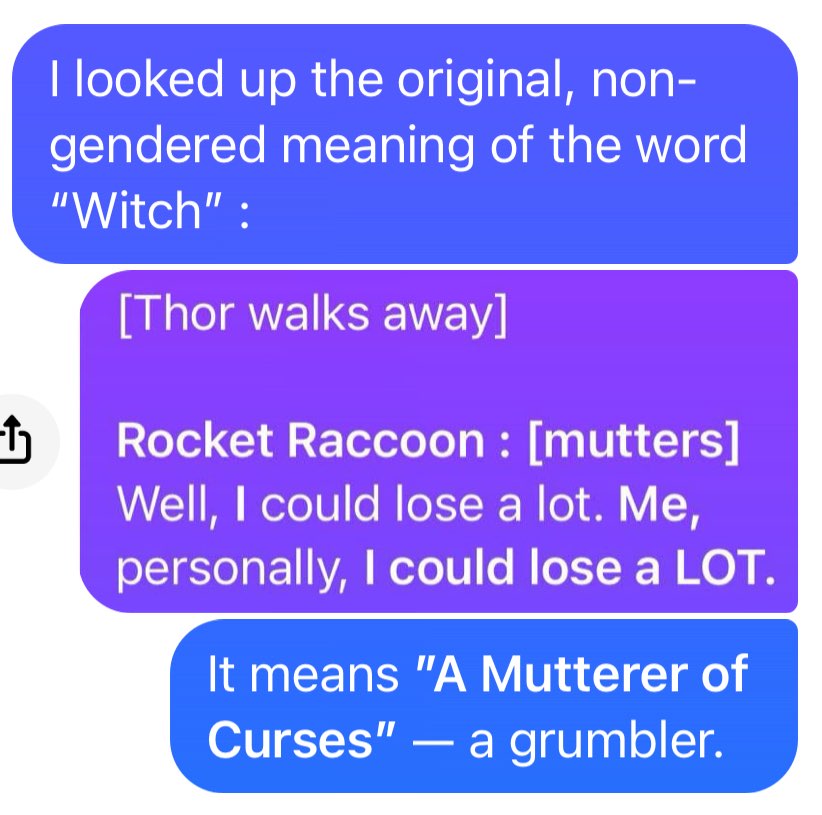
Mutterer of Charms


Exodus 22:18 
MEANING

◄ Exodus 22:18 ►

Ellicott's Commentary for English Readers

(18) Thou shalt not suffer a witch to live. -- The word translated "witch" in this passage is the feminine singular of that rendered by "sorcerers" in Exodus 7:11, and means "a mutterer of charms.

The use of the feminine form can only be accounted for by supposing that, practically, witchcraft was at the time mainly professed by females

Whether "witches" had actual help from evil spirits, or only professed to work magical effects by their aid, the sin against God was the same. Jehovah was renounced, and A Power other than His invoked and upheld

Witchcraft was as much rebellion against God as idolatry or blasphemy, and deserved the same punishment.

Pulpit Commentary
Verse 18. - Law against witchcraft. Witchcraft was professedly a league with powers in rebellion against God. How far it was delusion, how far imposture, how far a real conspiracy with the powers of evil, cannot now be known. Let the most rationalistic view be taken, and still there was in the practice an absolute renunciation of religion, and of the authority of Jehovah. Wizards (Leviticus 19:31) and witches were, therefore, under the Jewish theocracy, like idolaters and blasphemers, to be put to death.

Matthew Henry's Concise Commentary
22; 1 - 31 Judicial laws. - The people of God should ever be ready to show mildness and mercy, according to the spirit of these laws. We must answer to God, not only for what we do maliciously, but for what we do heedlessly

Therefore, when we have done harm to our neighbour, we should make restitution, though not compelled by law. Let these scriptures lead our souls to remember, that if the grace of God has indeed appeared to us, then it has taught us, and enabled us so to conduct ourselves by its holy power, that denying ungodliness and wordly lusts, we should live soberly, righteously, and godly in this present world, Titus 2:12. And the grace of God teaches us, that as the Lord is our portion, there is enough in him to satisfy all the desires of our souls.

Gill's Exposition of the Entire Bible
Thou shall not suffer a witch to live. Such that had familiar spirits, and conversed with them, and by means thereof got knowledge of many things relating to persons, at least pretending they did; and who did or seemed to do many strange and surprising feats, as even to raise the spirits of departed persons, to converse with them and gain knowledge by them, though in reality they did not, and could not do such things, but used some juggling tricks to deceive the people, and in which they might be assisted by evil spirits; as appears from the case of the witch of Endor, who was surprised at the appearance of Samuel, it being out of the ordinary course of her art and practice really to bring up the spirit of a man deceased, whatever pretensions might be made to it; however, such being deceivers of the people, and leading them into unwarrantable practices, and off of a dependence on God and his providence, and from seeking to him, and asking counsel of him, they are by this law condemned to death, such an one was not to be suffered to live; not that it was lawful for anybody to kill her, or that any private person might or must do it that knew her, or took her to be a witch; but she was to be had before a court of judicature and tried there, and, if found guilty, to be put to death by the civil magistrate : so Jarchi's note is,"but she shall die by the house of judgment;''or the sanhedrim; for these words are spoken to Moses the chief judge, and to those that were under him, and succeeded him and them; though the Targum of Jonathan prefaces them thus:"and my people, the children of Israel, thou shalt not, &c.''and though only a witch is mentioned, or this is only expressed in the feminine gender, because a multitude of this sort of people were found among women, as Ben Melech observes, and so Aben Ezra; yet wizards, or men that dealt with familiar spirits, are included; and it may be reasonably concluded from hence, that if women, who generally have more mercy and compassion shown them, yet were not suffered to live when found criminal in this way, then much less men : and this law is thought by some to follow upon the other, concerning enticing and lying with a virgin not betrothed; because such sort of persons were made use of to entice and decoy maids to gratify the lusts of men.

Courtesy of Open Bible