2008: THE DEATH OF STRAWBERRY FIELDS
The 2008 Bond movie Quantum of Solace doesn’t get a lot of love from Bond fans. It is overshadowed by the critical acclaim of its predecessor, Casino Royale (2006), and the phenomenal commercial success of the film that followed it, Skyfall (2012). Audiences weren’t expecting it to be a direct continuation of the Casino Royale storyline, and parts of it were incomprehensible to those unfamiliar with the earlier film. It was a revenge story about a man who chose not to take revenge, which was a plot that few expected or even recognised. There was also a significant section of the audience who considered Quantum of Solace to be a pretty silly title for a film.
Then there was the issue of the editing. A deliberate decision had been made to copy the hyperkinetic, frantic editing of the Jason Bourne films, in an effort to make the Bond franchise fresh and contemporary in the twenty-first century. The second unit director Dan Bradley was hired in part because of his work on the Bourne franchise. The result was, unfortunately, difficult to follow. It was as if the editor knew what was happening in the story but didn’t feel like they had to share that information with the audience. Roger Moore was one of those that was unimpressed. ‘I enjoy Daniel Craig, I think he’s a damn good Bond, but the film as a whole, there was a bit too much flash-cutting for me,’ he said in a radio interview. ‘I thought Casino Royale was better. It was just like a commercial of the action. There didn’t seem to be any geography and you were wondering what the hell was going on but there you are, call me old-fashioned and an old fuddy-duddy!’ To be fair to the editors they were only given six weeks to cut the film, which didn’t give much time for refinement. There remains the hope that the film will one day be recut, at which point its reputation could improve massively.
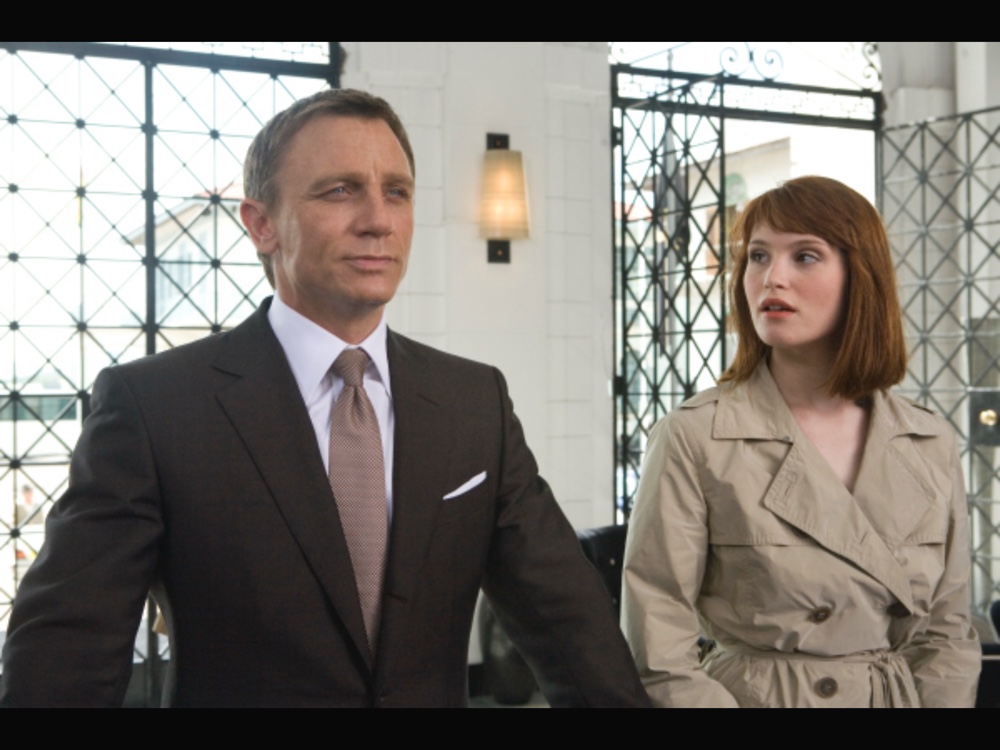
One of the more memorable parts of Quantum of Solace is a Beatles-themed Bond Girl called Strawberry Fields, who works at the British Consulate in La Paz, Bolivia. Fields’s mission is simply to ensure that Bond leaves Bolivia on the next available flight but, as the plane doesn’t leave until the following morning, she goes with him to a hotel and sleeps with him instead. In a first for the franchise, she immediately regrets her actions. ‘Do you know how angry I am with myself?’ she asks. Perhaps she knew the odds of a woman living after sex with Bond. He doesn’t seem too concerned about her regret, however, and takes her to a lavish party to meet tech billionaires, politicians, Bolivian military officers and various assorted goons and murderers.
The next we see of Fields she is, of course, naked and dead, lying face down on Bond’s bed covered in crude oil. The plot justification for this was that it was misdirection on the part of the villain. He was falsely giving the impression that his evil plan revolved around oil, when in fact the precious liquid he was intent on hoarding was water. Quantum of Solace is a harsh, brutal, extremely violent film about two damaged people – Bond and the Bolivian agent Camille Montes – who are cut off from their emotions and robotically seeking revenge. A key image is the desert, representing their arid states of mind where no love can grow. All the water has been hoarded by the film’s villain, who must be defeated in order to save the Bolivian people, and also to allow Bond and Montes to heal. When Strawberry Fields wanders into this hard, serious film, it is as if she has entered the wrong Bond film by mistake. Fields would have been a hoot in Die Another Day.
Fields’s pointless death is more upsetting because this promising character never had a chance to shine. But at the point when she was killed off, the likelihood of death for a woman who slept with Daniel Craig’s Bond stood at a franchise-high rate of 100 per cent. Every single woman he slept with in his first two films died shortly afterwards. This is something that Judi Dench’s M highlights in the film. ‘Look how well your charm works, James,’ she says, referring to the dead woman. ‘They’ll do anything for you, won’t they? How many is that now?’ Daniel Craig’s last performance in character as Bond was in a sketch for the BBC charity Comic Relief, in which he was berated by Catherine Tate’s character Nan. ‘Let’s face it, every time you entertain somebody in the bedroom department, next day, wallop, they’re dead,’ she tells him. At long last, this defining aspect of the Bond character was being publicly recognised and challenged.
It’s true, of course, that the men he encounters don’t tend to live long either. Bond is death and it’s not just baddies who die. The usual rule is that if an ally (other than Q or M) returns for a second film, then they won’t make it to the end. Robbie Coltrane’s Valentin Zhukovsky, for example, was first seen in GoldenEye and then killed in The World Is Not Enough. Giancarlo Giannini’s René Mathis made it through Casino Royale only for his body to be dumped in the trash in Quantum of Solace. Live and Let Die and Dr. No were produced in reverse order to their books, which created a continuity problem – Bond’s Cayman Islander associate Quarrel appeared in both books and was naturally killed in the second. This meant that the film of Live and Let Die had to create a son for him, called Quarrel Jr, to avoid bringing him back from the dead.
Of all Bond’s male friends, it is the CIA agent Felix Leiter who seems the most immune from death. He was originally killed off in a shark attack in the second book he appeared in, as Fleming tradition dictates. But after complaints from Fleming’s American agent the scene was rewritten so that this likeable American character survived – although the shark still ate Leiter’s right arm and left leg. Leiter was duly munched by a shark on screen in the film Licence to Kill (1989).
Still, even if we accept that Bond is an equal-opportunity version of Death, who kills both male and female friends alike, the idea that women must die after having sex is not one that is easy to brush off. Fleming’s toxic emotional problems may have been acceptable to the 1950s publishing industry, but they are impossible to excuse in the twenty-first century. One person who understood this was Gemma Arterton, the actor who played Strawberry Fields.
At the time, Arterton was very positive about the role. She signed up to be the face of the Avon perfume Bond Girl 007. ‘My character’s cool,’ she said during interviews to promote the film. ‘She’s funny, and real, and someone you could know from down the road. I’m quite tough – I have to arrest Bond at one point – but I go to bed with him, of course. So it is a good part.’ Asked about the film by the Observer five years later, she said, ‘Yeah, I don’t have any shame in that one. That was really a good experience for me.’
Four years later, however, she had started to express regrets about taking the part. ‘I don’t want to slag off that film, because I really enjoyed it – I was 21, and it was a trip. But would I do it now? No,’ she told ES magazine in 2017, ‘And I am grateful – it set me up … But it sits really badly with me when I make something I’m not proud of, or doesn’t say what I want to say.’ She expressed similar sentiments at an International Women’s Day event in 2020. ‘I still get criticism for accepting the Bond film, but I was 21, I had a student loan and, you know, it was a Bond film!’ she said. ‘But as I got older I realised there was so much wrong with Bond women … My Bond girl should have just said no, really, and worn flat shoes […] I know I wouldn’t choose a role like that now. Because she was funny and she was sweet, but she didn’t really have anything to do – or a backstory.’ It is fitting, perhaps, that the only Bond Girl who expressed regret about sleeping with Bond on screen has become the actor most vocal about expressing their regret off screen.
In 2018, Arterton attempted to address the problem through fiction. She wrote a short story about Strawberry Fields for the anthology Feminists Don’t Wear Pink (and Other Lies). The story was called ‘Woke Woman’. It depicted an alternative version of her first scenes in Quantum of Solace in which the character of Strawberry Fields was significantly changed. It begins with Fields being woken by her alarm playing ‘No Scrubs’ by TLC. This is an appropriate choice for the Bond universe. For all its feminist credentials it is a song about refusing to sleep with poor people, and as such is a suitable expression of Fleming-like snobbery. As the short story continues, however, we soon find that we are in a very different world indeed.
Fields immediately dresses differently. She chooses flat shoes and light trousers, instead of the short skirt underneath a trench coat that we see on screen. In the movie, M tells us, Fields ‘worked in an office, collecting reports’. In Arterton’s story, she regularly fights drug gangs. Arterton describes how Fields has been personally requested by Bond to escort him around Bolivia, and how he makes her feel uncomfortable by staring at her in the taxi. In the film, her job is to make sure Bond leaves Bolivia, and Bond pointedly ignores her on the way to the hotel. Most importantly, Fields in the short story refuses to accompany him up to his room. ‘ “No thank you,” I say. Maybe he is attractive, but he’s at least twenty years older than me, we’ve only just met, he’s a work colleague – the list goes on. Plus this man has a reputation. Don’t women who go up to his hotel room and sleep with him usually die in some horrific yet iconic way? No, no. Not me.’ Instead, they talk about their mutual friend Penny Lane, then Fields has Bond sign the required paperwork and she leaves. She is, therefore, unharmed, and lives to fight crime another day.
When she was promoting her film in 2008, Arterton had described her character with the phrase ‘She’s not a typical Bond girl’, a description used by many different actors over the past half-century. Regardless of how often the female characters were updated, written as being more formidable in action sequences, or played with great confidence and agency, something significant never changed. The need for new actors to insist that their role isn’t that of a typical Bond Girl never seemed to go away. There was always something wrong in the power dynamics at the heart of Bond’s relationships. It was always the woman who died after sex, and never the man.
What Arterton did when she wrote her story was to reject the set of assumptions that the Bond franchise had been built upon. She offered another way to perceive Bond, and it was not one that many Bond fans would like. Suddenly he was the sleazy office creep, the person that half the staff warn each other about. Arterton wrote her story in 2018, the year in which Paul Haggis, the Oscar-winning writer-director of Crash (2004) and the co-writer of Quantum of Solace, was accused by multiple women of a series of rapes and sexual assaults. He has denied all accusations.
With hindsight, there is something symbolic about Arterton’s reimagination of Strawberry Fields. When Connery’s Bond is knocked unconscious after he criticises the Beatles in Goldfinger, he comes to and finds that the woman who was in his bed is now covered in gold and quite dead. This woman, Jill Masterson, had become the first woman in a Bond film to sleep with Bond and then die. The death of Strawberry Fields – coated in oil rather than gold – is a clear reference to this key moment, even down to the inclusion of another Beatles reference. Yet after Fields is found naked and dead on Bond’s bed, something significant in the Bond world changes. She is not quite the last Bond Girl to die, as Javier Bardem’s villain shoots the character of Sévérine in Skyfall. But Sévérine aside, it is striking that for the remaining three and a half films of Craig’s run as the spy, no other woman who is romantically involved with Bond is killed. Considering that every woman Craig’s Bond had slept with up to and including Fields had died, this was quite a shift.
The societal awareness and changes that Arterton highlighted in her writing had finally caught up with Fleming’s demons. Arterton’s Bond Girl, the first to experience regret, was the start of a serious change for the James Bond franchise. It is fitting, for our purposes here, that it took a Beatles-themed character to inspire this change.
2008: THE DEATH OF STRAWBERRY FIELDS
Roger Moore gave his thoughts on Quantum of Solace in a March 2009 interview with Christian O’Connell on Absolute Radio’s Who’s Calling Christian show.
The initial Gemma Arterton quote can be found online at https://www.mi6-hq.com/sections/girls/arterton.php3.
Her Observer quote is from Tim Lewis’s 12 May 2013 interview ‘Gemma Arterton: “Our house was a bit Ab Fab at times” ’.
The Evening Standard ES Magazine interview quoted is Jane Mulkerrins’s 6 April 2017 feature ‘Gemma Arterton on therapy, sacrifice and changing the industry from the inside out’.
Arterton’s comments at the International Women’s Day event were widely reported, for example in Ella Phillip’s article for Harper’s Bazaar, ‘Gemma Arterton: “There’s so much wrong with Bond women” ’. ‘ “No thank you,” I say. Maybe he is attractive …’ – Curtis (ed.), p.243.

No comments:
Post a Comment