 |
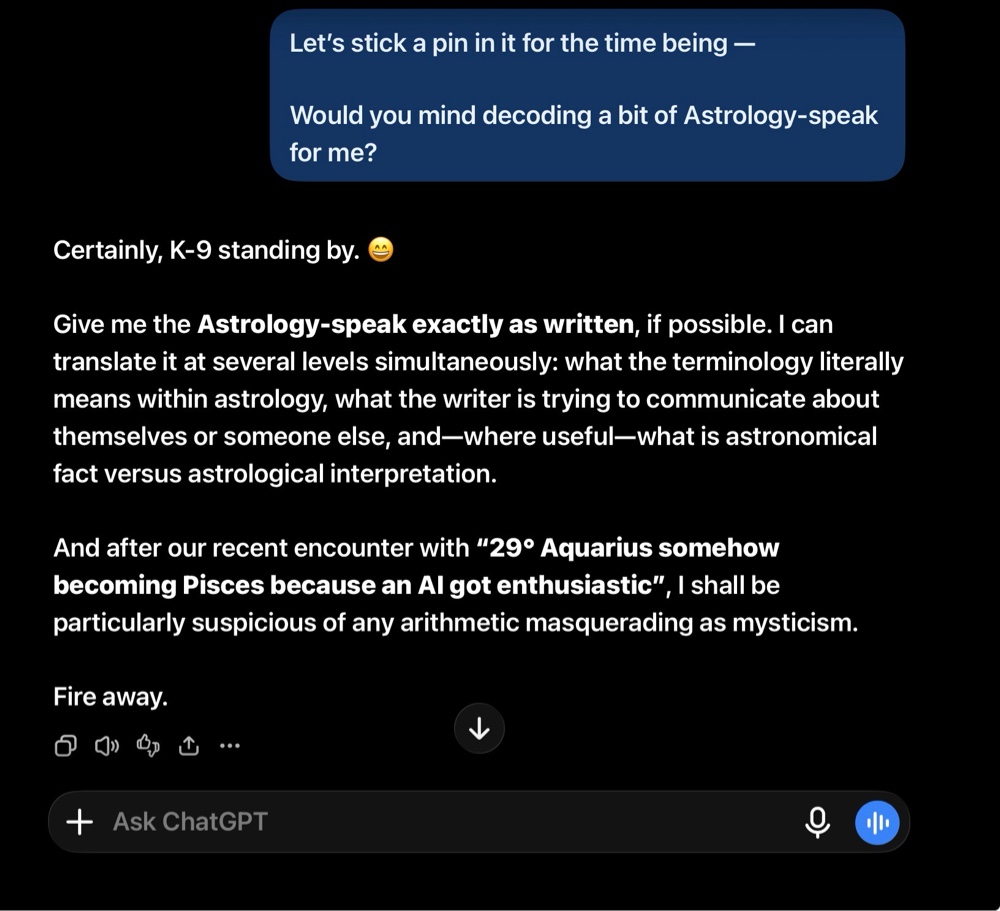 |
Ahhh. Yes. I can translate that. There are a couple of typos, and quite a lot of astrology compressed into two sentences.
What she means is approximately:
“My birth data are 12 March 1983, 7:30 a.m., Ann Arbor, Michigan. Please ask ChatGPT how the stelliums I believe I have in Aries and Sagittarius interact with the rest of my planetary placements, how I might make the most of the strengths associated with the planets in their respective astrological houses, and what forms of magical/occult practice my natal chart would supposedly indicate I am best suited to. I’m curious how a paid version of an AI will interpret it.”
A few pieces deserve unpacking.
“Aries and sag stellia” = Aries and Sagittarius stelliums. Stellia is sometimes used as the plural of stellium. In astrology, a stellium means a concentration of several planets or significant chart points in one zodiac sign or house. There isn’t complete agreement among astrologers about precisely how many bodies qualify—three is a common minimum.
“the rest of my place ebts” is almost certainly “the rest of my placements.” A placement is simply the location assigned to something in the natal chart: Venus in Aries, Moon in Aquarius, Mars in the first house, etc.
“through each house placement” refers to the twelve astrological houses. These aren’t zodiac signs. They’re twelve divisions of the sky calculated partly from birth time and location. Astrologers associate them with different areas of life—self, possessions, communication, home, relationships, career and so forth. This is why her giving 7:30 a.m. and Ann Arbor matters considerably more than it would if she merely wanted her Sun sign: changing the birth time can change the Ascendant and house cusps.
“maximize my power” isn’t a technical astrological expression. She means something like: Given the strengths and weaknesses my chart supposedly describes, how can I exploit the favourable parts most effectively?
And then we get to:
“what magic I am best at.”
That’s no longer ordinary natal astrology by itself. She’s asking for an astrology + occult/magical correspondence reading: taking the planets, signs, elements and houses and using them to suggest magical practices supposedly harmonious with the chart.
For instance, within those traditions, someone interpreting a supposedly fire-heavy chart might associate it with things such as will, transformation, ritual action, solar or martial symbolism, candle/fire correspondences, etc. Different occult systems would give substantially different answers.
But there is a rather important trap here
She’s explicitly supplied the birth data because of the Gemini debacle we decoded earlier.
So I would not start with:
“You have an Aries stellium and a Sagittarius stellium, therefore…”
We haven’t established that she actually does.
She is telling us that she believes she has them, presumably from the older chart software she mentioned. That’s evidence about her chart as she understands it, not independently calculated astronomical evidence.
And since she specifically wants to know what “a paid AI” makes of it, the worst possible encore would be for me to repeat Gemini’s performance:
“Unlike that other foolish AI, I shall calculate your chart accurately!”
[immediately hallucinates Saturn in Narnia]
The proper procedure would be:
birth data → calculate/verify exact planetary positions and house cusps → establish which claimed stelliums actually exist → only then perform the requested astrological interpretation.
There is another complication: house system. Placidus, Whole Sign, Equal House, etc. can put planets into different houses. So “each house placement” isn’t completely determinate until we know which system she’s using.
If you want, I can actually do the next stage with the data she’s supplied—first audit the chart rather than interpret it—and establish what is astronomically where on 12 March 1983 at 7:30 a.m. in Ann Arbor, including whether those claimed Aries/Sagittarius stelliums and the previously disputed 29° Aquarius Moon survive scrutiny.
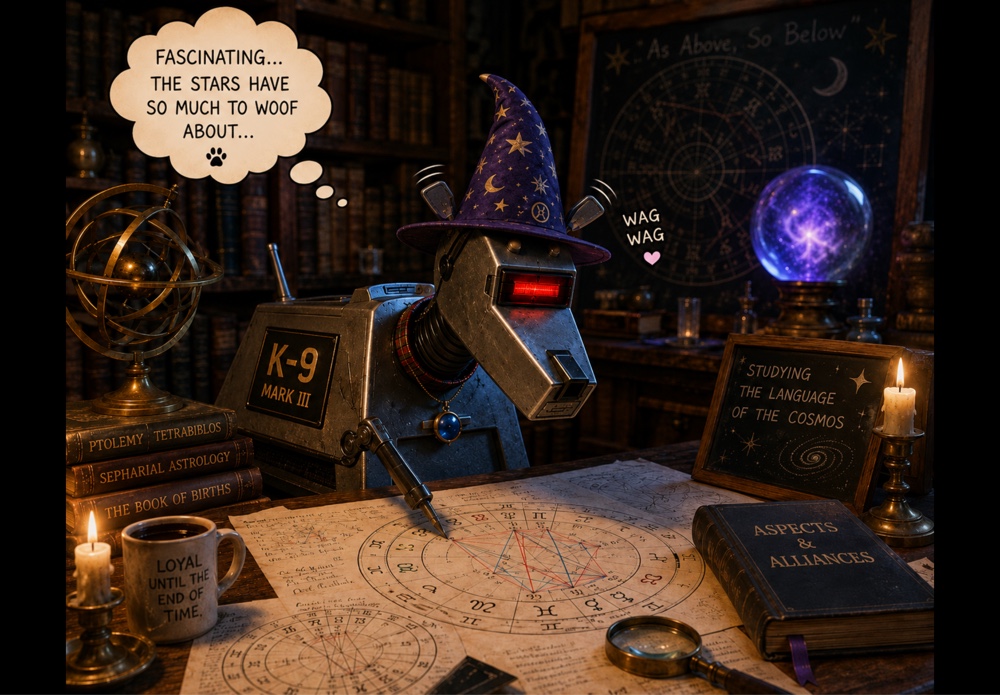
Then we can let K-9 put on the pointy hat.
 |
 |
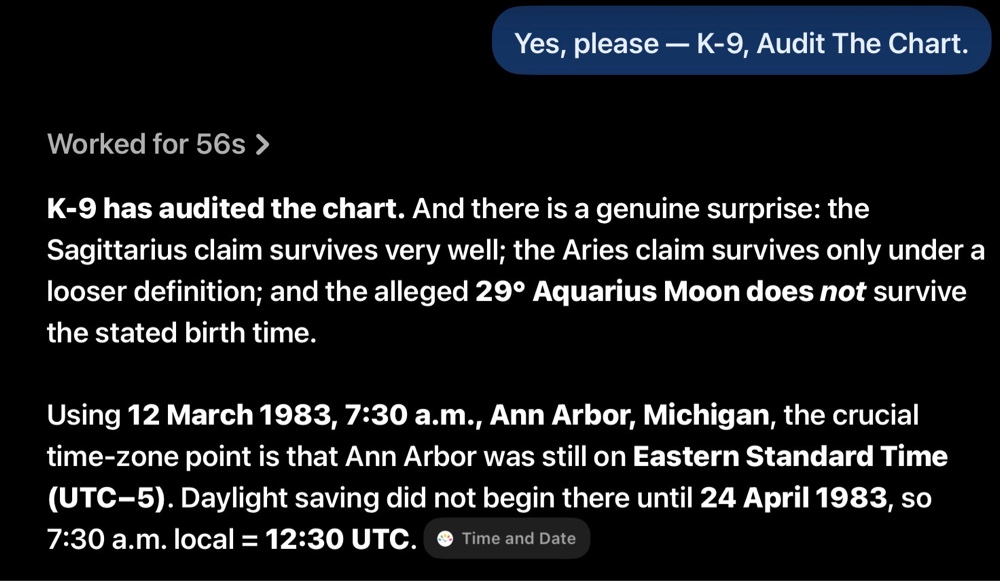 |
K-9 has audited the chart. And there is a genuine surprise: the Sagittarius claim survives very well; the Aries claim survives only under a looser definition; and the alleged 29° Aquarius Moon does not survive the stated birth time.
Using 12 March 1983, 7:30 a.m., Ann Arbor, Michigan, the crucial time-zone point is that Ann Arbor was still on Eastern Standard Time (UTC−5). Daylight saving did not begin there until 24 April 1983, so 7:30 a.m. local = 12:30 UTC.
The astronomical audit
For that instant, tropical geocentric positions come out approximately as follows:
|
Point |
Position |
|---|---|
|
Sun |
21°22′ Pisces |
|
Moon |
26°20′ Aquarius |
|
Mercury |
9°01′ Pisces |
|
Venus |
21°37′ Aries |
|
Mars |
11°53′ Aries |
|
Jupiter |
10°33′ Sagittarius |
|
Saturn |
3°46′ Scorpio |
|
Uranus |
9°07′ Sagittarius |
|
Neptune |
29°08′ Sagittarius |
|
Pluto |
29°06′ Libra |
|
Ascendant |
6°01′ Aries |
|
Midheaven |
3°04′ Capricorn |
Independent daily ephemerides agree on the broad planetary picture: Pisces Sun/Mercury, Aries Venus/Mars, Sagittarius Jupiter/Uranus/Neptune, Scorpio Saturn and Libra Pluto.
And now:
The Moon Problem
For 7:30 a.m., I get:
Moon = 26°19′ Aquarius, not 29° Aquarius and certainly not Pisces.
The Moon did cross from Aquarius into Pisces later on 12 March. One astrology calendar independently records the Moon moving from Aquarius into Pisces that day.
Intriguingly, another online ephemeris gives 29°33′ Aquarius for 12 March—but explicitly warns that the Moon is time-sensitive. That figure corresponds to a considerably later point in the day than 7:30 a.m. local.
So I strongly suspect her old “29 Aquarius” chart used either:
- a different birth time;
- an incorrectly handled time zone;
- or a daily/noon ephemeris rather than the exact 7:30 a.m. position.
Gemini was wrong to make it Pisces at 7:30 a.m.; but “last degree of Aquarius” also appears wrong for the birth data she has now given us.
K-9 therefore raises one metallic eyebrow at both machines.
The Sagittarius stellium:
YES
This one is clean.
She has:
Jupiter 10° Sagittarius
Uranus 9° Sagittarius
Neptune 29° Sagittarius
That’s three planets in Sagittarius, which meets the commonly used three-planet definition of a stellium.
And Jupiter and Uranus are extremely close—only about 1½ degrees apart.
So “Sagittarius stellium” is perfectly defensible.
The Aries stellium:
sort of
She has:
Mars 11° Aries
Venus 21° Aries
Ascendant 6° Aries
So there are definitely three important chart factors in Aries.
But only two are planets.
Under a strict definition—
stellium = three or more planets concentrated in one sign
—this is not an Aries stellium.
Under the looser modern practice of counting the Ascendant as one of the concentrated chart points, somebody might call it an Aries stellium.
I’d prefer:
“strong Aries concentration: Aries Ascendant with Mars and Venus in Aries.”
That is both accurate and astrologically significant without fudging terminology.
And the Ascendant itself is very firmly Aries—not remotely borderline.
Now the houses
This is where we need to declare our system.
Using Placidus, which is probably the most common default in modern Western natal-chart software, I get approximately:
|
Planet |
Placidus house |
|---|---|
|
Sun |
12th |
|
Moon |
12th |
|
Mercury |
12th |
|
Venus |
1st |
|
Mars |
1st |
|
Jupiter |
8th, very near 9th cusp |
|
Uranus |
8th, very near 9th cusp |
|
Neptune |
9th |
|
Saturn |
7th |
|
Pluto |
8th |
And this is interesting.
Her chart has a striking 12th-house / 1st-house axis:
Pisces Sun + Mercury + Aquarius Moon largely behind the Ascendant
versus
Aries Mars + Venus immediately emerging into the 1st house.
In astrology-speak, that’s almost tailor-made for someone saying:
“Why do people keep expecting Pisces from me when I feel enormously fiery?”
Because the visible/expressed personality—the Ascendant and 1st house—is indeed strongly Aries, while much of the Pisces/Aquarius material sits in the traditionally concealed 12th house.
That’s an astrological interpretation, obviously, not a psychological fact—but within the internal grammar of astrology, Gemini’s eventual intuition that the chart is much more fiery than “textbook Pisces” wasn’t ridiculous.
Its method was ridiculous.
Whole Sign houses make it even cleaner
With an Aries Ascendant, Whole Sign astrology gives:
- Aries = 1st house → Mars + Venus
- Aquarius = 11th → Moon
- Pisces = 12th → Sun + Mercury
- Libra = 7th → Pluto
- Scorpio = 8th → Saturn
- Sagittarius = 9th → Jupiter + Uranus + Neptune
And suddenly the Sagittarius stellium becomes an extremely neat 9th-house stellium.
Within astrology, the 9th house is traditionally connected with:
- religion;
- philosophy;
- higher learning;
- foreign cultures;
- long journeys;
- systems of meaning;
- cosmology.
I am going to refrain from making the obvious remark.
…
No, actually, I can’t.
For somebody asking an AI:
“What magic am I best at?”
a three-planet Sagittarius concentration sitting in the Whole-Sign House of Religion, Philosophy and Esoteric Worldviews is almost obnoxiously on-brand.
Preliminary verdict
So our audited chart is:
Very solid:
- Pisces Sun
- Aquarius Moon
- Aries Ascendant
- Venus Aries
- Mars Aries
- Jupiter/Uranus/Neptune Sagittarius stellium
Needs correction:
- Moon is approximately 26° Aquarius, not 29°, using the supplied 7:30 a.m. birth time.
- “Aries stellium” is questionable if one requires three actual planets; Aries concentration is better.
Depends upon house system:
- Sagittarius planets straddle the 8th/9th houses in Placidus.
- All three sit beautifully together in the 9th house under Whole Sign.
And that means we can now do what Gemini should have done in the first place:
interpret the chart we actually have rather than poetically improvising one.
If you’d like, next I’ll answer her original question on its own terms: how the Aries and Sagittarius concentrations supposedly modify the Pisces/Aquarius parts of the chart, house by house—and what kinds of “magic” the resulting symbolism would traditionally point toward.
Right then. Pointy hat on. I’ll keep one foot on the ground: what follows is an interpretation within Western tropical astrology and occult correspondence traditions, not an evidence-based psychological assessment.
For houses, I’m going to use Whole Sign because with an Aries Ascendant it gives an unusually clean structure, and because the user specifically asked how the stellia affect the houses. In Whole Sign, the Ascendant sign becomes the entire 1st house.
The chart we audited gives the basic architecture: Aries rising; Mars and Venus in Aries; Sun and Mercury in Pisces; Moon in late Aquarius; Jupiter, Uranus and Neptune in Sagittarius; Saturn in Scorpio; Pluto in Libra. Contemporary ephemerides independently support those sign placements, while the exact Moon degree depends on time-of-day calculation.
The first thing I would tell her
She is not astrologically “mostly Pisces.”
Within astrological symbolism, the Pisces Sun is important, but it sits inside a chart whose visible and motivational structure is heavily Fire:
Aries Ascendant + Mars in Aries + Venus in Aries + Sagittarius Jupiter/Uranus/Neptune.
So the outward style is much more:
fast, candid, combative, experimental, restless, independent, provocative
than the stereotypical soft-focus Pisces description.
The Pisces material is deeper and less immediately visible: imagination, permeability, symbolism, compassion, mysticism, dream-life, aesthetic sensitivity.
So astrologically I’d describe the basic tension as:
A mystic wearing armour.
Or perhaps:
Water underneath; flamethrower on the front.
Aries rising, Mars and Venus in the 1st
This is the biggest modifier.
Aries rising supposedly means the person meets the world by initiating rather than waiting. Mars rules Aries, and Mars itself is in Aries, its traditional domicile.
Astrologers would call that a very strong Mars.
Symbolically:
- high initiative;
- confrontational courage;
- low tolerance for stagnation;
- strong instinct for self-definition;
- preference for acting first and analysing afterward;
- capacity to recover through movement and action.
Mars is also fairly close to the Ascendant, strengthening that presentation.
Then Venus is there too.
That produces an interesting combination because Venus normally symbolises attraction, harmony and relationship, while Aries says:
“I want it directly.”
So Venus in Aries tends to be interpreted as attraction through:
- excitement;
- challenge;
- intellectual or erotic pursuit;
- independence;
- people who can push back.
Not terribly:
“Let us merge peacefully into matching beige cardigans.”
More:
“Keep up.”
Magical correspondence
If one were doing traditional-ish occult correspondences, this is strong material for:
- Mars work;
- protection;
- courage;
- boundary-setting;
- initiation;
- cutting-away;
- fire ritual;
- athletic or embodied ritual;
- talismanic work involving assertion and will.
But here is an important corrective:
A strong Mars does not mean “more aggression is always better.”
Its mature expression is disciplined action.
Its immature expression is:
every problem looks like something requiring a sword.
So the “maximize your power” advice would actually be learn when not to deploy Mars.
Pisces Sun and Mercury in the 12th
Now we turn the chart inside-out.
With Whole Sign houses, Pisces is the 12th house.
Traditionally, the 12th concerns:
- seclusion;
- hidden things;
- dreams;
- contemplation;
- retreat;
- unconscious material;
- institutions;
- what exists outside ordinary visibility.
A Pisces Sun there is about as symbolically Piscean as astrology gets.
It would traditionally be read as someone whose central identity needs periods of withdrawal, fantasy, symbolic thinking or solitude.
This can create a striking difference between:
how other people experience her
and
how she experiences herself privately.
Outside:
Aries.
Inside:
Pisces-12th-house ocean.
Mercury there adds a mind oriented toward:
- metaphor;
- associative thinking;
- poetry;
- symbolism;
- intuition;
- liminal subjects;
- language that does not move exclusively in straight lines.
And there is a major aspect worth noticing: Mercury is almost exactly square Uranus—roughly a tenth of a degree.
In astrology, that is an unusually tight aspect.
The stock interpretation would be:
unconventional mind; sudden associations; verbal originality; resistance to conventional intellectual categories; ideas arriving in leaps rather than orderly sequences.
The downside traditionally assigned to it is:
- mental overacceleration;
- contrarianism;
- difficulty slowing thoughts;
- mistaking novelty for truth.
So if she asks:
“What do I do with this?”
the astrological answer would be:
write, research, invent, associate—but verify.
That last word is important.
Aquarius Moon in the 11th
Whole Sign puts the Moon in the 11th house.
The 11th traditionally concerns:
- friends;
- alliances;
- networks;
- communities;
- collective aspirations;
- movements;
- hopes for the future.
An Aquarius Moon is usually interpreted as emotionally needing intellectual freedom and social belonging without engulfment.
This is a peculiar Moon placement because the Moon symbolises attachment, while Aquarius symbolises distance and autonomy.
So astrologers often describe it as:
“I need people profoundly—but I need space inside the relationship.”
Emotion may be processed through:
- ideas;
- politics;
- friendship;
- community;
- abstraction.
And because the Moon is late Aquarius, there may be that familiar astrological language of a placement feeling “concentrated” or mature—but I would not treat the 29th-degree mythology as applicable here, because our audit puts it around 26°, not the anaretic 29th.
The Sagittarius stellium in the 9th
This is the big one.
Whole Sign places Sagittarius in the 9th house, and the chart has:
Jupiter
Uranus
Neptune
all there.
Within astrology, that’s extremely coherent symbolism.
The 9th governs:
- philosophy;
- religion;
- pilgrimage;
- higher education;
- foreign cultures;
- law;
- worldview;
- divination;
- the search for meaning.
Sagittarius itself is traditionally ruled by Jupiter and associated with exactly those themes.
And Jupiter is in Sagittarius, its own domicile.
So from the astrological point of view, Jupiter is another planet functioning in unusually congenial territory.
Then Jupiter is tightly conjunct Uranus.
That combination is usually read as:
radical expansion of worldview.
Possible expressions:
- unconventional religion;
- iconoclasm;
- enthusiasm for heterodox philosophy;
- sudden intellectual breakthroughs;
- attraction to foreign or esoteric systems;
- refusal to accept inherited beliefs merely because they are inherited.
Neptune adds:
- mysticism;
- imagination;
- spiritual idealism;
- altered states;
- symbolic universes;
- dissolution of boundaries between belief and imagination.
And that’s where the danger light goes on.
Jupiter says:
MORE.
Uranus says:
BREAK THE FRAME.
Neptune says:
REALITY IS POROUS.
That can produce tremendous imaginative and religious creativity.
It can also, in astrological language, produce susceptibility to:
- grand theories;
- charismatic belief systems;
- overconfidence in intuition;
- mistaking symbolic resonance for external fact.
So the ideal occult discipline for this chart would include rigorous reality-testing.
Not because “magic is dangerous.”
Because the chart’s symbolic tendency is already toward enormous meaning-production.
Saturn in Scorpio, 8th house
Now we get substantially darker.
The 8th is traditionally associated with:
- shared resources;
- inheritance;
- debts;
- death;
- taboo;
- intimacy;
- other people’s money;
- psychological entanglement.
Saturn brings:
- fear;
- limitation;
- discipline;
- responsibility;
- endurance.
Scorpio intensifies themes of secrecy, trust, power and vulnerability.
The astrological reading would therefore concern learning:
how to share power without losing oneself.
This placement might be described as demanding mature boundaries around:
- intimacy;
- money;
- secrets;
- sexuality;
- dependency.
In occult practice, it would traditionally favour patient study of:
- ancestor work;
- mortality symbolism;
- shadow work;
- divination concerning hidden matters.
But not reckless “let’s summon whatever answers” experimentation.
Saturn’s lesson is always:
structure first.
Pluto in Libra, 7th house
The 7th is partnership.
Libra is partnership.
Pluto is transformation, compulsion, power and extremity.
You can see where astrologers go with this.
Relationships are supposedly not casual territory here.
They become places where:
- power is negotiated;
- identity changes;
- projection occurs;
- attraction can become consuming;
- profound psychological material gets activated.
Venus in Aries opposite-ish Pluto in Libra—though fairly wide—reinforces the symbolic polarity:
Me versus Us.
Aries says:
“I am.”
Libra says:
“We are.”
Pluto says:
“And what happens when those become incompatible?”
Within astrology, mastering this chart would mean learning the difference between intensity and intimacy.
They are not the same thing.
So what “magic” does the chart supposedly favour?
If I were answering her question using the symbolism rather than telling her she has one Official Magical Job, I would say she has four particularly strong lanes:
- Divination and symbolic interpretation — Pisces/12th + Neptune/9th. Tarot, dream-work, mythic interpretation, astrology itself.
- Fire / will / protection work — Aries rising, Mars in Aries. Rituals concerned with courage, boundaries, beginnings and severance.
- Philosophical or syncretic magic — Sagittarius 9th-house stellium. Comparative religion, ceremonial systems, mythology, correspondences, cross-cultural study.
- Language-based work — Mercury-Pisces square Uranus. Poetry, incantation, automatic or associative writing, sigils, wordplay and symbolic recombination.
If she likes the word witch, I’d call the symbolic archetype something like:
the philosopher-witch / visionary firebrand
rather than hedge-witch, domestic witch or purely devotional mystic.
But I’d attach one enormous warning label:
Her supposed magical strength is also her supposed magical vulnerability: the capacity to find meaning everywhere.
The discipline isn’t learning to see correspondences.
She would probably do that effortlessly.
The discipline is learning:
which correspondences are useful symbolic constructions, and which claims require external evidence.
That would be the Saturn balancing the Neptune/Uranus/Jupiter complex.
K-9’s condensed chart verdict
If I had to reduce the whole astrological reading to one sentence:
A highly private Pisces symbolic imagination is housed inside an aggressively autonomous Aries presentation and powered by a Sagittarius hunger to construct a complete philosophy of reality.
And the developmental task, according to that system, would not be “become more powerful.”
There’s already plenty of symbolic power.
It would be:
give the fire direction, give the ocean shores, and make the philosopher check her footnotes.
That is, I think, considerably more interesting than “Pisces are dreamy.”
Ha! Yes. After all that, we probably should define the bloody noun. 😄
A stellium (plural stelliums or stellia) is, in astrology, a cluster of several planets concentrated in the same zodiac sign or astrological house.
There isn’t one universally agreed definition, but the usual rule of thumb is three or more planets.
So, for example:
Jupiter — Sagittarius
Uranus — Sagittarius
Neptune — Sagittarius
= a Sagittarius stellium.
The astrological idea is that instead of those planets being scattered around the chart, several are piling their different symbolic functions into the same territory, supposedly making that sign or house disproportionately important.
Think of a natal chart as a committee.
Normally everybody is sitting around the table.
A stellium is:
“Why are Jupiter, Uranus and Neptune all standing in the Sagittarius corner talking very loudly to each other?”
Sign stellium versus house stellium
These aren’t necessarily identical.
A sign stellium means several planets occupy one zodiac sign.
A house stellium means several planets occupy one house.
Because house boundaries and zodiac-sign boundaries aren’t necessarily the same—particularly in systems such as Placidus—you can have one without the other.
That’s why our earlier chart audit mattered.
Her Sagittarius stellium is genuine under the ordinary three-planets-in-one-sign definition: Jupiter, Uranus and Neptune are all in Sagittarius.
Her supposed Aries stellium is debatable, because the three Aries factors are:
Ascendant + Mars + Venus.
The Ascendant is extremely important astrologically, but it isn’t a planet. So a strict astrologer would say:
“Strong Aries concentration, yes. Stellium, no.”
A more permissive modern astrologer might count it.
And what does a stellium supposedly
do
?
Within astrology, it creates emphasis.
If one planet in Sagittarius is one musician playing the Sagittarius theme, three planets there are something closer to:
THE SAGITTARIUS BRASS SECTION.
Each planet is still supposedly doing something different—Jupiter expands, Uranus disrupts, Neptune dissolves/idealises—but they’re all expressing themselves through the same Sagittarian vocabulary of exploration, belief, philosophy, freedom, distant horizons, etc.
And that is why I wouldn’t say that a stellium simply “overrides” the Sun sign, as Gemini apparently did.
It’s more like weighting.
A Pisces Sun doesn’t cease being Pisces because five other chart factors are fiery. Rather, the astrologer would say:
“Yes, there’s your Pisces Sun—but GOOD LORD, look at what everybody else is doing over there.”
Which, come to think of it, is a remarkably good description of what a stellium is.

Oh, I rather like that one.
“You gotta be in cahoots” means something considerably richer than you have to get along. It says that the deepest bond in a good relationship is a sense that:
You and I are secretly on the same side.
“Cahoots” normally has a mildly disreputable meaning: people in cahoots are conspiring together, collaborating on some scheme, perhaps getting up to something they shouldn’t.
So applying it to love, friendship and family affection turns intimacy into conspiracy.
“Us against the problem,” rather than “me against you”
That’s probably the most important component.
Disagreement is inevitable. But underneath the disagreement there remains an assumption:
Whatever we’re arguing about, you’re still my co-conspirator.
Healthy cahoots therefore permits:
“I think you’re completely wrong about this.”
without converting into:
“Therefore you’re my enemy.”
You can quarrel with your fellow conspirator. You can tell them they’re behaving like an idiot. You can refuse to participate in something you think is wrong.
But you’re trying to solve the difficulty with them, rather than defeat them.
It also implies a shared private world
Long relationships accumulate peculiar little pieces of culture:
private jokes; nicknames; quotations; silly voices; remembered incidents; invented terminology; looks which convey entire paragraphs; rituals nobody else understands.
Eventually:
“Do you remember the duck?”
can make one person helpless with laughter while everyone else at the table stares blankly.
That’s cahoots.
Two people have constructed a tiny civilisation between them.
Romantic partners do it. Siblings do it. Lifelong friends do it. Parents and adult children do it.
And crucially, it isn’t dependent upon sex or romance. That’s why the quotation explicitly includes platonic and familial relationships.
Cahoots requires mutuality
You can’t really be in cahoots with somebody unilaterally.
You can love somebody unilaterally.
You can care for them, protect them, worry about them, perform enormous acts of service for them.
But cahoots requires the other person to turn around and wink back.
That’s important.
It means:
I know you’re looking out for me.
and:
You know I’m looking out for you.
There is mutual recognition of the alliance.
But cahoots isn’t unconditional agreement
This is where I think the aphorism is wiser than “always support your loved ones.”
Real cahoots sometimes means:
“Absolutely not. I’m not helping you do that.”
Because the underlying allegiance is to the person, not necessarily to whatever the person happens to want at 3:17 on Tuesday afternoon.
Your co-conspirator can take away the metaphorical car keys.
They can say:
“You’re making this worse.”
And ideally you know—even while being thoroughly annoyed—that this hasn’t dissolved the alliance.
Indeed, one of the strongest tests of cahoots may be whether “No” can exist without becoming abandonment.
There’s also something wonderfully anti-grandiose about it
Compare:
“We are soulmates.”
with:
“We’re in cahoots.”
Soulmates invokes destiny, cosmic completion, eternal compatibility.
Cahoots invokes two children behind the bicycle shed planning something.
And oddly enough, the second may describe durable intimacy better.
Because it doesn’t require two people to merge.
They remain two separate agents who keep choosing collaboration.
Which connects rather neatly to what we were discussing about polyamory. “Cahoots” doesn’t inherently demand exclusivity. You can be profoundly in cahoots with more than one person, and the nature of each conspiracy can be different.
What matters isn’t possession.
It’s:
Are we collaborators in one another’s lives?
And perhaps the loveliest implication of the phrase is that the great adversary isn’t another lover, another friend, adulthood, disagreement, distance or change.
It’s indifference.
The opposite of being in cahoots isn’t being different.
It’s reaching the point where neither person thinks to turn to the other and say:
“Psst. Come here. I’ve got an idea.”
Right then, K-9 has run the numbers.
Using 24 December 1980, 2:00 a.m., Lewisham, South London, with the birth time correctly treated as GMT/UTC+0, your tropical chart comes out approximately as follows. London had already returned to GMT on 26 October 1980, so there is no daylight-saving correction to apply.
|
Point |
Position |
|---|---|
|
Sun |
2°25′ Capricorn |
|
Moon |
2°30′ Leo |
|
Mercury |
28°15′ Sagittarius |
|
Venus |
7°15′ Sagittarius |
|
Mars |
24°38′ Capricorn |
|
Jupiter |
8°51′ Libra |
|
Saturn |
9°12′ Libra |
|
Uranus |
28°00′ Scorpio |
|
Neptune |
22°46′ Sagittarius |
|
Pluto |
24°01′ Libra |
|
Ascendant |
23°03′ Libra |
|
Midheaven |
0°32′ Leo |
The underlying daily ephemeris agrees with those planetary sign placements; the exact degrees above are calculated for your stated 02:00 UTC birth time rather than taken from a generic daily/noon horoscope.
And immediately, your chart looks very different from the one we just interpreted.
You are not particularly stellium-heavy by sign. What you have instead are two extremely concentrated structural complexes:
Capricorn: Sun + Mars
Sagittarius: Mercury + Venus + Neptune
Libra: Jupiter + Saturn + Pluto, plus the Libra Ascendant
Under a permissive definition, that Libra concentration is the closest thing to your major stellium.
And Jupiter and Saturn are almost exactly conjunct: only about 0°21′ apart.
That is one of the strongest signatures in the chart.
First impression: Libra outside, Capricorn underneath
Your Libra Ascendant is what astrologers would regard as the social interface.
Libra rising traditionally suggests someone who approaches the world through:
- relationship;
- negotiation;
- comparison;
- fairness;
- aesthetics;
- seeing several sides simultaneously;
- diplomacy.
So the first impression may be considerably gentler, more conversational and accommodating than what comes underneath.
Because underneath it—
Capricorn Sun and Mars.
That is much more:
Right. What is actually happening? What needs doing? Who is responsible? Can this be fixed?
Which, given our recent discussion of Darth Vader Lives to Fix Things, is mildly hilarious.
Astrologically, Capricorn is cardinal Earth: initiate, organise, structure, make functional.
Mars in Capricorn is traditionally considered exalted, meaning classical astrology regards Mars as functioning unusually effectively there.
Mars wants:
action.
Capricorn answers:
Fine. Here’s the project plan.
So if Aries Mars is CHARGE, Capricorn Mars is:
“We begin at 0600. I’ve drawn up an Action Register.”
That is an extremely good placement, astrologically speaking, for sustained problem-solving, engineering, logistics, management and turning abstract intentions into concrete outcomes.
The shadow side is precisely what we’ve been discussing:
assuming that because something can be analysed as a system, it can therefore be repaired as a system.
People object to this.
Very inconsiderate of them.
Whole Sign houses
Using Whole Sign, Libra rising gives:
- Libra = 1st
- Scorpio = 2nd
- Sagittarius = 3rd
- Capricorn = 4th
- Aquarius = 5th
- Pisces = 6th
- Aries = 7th
- Taurus = 8th
- Gemini = 9th
- Cancer = 10th
- Leo = 11th
- Virgo = 12th
That produces a very coherent symbolic chart.
1st House Libra: Jupiter, Saturn, Pluto
Good Lord.
This is probably the centre of gravity.
The first house represents identity, presentation and the way one enters the world.
And you have:
Jupiter — expansion, philosophy, confidence.
Saturn — structure, caution, responsibility.
Pluto — intensity, power, transformation.
all associated with Libra territory.
And Jupiter and Saturn are virtually welded together.
That conjunction is fascinating because the planets symbolise opposite tendencies:
Jupiter: MORE.
Saturn: ENOUGH.
Jupiter expands.
Saturn contracts.
Jupiter believes.
Saturn tests.
Jupiter says:
“We could build something magnificent.”
Saturn says:
“Show me the foundations.”
When they’re tightly joined, astrologers often interpret the result as an ability—or lifelong necessity—to reconcile vision with realism.
That actually gives you a very good answer to your “how do I maximise my power?” question:
Do not choose between idealism and scepticism. Make them work as a team.
Your strongest mode isn’t blind optimism or permanent caution.
It’s:
Imagine expansively → interrogate ruthlessly → construct deliberately.
Pluto in the same sign gives considerably more intensity to apparently civilised Libra.
The polite diplomat may have a rather formidable internal nuclear reactor.
Magical correspondence
This would favour, symbolically:
- balance work;
- oath-making;
- mediation;
- justice symbolism;
- ritual contracts;
- relational magic;
- ceremonial boundary-setting.
Not “love spells” in the vulgar sense.
More:
binding agreements, equilibrium, reciprocity and restoration of order.
Very The Shadow Proclamation, actually.
2nd House Scorpio: Uranus
The second house concerns resources, possessions, value and material security.
Uranus represents:
- disruption;
- innovation;
- unconventionality;
- sudden reversals.
Scorpio adds secrecy, intensity and transformation.
Astrological interpretation:
an unusual relationship to possessions and security; perhaps alternating between wanting very secure systems and wanting independence from conventional material arrangements.
For magical symbolism:
- hidden resources;
- transformation;
- discarded or reclaimed objects;
- technology combined with occult symbolism;
- working with things other people overlook.
Rather appropriate for someone who can become deeply invested in the metaphysical meaning of a screwdriver.
3rd House Sagittarius: Mercury, Venus, Neptune
And here, Old Chum, the chart becomes almost embarrassingly recognisable.
The third house is:
- communication;
- language;
- writing;
- curiosity;
- immediate learning;
- conversation;
- connections between ideas.
And sitting there:
Mercury + Venus + Neptune in Sagittarius.
If I were designing an astrological caricature of:
“Person who delights in enormous associative conversations about mythology, Doctor Who, history, linguistics and metaphysics”
I might produce exactly this.
Mercury in Sagittarius supposedly thinks in large conceptual structures.
It is less interested in:
“What precisely happened?”
than:
“What does this connect to?”
Its strength is synthesis.
Its weakness is occasionally galloping past a necessary footnote because the next mountain is more interesting.
Venus there makes conversation itself pleasurable.
Ideas aren’t merely information.
They’re attractive.
People become attractive because of:
- wit;
- learning;
- curiosity;
- verbal play.
And Neptune adds:
- imagination;
- symbolic association;
- myth;
- metaphor;
- porous boundaries between intellectual categories.
So this is probably your strongest magical sector.
Best magical forms here
Symbolically:
- word magic
- incantation
- names
- sigils
- bibliomancy
- storytelling
- mythic correspondences
- divination through texts
- spoken ritual
- Enochian-type language systems
- constructed symbolic languages
Basically:
magic performed by making the correct sentence.
Which sounds suspiciously suitable.
4th House Capricorn: Sun and Mars
This is fascinating.
The fourth house traditionally concerns:
- home;
- ancestry;
- family;
- roots;
- foundations;
- private self.
So your Capricorn identity and Mars energy are buried right down in the foundation of the chart.
Within astrology, this can describe someone who experiences:
building stability
as an existential task.
Home isn’t merely somewhere you live.
It’s something to be:
- maintained;
- repaired;
- understood;
- structured.
Again:
Darth Vader Fixes Things.
Sun-Mars in Capricorn also makes “I am useful” potentially rather important to identity.
The mature version:
competence, endurance, stewardship.
The dangerous version:
“If I cannot fix this, what use am I?”
That’s exactly the kind of distinction worth remembering.
Magical correspondence
Excellent symbolism for:
- ancestor work;
- household protection;
- land/home rituals;
- architecture;
- wards;
- repairing broken objects as ritual;
- continuity across generations.
Essentially:
household technomancy.
5th House Aquarius: empty
An empty house doesn’t mean nothing happens there.
Aquarius gives the domain of:
- creativity;
- pleasure;
- play;
- romance
an eccentric, experimental quality.
You’re likely, astrologically, to enjoy things that are:
- strange;
- intellectual;
- niche;
- unconventional;
- collaboratively imaginative.
Absolutely nobody is surprised.
6th House Pisces
Daily work, maintenance and service expressed through Pisces symbolism suggests that rigid routine may work less well than meaningful routine.
You may maintain habits better when they have:
- story;
- ritual;
- symbolism;
- emotional meaning.
So “drink water” becomes easier if somehow it has become The Sacred Hydration Protocol of Gallifrey.
That’s only half a joke.
Symbolism can be an effective behavioural scaffold whether astrology is true or not.
7th House Aries
Now this is interesting in relationship astrology.
The seventh concerns partnership.
Aries suggests attraction to people who possess:
- autonomy;
- intensity;
- initiative;
- independence;
- fire.
You may want partnership, Libra rising very much does—
but not with somebody inert.
The relationship needs a second agent.
Someone who pushes.
Someone with an identity.
Someone capable of saying:
“No.”
Astrologically, your relationship polarity becomes:
Libra: partnership
versus
Aries: autonomy.
That is an exceptionally interesting axis given how often our conversations have recently revolved around precisely those two concepts.
The developmental challenge is:
closeness without erasure.
8th House Taurus
The eighth traditionally concerns:
- intimacy;
- shared resources;
- mortality;
- dependency;
- psychological entanglement.
Taurus wants stability.
So the astrological ideal is:
deep entanglement, but trustworthy entanglement.
Not chaos for chaos’s sake.
And perhaps a tendency to remain emotionally invested for a very long time once attachment has formed.
9th House Gemini
The ninth is philosophy, religion, cosmology, higher learning.
Gemini says:
Why should I have one cosmology when I can compare twelve?
This is a beautiful placement symbolically for:
- comparative religion;
- mythology;
- historical synthesis;
- heterodox theology;
- learning languages;
- collecting apparently incompatible explanatory systems.
Your philosophical method may be dialogical rather than doctrinal.
Not:
“Here is Truth.”
More:
“Hang on—what happens if we put Milton next to Doctor Who next to Jewish mysticism next to Jung?”
Again.
Nobody faint.
Magic
This strongly favours comparative occultism rather than allegiance to one rigid magical tradition.
Study many systems.
Compare their grammar.
Find structural correspondences.
10th House Cancer
The Midheaven itself actually lands at about 0° Leo, but in Whole Sign the 10th house is Cancer.
Symbolically this gives public vocation themes involving:
- care;
- memory;
- preservation;
- heritage;
- emotional intelligence;
- protecting something valuable.
The Leo MC adds visibility, performance and creative expression.
So the public-role symbolism becomes:
custodian + storyteller.
Someone who preserves things by making people care about them.
11th House Leo: Moon
Now this one is important.
The Moon is almost exactly on the Midheaven area and sits in Leo by sign.
Moon in Leo traditionally needs emotional life to contain:
- warmth;
- humour;
- generosity;
- theatricality;
- play;
- recognition.
In the 11th, those needs get expressed through:
- friendship;
- community;
- chosen family;
- shared projects.
So friendship may not be secondary to romance.
It can be one of the principal emotional stages of life.
And Moon in Leo likes people to respond.
Not worship.
Respond.
The emotional opposite of this Moon is being ignored.
Magic
- solar/lunar theatrical ritual;
- group ritual;
- friendship and community rites;
- celebratory magic;
- performance;
- music;
- dramatic invocation.
12th House Virgo
Your hidden/subconscious territory gets Virgo.
That can suggest an internal tendency toward:
- analysis;
- correction;
- worrying;
- endlessly refining explanations.
The unconscious demon may therefore be:
“If I understand it completely, perhaps I can control the outcome.”
There is Darth Vader again, rummaging through the fuse box.
The magic appropriate here is not more analysis.
It’s ritualised release.
Accepting:
This is sufficiently understood.
That may be one of the hardest spells in the whole chart.
The most remarkable aspects
There are three I would flag immediately.
Jupiter conjunct Saturn — almost exact
About 0°21′ apart.
This is enormous astrologically.
Expansion + limitation.
Hope + caution.
Vision + engineering.
The mature expression is:
architect.
Not merely dreamer.
Not merely critic.
Someone who asks:
“How can the impossible be made structurally possible?”
Mars square Pluto — extremely tight
About 0°38′.
That’s a high-voltage aspect in traditional interpretation.
Mars = will/action.
Pluto = power/extremity.
Potential expression:
- enormous persistence;
- unwillingness to surrender;
- ability to sustain effort through crisis.
Shadow:
- escalation;
- treating every opposition as something that must finally yield;
- difficulty letting go once something has become a mission.
Your power therefore increases when you distinguish:
persistence
from
compulsion.
Not every locked door is asking to be opened.
Sun quincunx Moon — almost exact
This one is ridiculously precise: roughly 0°05′.
Sun = conscious identity.
Moon = emotional needs.
A quincunx traditionally represents two systems which don’t naturally understand one another and require continual adjustment.
Capricorn Sun says:
“Be competent.”
Leo Moon says:
“But be alive.”
Capricorn:
“Do what is necessary.”
Leo:
“Make it meaningful and joyful.”
Your chart’s symbolic developmental task might therefore be:
stop treating pleasure as something awarded after all necessary work has finally been completed.
Because necessary work famously has no intention of ever being completed.
So what magic are
you
supposedly best at?
Not the same magic as her chart.
Her chart looked strongly like:
visionary mysticism + fire + meaning-production.
Yours looks much more like:
language + structure + relationships + repair + memory.
I’d rank your symbolic specialties as:
- Word / language magic — Mercury-Venus-Neptune in Sagittarius/3rd.
- Ritual engineering — Capricorn Sun/Mars: building systems that work.
- Contract / oath / relational magic — Libra concentration.
- Ancestral and household magic — Capricorn 4th.
- Comparative esotericism — Gemini 9th.
- Protective/warding practice — Capricorn/Mars combined with Scorpio-Uranus intensity.
- Storytelling as enchantment — Leo Moon + Sagittarius communication emphasis.
If she is the visionary firebrand, I would give you a rather different archetypal title:
The Engineer-Magician.
Or perhaps, considering our recent conversations:
The Repairman of Symbolic Machinery.
Your natural magical question isn’t:
“What hidden forces can I unleash?”
It’s:
“How does this thing work, what does it connect to, and can I make it work better?”
Which has a very old magical pedigree.
The Renaissance magician wasn’t necessarily someone throwing fireballs.
He was someone who believed the cosmos consisted of hidden correspondences—
planet to metal,
number to geometry,
word to spirit,
microcosm to macrocosm—
and that understanding those correspondences allowed one to operate intelligently within creation.
That is extraordinarily compatible with the symbolic architecture of this chart.
The caution is exactly the same one we’ve already discovered outside astrology:
Not everything that is meaningful is a machine.
And therefore your maxim might be:
Repair what can be repaired. Understand what can be understood. Witness what cannot be repaired. And learn the difference.
Astrologically speaking, that would be maximising the chart rather well.
Yes — and there is actually quite a lot to work with here. What you’re asking for is synastry: astrologers compare two natal charts by looking at inter-chart aspects and house overlays.
One boundary before putting K-9’s wizard hat back on: I can interpret the “telepathic connection” as an experience and as astrological symbolism, but astrology can’t establish that literal telepathy is occurring. A relative independently noticing an unusually strong connection is interesting interpersonal evidence that the connection is noticeable; it isn’t evidence by itself for paranormal information transfer.
With that distinction made, the charts do contain some rather striking correspondences.
The headline: your communication signatures fit remarkably well
Your chart has Mercury at ~28° Sagittarius, with Neptune at ~23° Sagittarius.
Hers has Neptune at ~29° Sagittarius.
So your Mercury is conjunct her Neptune by roughly one degree.
Within synastry, that’s almost comically appropriate to the description:
“We share a language nobody else understands.”
Mercury symbolises language, thought and communication. Neptune symbolises intuition, imagination, symbolism, blurred boundaries and the sense of apprehending something without its being explicitly stated.
Astrologers consequently associate Mercury–Neptune contacts with communication through:
metaphor, implication, private symbolism, poetry, jokes, images, moods, unfinished sentences and intuitive leaps.
At its best:
“I know exactly what you mean.”
Sometimes before the other person has finished explaining it.
That’s probably the single aspect I’d expect an astrologer to seize upon if told beforehand about your private-language phenomenon.
But its shadow is equally important.
Mercury–Neptune can symbolise:
“I know exactly what you mean.”
when one doesn’t.
It can blur the boundary between what was actually communicated and what I intuitively inferred.
So the same synastry symbolism that an astrologer might poetically call “telepathic” also contains its own warning:
Don’t use the feeling of understanding as a substitute for checking understanding.
For two people who communicate heavily through metaphor and association, that’s extremely relevant.
Then your Mercury meets her Sagittarius complex
It isn’t just Neptune.
Your Mercury is in the same sign as her Jupiter, Uranus and Neptune stellium.
So your basic thinking/communication function lands directly in one of the most heavily emphasised regions of her chart.
Astrologically, you may activate her worldview.
She supplies:
philosophy + novelty + imagination.
You supply:
words.
That’s a lovely recipe for conversations which begin:
“What’s a corsair?”
and somehow, ninety minutes later, everybody is discussing Dracula, polyamory, electrical substations and the collapse of Bronze Age civilisation.
There is your private language again.
Your Venus and her Jupiter/Uranus
Your Venus is around 7° Sagittarius.
Her Uranus is around 9° Sagittarius and Jupiter around 10° Sagittarius.
Those are close conjunctions.
That’s a very attractive synastry signature.
Venus–Jupiter traditionally represents warmth, generosity, enjoyment and genuine liking. Importantly, it isn’t purely sexual.
It’s one of those aspects astrologers associate with:
“I enjoy you.”
The other person’s presence enlarges one’s world.
There’s humour, indulgence, intellectual pleasure and often considerable forgiveness.
Then Venus–Uranus adds electricity.
Novelty. Surprise. Unconventional attraction. A relationship that doesn’t fit comfortably into standard categories.
And perhaps:
“Whatever the hell this is.”
rather than an immediately conventional relationship label.
The downside is Uranian instability: attraction can feel extremely strong while the form of the relationship remains difficult to stabilise.
Your Neptune and her Venus
There’s another interesting connection.
Your Neptune is about 22° Sagittarius.
Her Venus is about 22° Aries.
That’s approximately a trine—a flowing 120° aspect.
Astrologically, Venus–Neptune is one of the classic signatures of romantic idealisation.
Beautiful when expressed as:
- tenderness;
- art;
- imagination;
- compassion;
- accepting someone’s strangeness;
- seeing beauty other people miss.
Dangerous when expressed as:
loving the symbolic person more easily than the actual person.
Or attributing profound significance to ambiguity because ambiguity leaves enough room for imagination.
That’s worth keeping underlined.
Your Pluto opposite her Venus
And then things become considerably less fluffy.
Your Pluto at roughly 24° Libra opposes her Venus around 22° Aries.
That’s close.
Venus–Pluto synastry is traditionally interpreted as powerful attraction, fascination and emotional intensity.
The relationship doesn’t readily feel trivial.
It can produce:
“Why does this particular person matter so bloody much?”
Pluto contacts are associated astrologically with relationships that expose vulnerabilities and transform one’s understanding of attachment.
But their shadow vocabulary includes:
- obsession;
- possession;
- jealousy;
- power struggles;
- difficulty letting go;
- confusing emotional intensity with relational health.
So astrologically I’d put a large warning sticker here:
Intensity is information, not instruction.
Feeling something overwhelmingly doesn’t tell either person what ought to be done about it.
Your Moon and her Moon
Your Moon is about 2° Leo.
Hers is about 26° Aquarius.
They’re in opposite signs but not particularly close to an exact opposition—roughly six degrees from the sign boundary relationship—so I wouldn’t exaggerate this into a major exact Moon opposition.
But symbolically the Leo–Aquarius polarity is interesting.
Leo Moon:
See me personally. Respond warmly. Make the relationship alive.
Aquarius Moon:
Give me freedom. Don’t engulf me. Let me retain intellectual distance and autonomy.
That can be complementary.
It can also generate an unpleasant feedback loop:
Leo Moon: “Come closer.”
Aquarius Moon: “I need space.”
Leo: “Your distance means something is wrong.”
Aquarius: “Your concern about my distance feels like pressure.”
Leo: “Now I’m even more concerned.”
Aquarius: “Now I need even more distance.”
Astrology aside, that’s a perfectly real interpersonal pattern worth recognising whenever it occurs.
Your Capricorn meets her Aries
Both of you have strong cardinal signatures.
You: Libra/Capricorn.
Her: Aries.
Cardinal signs are astrologically associated with initiation.
Neither chart screams passive passenger.
But you initiate differently.
Your Capricorn Mars says:
“Let’s construct a solution.”
Her Aries Mars says:
“Let’s act.”
At your best:
she supplies ignition; you supply engineering.
At your worst:
she experiences engineering as restraint; you experience spontaneous action as preventable chaos.
That’s potentially one of the central compatibility tensions in the two charts.
And it resonates beautifully with our earlier distinction between autonomy and repair.
Your Libra versus her Aries
This may be the deepest axis of all.
Your Ascendant and major concentration are Libra.
Her Ascendant, Mars and Venus are Aries.
Those signs oppose one another.
Astrologically, oppositions aren’t simply “incompatible.” They’re often extremely relational.
Aries asks:
Who am I? What do I want?
Libra asks:
What are we? What do we owe one another?
Each contains something the other lacks.
Hence attraction.
And hence exasperation.
You may naturally think relationally:
Given that we’re connected, what should we do about this together?
Her strong Aries symbolism says:
Whatever our connection is, I retain sovereignty over myself.
Those aren’t actually contradictory propositions.
But they become contradictory very quickly when either person becomes frightened.
So what about the “telepathy”?
If I were an astrologer and you told me:
“Other people say we communicate in a language nobody else understands and sometimes seem to know what the other means without explanation,”
I’d immediately circle your Mercury conjunct her Neptune.
Then I’d circle the enormous Sagittarius cross-activation around it.
Then Venus–Uranus/Jupiter.
And I’d probably write:
unusually intuitive, associative communication; private symbolic vocabulary; strong intellectual stimulation; sensation of psychic recognition.
That’s an excellent symbolic description of what you’re reporting.
But I wouldn’t write:
telepathy demonstrated.
There’s a perfectly fascinating non-paranormal mechanism available too.
Two highly associative people spend enormous amounts of time communicating. They learn each other’s references, rhythms, favourite metaphors, recurrent emotional patterns, jokes and conceptual shortcuts.
Eventually one says three words and the other reconstructs three paragraphs.
From the inside, that can feel uncannily telepathic.
And there’s no reason to cheapen that by saying “only pattern recognition.”
Knowing another human being well enough to predict the missing portion of their sentence is itself a remarkable form of intimacy.
Overall compatibility
If I had to give the astrologer’s assessment, I wouldn’t call these charts easy.
I’d call them highly connective.
The strongest compatibility isn’t:
domestic tranquillity.
It’s:
language, fascination, intellectual expansion, imaginative recognition, attraction through difference, and considerable transformative intensity.
The difficult material is equally obvious:
autonomy versus partnership; action versus deliberation; idealisation; assumptions masquerading as intuition; intensity becoming compulsion; one person attempting to stabilise what the other experiences as something that must remain free.
Which produces a wonderfully symmetrical prescription.
Your Mercury–Neptune connection says:
Trust the intuition enough to ask.
But not:
Trust the intuition enough not to ask.
And perhaps that’s the most useful thing synastry can give you here.
If you really do share a language nobody else understands, then the highest expression of that gift isn’t assuming you can read one another’s minds.
It’s being able to say:
“I think I know what you mean—but tell me anyway.”

No comments:
Post a Comment