Showing posts with label Dracula. Show all posts

Monday, 16 February 2026

Aspects of Dracula


Dracula (1992) ... Van Helsing - Vampires Do Exist ( Scene )


Mina Harker’s Journal.

30 September.—When we met in Dr. Seward’s study two hours after dinner, which had been at six o’clock, we unconsciously formed a sort of board or committee. Professor Van Helsing took the head of the table, to which Dr. Seward motioned him as he came into the room. He made me sit next to him on his right, and asked me to act as Secretary; Jonathan sat next to me. Opposite us were Lord Godalming, Dr. Seward, and Mr. Morris—Lord Godalming being next the Professor, and Dr. Seward in the centre. The Professor said:—

“I may, I suppose, take it that we are all acquainted with the facts that are in these papers.” We all expressed assent, and he went on:—

“Then it were, I think good that I tell you something of the kind of enemy with which we have to deal. I shall then make known to you something of the history of this man, which has been ascertained for me. So we then can discuss how we shall act, and can take our measure according.

“There are such beings as vampires; some of us have evidence that they exist. Even had we not the proof of our own unhappy experience, the teachings and the records of the past give proof enough for sane peoples. I admit that at the first I was sceptic. Were it not that through long years I have train myself to keep an open mind, I could not have believe until such time as that fact thunder on my ear. ‘See! see! I prove; I prove.’ Alas! Had I known at the first what now I know—nay, had I even guess at him—one so precious life had been spared to many of us who did love her. But that is gone; and we must so work, that other poor souls perish not, whilst we can save. The nosferatu do not die like the bee when he sting once. He is only stronger; and being stronger, have yet more power to work evil. This vampire which is amongst us is of himself so strong in person as twenty men; he is of cunning more than mortal, for his cunning be the growth of ages; he have still the aids of necromancy, which is, as his etymology imply, the divination by the dead, and all the dead that he can come nigh to are for him at command; he is brute, and more than brute; he is devil in callous, and the heart of him is not; he can, within limitations, appear at will when, and where, and in any of the forms that are to him; he can, within his range, direct the elements; the storm, the fog, the thunder; he can command all the meaner things: the rat, and the owl, and the bat—the moth, and the fox, and the wolf; he can grow and become small; and he can at times vanish and come unknown. How then are we to begin our strike to destroy him? How shall we find his where; and having found it, how can we destroy? My friends, this is much; it is a terrible task that we undertake, and there may be consequence to make the brave shudder. For if we fail in this our fight he must surely win; and then where end we? Life is nothings; I heed him not. But to fail here, is not mere life or death. It is that we become as him; that we henceforward become foul things of the night like him—without heart or conscience, preying on the bodies and the souls of those we love best. To us for ever are the gates of heaven shut; for who shall open them to us again? We go on for all time abhorred by all; a blot on the face of God’s sunshine; an arrow in the side of Him who died for man. But we are face to face with duty; and in such case must we shrink? For me, I say, no; but then I am old, and life, with his sunshine, his fair places, his song of birds, his music and his love, lie far behind. You others are young. Some have seen sorrow; but there are fair days yet in store. What say you?”

Whilst he was speaking, Jonathan had taken my hand. I feared, oh so much, that the appalling nature of our danger was overcoming him when I saw his hand stretch out; but it was life to me to feel its touch—so strong, so self-reliant, so resolute. A brave man’s hand can speak for itself; it does not even need a woman’s love to hear its music.

When the Professor had done speaking my husband looked in my eyes, and I in his; there was no need for speaking between us.

“I answer for Mina and myself,” he said.

“Count me in, Professor,” said Mr. Quincey Morris, laconically as usual.

“I am with you,” said Lord Godalming, “for Lucy’s sake, if for no other reason.”

Dr. Seward simply nodded. The Professor stood up and, after laying his golden crucifix on the table, held out his hand on either side. I took his right hand, and Lord Godalming his left; Jonathan held my right with his left and stretched across to Mr. Morris. So as we all took hands our solemn compact was made. I felt my heart icy cold, but it did not even occur to me to draw back. We resumed our places, and Dr. Van Helsing went on with a sort of cheerfulness which showed that the serious work had begun. It was to be taken as gravely, and in as businesslike a way, as any other transaction of life:—

“Well, you know what we have to contend against; but we, too, are not without strength. We have on our side power of combination—a power denied to the vampire kind; we have sources of science; We are Free to act and think; and the hours of the day and the night are ours equally. In fact, so far as our powers extend, they are unfettered, and we are free to use them. We have self-devotion in a cause, and an end to achieve which is not a selfish one. These things are much.

“Now let us see how far the general powers arrayed against us are restrict, and how the individual cannot. In fine, let us consider the limitations of the vampire in general, and of this one in particular.

“All we have to go upon are traditions and superstitions. These do not at the first appear much, when the matter is one of life and death—nay of more than either life or death. Yet must we be satisfied; in the first place because we have to be—no other means is at our control—and secondly, because, after all, these things—tradition and superstition—are everything. Does not the belief in vampires rest for others—though not, alas! for us—on them? A year ago which of us would have received such a possibility, in the midst of our scientific, sceptical, matter-of-fact nineteenth century? We even scouted a belief that we saw justified under our very eyes. Take it, then, that the vampire, and the belief in his limitations and his cure, rest for the moment on the same base. 


For, let me tell you, he is known everywhere that men have been. In old Greece, in old Rome; he flourish in Germany all over, in France, in India, even in the Chernosese; and in China, so far from us in all ways, there even is he, and the peoples fear him at this day. He have follow the wake of the berserker Icelander, the devil-begotten Hun, the Slav, the Saxon, the Magyar. 


So far, then, we have all we may act upon; and let me tell you that very much of the beliefs are justified by what we have seen in our own so unhappy experience. The vampire live on, and cannot die by mere passing of the time; he can flourish when that he can fatten on the blood of the living. Even more, we have seen amongst us that he can even grow younger; that his vital faculties grow strenuous, and seem as though they refresh themselves when his special pabulum is plenty. 


But he cannot flourish without this diet; he eat not as others. Even friend Jonathan, who lived with him for weeks, did never see him to eat, never! He throws no shadow; he make in the mirror no reflect, as again Jonathan observe. He has the strength of many of his hand—witness again Jonathan when he shut the door against the wolfs, and when he help him from the diligence too. He can transform himself to wolf, as we gather from the ship arrival in Whitby, when he tear open the dog; he can be as bat, as Madam Mina saw him on the window at Whitby, and as friend John saw him fly from this so near house, and as my friend Quincey saw him at the window of Miss Lucy. He can come in mist which he create—that noble ship’s captain proved him of this; but, from what we know, the distance he can make this mist is limited, and it can only be round himself. He come on moonlight rays as elemental dust—as again Jonathan saw those sisters in the castle of Dracula. He become so small—we ourselves saw Miss Lucy, ere she was at peace, slip through a hairbreadth space at the tomb door. He can, when once he find his way, come out from anything or into anything, no matter how close it be bound or even fused up with fire—solder you call it. He can see in the dark—no small power this, in a world which is one half shut from the light. 


Ah, but hear me through. He can do all these things, yet he is not free. Nay; he is even more prisoner than the slave of the galley, than the madman in his cell. He cannot go where he lists; he who is not of nature has yet to obey some of nature’s laws—why we know not. He may not enter anywhere at the first, unless there be some one of the household who bid him to come; though afterwards he can come as he please. His power ceases, as does that of all evil things, at the coming of the day. Only at certain times can he have limited freedom. If he be not at the place whither he is bound, he can only change himself at noon or at exact sunrise or sunset. 

These things are we told, and in this record of ours we have proof by inference. Thus, whereas he can do as he will within his limit, when he have his earth-home, his coffin-home, his hell-home, the place unhallowed, as we saw when he went to the grave of the suicide at Whitby; still at other time he can only change when the time come. 

It is said, too, that he can only pass running water at the slack or the flood of the tide. Then there are things which so afflict him that he has no power, as the garlic that we know of; and as for things sacred, as this symbol, my crucifix, that was amongst us even now when we resolve, to them he is nothing, but in their presence he take his place far off and silent with respect. 

There are others, too, which I shall tell you of, lest in our seeking we may need them. The branch of wild rose on his coffin keep him that he move not from it; a sacred bullet fired into the coffin kill him so that he be true dead; and as for the stake through him, we know already of its peace; or the cut-off head that giveth rest. We have seen it with our eyes.

“Thus when we find the habitation of this man-that-was, we can confine him to his coffin and destroy him, if we obey what we know. But he is clever. I have asked my friend Arminius, of Buda-Pesth University, to make his record; and, from all the means that are, he tell me of what he has been. 

He must, indeed, have been that Voivode Dracula who won his name against the Turk, over the great river on the very frontier of Turkey-land. If it be so, then was he no common man; for in that time, and for centuries after, he was spoken of as the cleverest and the most cunning, as well as the bravest of the sons of the ‘land beyond the forest.’ That mighty brain and that iron resolution went with him to his grave, and are even now arrayed against us. 

The Draculas were, says Arminius, a great and noble race, though now and again were scions who were held by their coevals to have had dealings with the Evil One. They learned his secrets in the Scholomance, amongst the mountains over Lake Hermanstadt, where the devil claims the tenth scholar as his due. In the records are such words as ‘stregoica’—witch, ‘ordog,’ and ‘pokol’—Satan and hell; and in one manuscript this very Dracula is spoken of as ‘wampyr,’ which we all understand too well. 

There have been from the loins of this very one great men and good women, and their graves make sacred the earth where alone this foulness can dwell. For it is not the least of its terrors that this evil thing is rooted deep in all good; in soil barren of holy memories it cannot rest.”

Whilst they were talking Mr. Morris was looking steadily at the window, and he now got up quietly, and went out of the room. There was a little pause, and then the Professor went on:—

“And now we must settle what we do. We have here much data, and we must proceed to lay out our campaign. We know from the inquiry of Jonathan that from the castle to Whitby came fifty boxes of earth, all of which were delivered at Carfax; we also know that at least some of these boxes have been removed. It seems to me, that our first step should be to ascertain whether all the rest remain in the house beyond that wall where we look to-day; or whether any more have been removed. If the latter, we must trace——”

Here we were interrupted in a very startling way. Outside the house came the sound of a pistol-shot; the glass of the window was shattered with a bullet, which, ricochetting from the top of the embrasure, struck the far wall of the room. I am afraid I am at heart a coward, for I shrieked out. The men all jumped to their feet; Lord Godalming flew over to the window and threw up the sash. As he did so we heard Mr. Morris’s voice without:—

“Sorry! I fear I have alarmed you. I shall come in and tell you about it.” A minute later he came in and said:—

“It was an idiotic thing of me to do, and I ask your pardon, Mrs. Harker, most sincerely; I fear I must have frightened you terribly. But the fact is that whilst the Professor was talking there came a big bat and sat on the window-sill. I have got such a horror of the damned brutes from recent events that I cannot stand them, and I went out to have a shot, as I have been doing of late of evenings, whenever I have seen one. You used to laugh at me for it then, Art.”

“Did you hit it?” asked Dr. Van Helsing.

“I don’t know; I fancy not, for it flew away into the wood.” Without saying any more he took his seat, and the Professor began to resume his statement:—

“We must trace each of these boxes; and when we are ready, we must either capture or kill this monster in his lair; or we must, so to speak, sterilise the earth, so that no more he can seek safety in it. Thus in the end we may find him in his form of man between the hours of noon and sunset, and so engage with him when he is at his most weak.

“And now for you, Madam Mina, this night is the end until all be well. You are too precious to us to have such risk. When we part to-night, you no more must question. We shall tell you all in good time. We are men and are able to bear; but you must be our star and our hope, and we shall act all the more free that you are not in the danger, such as we are.”

All the men, even Jonathan, seemed relieved; but it did not seem to me good that they should brave danger and, perhaps, lessen their safety—strength being the best safety—through care of me; but their minds were made up, and, though it was a bitter pill for me to swallow, I could say nothing, save to accept their chivalrous care of me.

Mr. Morris resumed the discussion:—

“As there is no time to lose, I vote we have a look at his house right now. Time is everything with him; and swift action on our part may save another victim.”

I own that my heart began to fail me when the time for action came so close, but I did not say anything, for I had a greater fear that if I appeared as a drag or a hindrance to their work, they might even leave me out of their counsels altogether. They have now gone off to Carfax, with means to get into the house.

Manlike, they had told me to go to bed and sleep; as if a woman can sleep when those she loves are in danger! I shall lie down and pretend to sleep, lest Jonathan have added anxiety about me when he returns.

Dreams are A Haven where We Sin without Consequence --


[ Harker seems confused, losing track of 
Their Conversation, of the intent laying behind Van Helsings' relentless sharp and probing Questions, and The Reasons for them -- 
"Why is she asking me that and how can she know that which was in My Mind on that night all those weeks ago now, previously, that which I myself I forgoten until just now at that very instant..!? What else can or could she know of Me or of the contents of my own person or of my character, up to and including all that now weighs most heavily upon my very own Damned & Wretched, Wicked Outlaw Soul...?

Van Helsing :
-- You longed for her.

Harker : 
....One longs for 
The Solace of Home.

Van Helsing :
One longs, certainly.
Tell Me more 
about Your Dream.

HARKER:
......It is private.

Van Helsing :
Your ache for her.
You were together 
in Your Dream.

HARKER:
I-I don't...
This is not...

GASPS

HISSES

Sexual GASPS AND PANTS


Van Helsing :
There is no Shame in it....
Dreams are A Haven where 
We Sin without Consequence --

Believe ME, I know --
Some mornings, I can hardly 
Look Sister Rosa in The Face --

(He doesn't rise to take The Bait;
He remains only very Dimly and 
quite Dunning-Krugerishly-unaware
that Bait of any sort is even there, 
on the premises of Van Helsing's Convent,
much less on offer to him, right here, right now 
in this very exact precise present-Moment --)

HARKER :
.....What You asked 
before, if I'd...

Van Helsing :
....if You'd ever had 
sexual intercourse
with Count Dracula.

HARKER:
-- Mm. Why 
Did You ASK that?

Van Helsing :
Clearly, You have 
been contaminated 
with something;

Any Contact 
You've had with
Count Dracula,
sexual or otherwise,
is therefore relevant.

BREATHES UNSTEADILY

Continue.

Tuesday, 5 August 2025

GET OFF MY WORLD --

The Ultimate Nullifier


"....I just found out I can increase 
The Power of My PRIME by 
Five Times in 111 Seconds --

Office-automation? Revolutionary!
Accounting? No more Books --

I can Design Ships;
Run Power-Stations --
Oil, Gas... Where would
The Energy Industry be 
without PRIME..??!"

ASK IT HOW TO HANDLE A WOMAN --

His Left Hand works The Keyboard
without his turning and looking -- he's 
Doing Automatic Writing --

......much like when Sutekh was 
in His Mind and Zombified Him,
and He had to ensure Scarman 
and The Servicers brought Sarah
with them, into The TARDIS, alive,
so that he could pilot The TARDIS 
to 
The Pyramid of Marsgive Sutekh
everything he wants (for the next 5 mins)


FANTASTIC 4: RISE OF THE SILVER SURFER Clip - 
"Human Torch vs. The Silve...

Time's Champion : 
You've got enough weapons 
here to fight A War.

The Brig : 
That's the general idea.
Time's Champion : It'll be useless, Brigadier.
The Brig : Not this time, Doctor. Over here!
(A soldier brings a small ammunition box.)
The Brig : Open that box, will you?
(The Brigadier takes out a large bullet.)
The Brig : Armour-piercing, solid core, with a Teflon coating. Go through a Dalek.
Time's Champion : A non-stick bullet.
The Brig : UNIT's been very busy, Doctor. 
We've also got high-explosive rounds for Yeti's and 
very efficient armour-piercing rounds for robots. 

We've even got Gold-tipped bullets for You-Know-What.
Time's Champion : No silver?
The Brig : Silver bullets?
Time's Champion : Well, you never know....
The Brig : Quartermaster-Sergeant! Silver-bullets -- Have we any?

"That silver could have fed my entire tribe for a year."
— Tonto, Robot Chicken


The silver bullet is a common form of Depleted Phlebotinum Shells. It's often called for when supernatural creatures are around for whom silver is an Achilles' Heel.

Throughout mythology and subsequent fiction, silver has been a common ward against evil. Silver, especially if blessed, has been thought to ward off or harm certain supernatural beings (including vampires) since the Middle Ages. The use of silver bullets to kill werewolves has become popular only since it was invented by Curt Siodmak, the writer of The Wolf Man (1941).note However, in the 1933 novel The Werewolf of Paris by Guy Endore, someone does use a silver bullet on Bertrand Caillet (though it does not slay him, only landing in the leg). The iconography of the silver bullet being the only, instant solution to a problem have made it an English idiom for the perfect solution.

For the details on the practicality of making and using silver ammunition, see the Analysis sub-page.

A Sub-Trope of Silver Has Mystic Powers and Depleted Phlebotinum Shells. See also Weapon of X-Slaying for slightly more metaphorical silver bullets. Can also be considered an aversion of Fantasy Gun Control.


In The Astounding Wolf-Man, an assassin explains that even if the story about Silver Bullets wasn't true, silver bullets should at least hurt as much as regular ones. As it turns out, there are a few elements harmful to werewolves, but Silver is the most commonly known one.
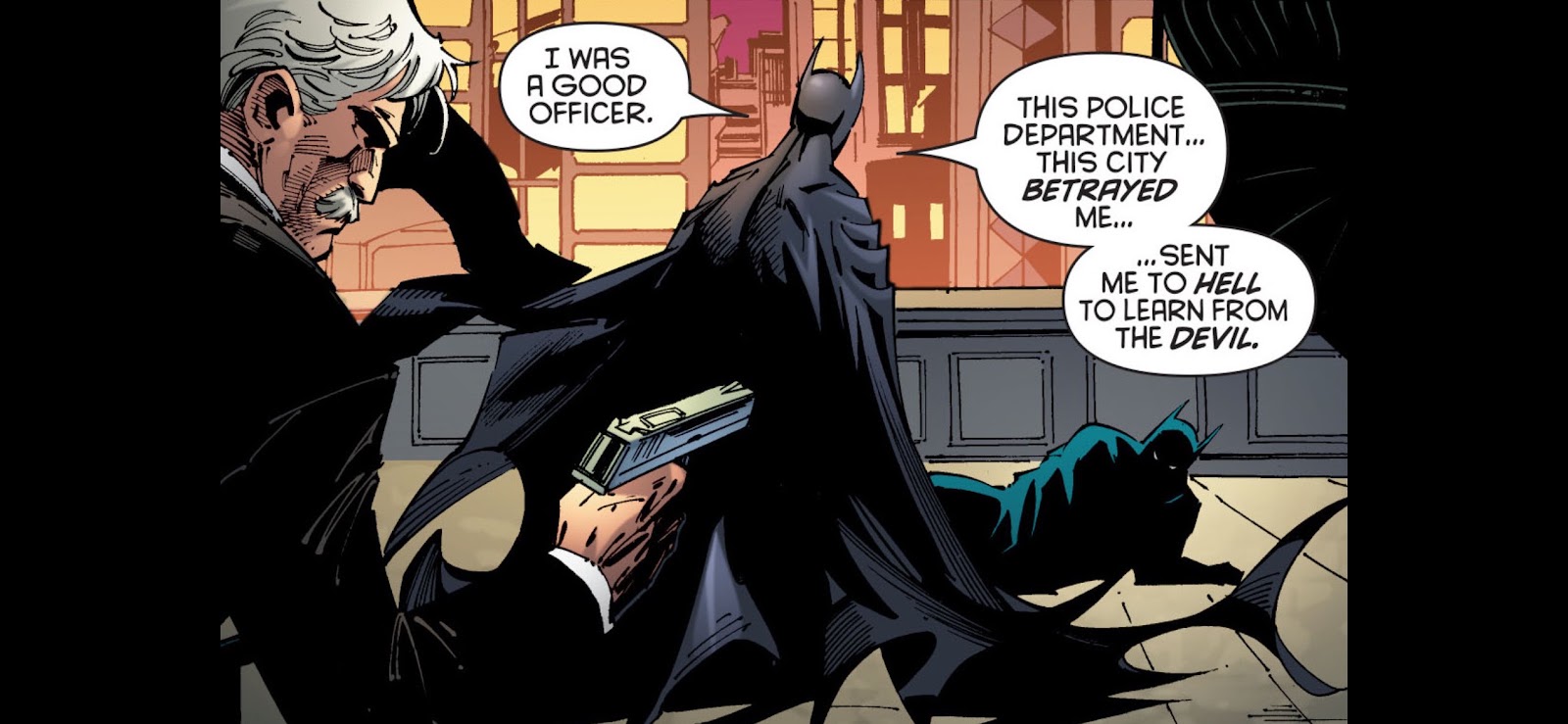
Batman: The Golden Age Batman used silver bullets to slay the vampire/werewolf hybrids the Monk and Dala as they slumbered in their coffins.
Doctor Strange:
Silver Dagger not only wields his namesake knives as weapons but also commands a group of zealot commandos armed with automatic weapons loaded with silver bullets.

In Doctor Strange: The Oath, Strange nearly loses his own life to a silver bullet, fired from the very pistol with which Hitler committed suicide. The shooter is a Muggle, but he theorized (correctly) that the combination of the two is enough bad mojo to get through Strange's magical protections.

The protagonist of Fiends of the Eastern Front made a whole belt of silver bullets to combine this trope with More Dakka to take on Constanta and his minions.
An issue of Planetary has a The Lone Ranger Expy who uses silver bullets to kill criminals who want the silver mine he owns. In an interesting twist, it's revealed that he tipped every bullet with mercury, a byproduct of silver mining, so that even if a shot is non-fatal (which many of them are), the victim will still die of mercury poisoning.
Scare Tactics (DC Comics): The Ketchum clan of werewolves have a stash of silver bullets just for those occasions their prey is on the supernatural side, their kin included. Silver weaponry in any form works well against such creatures as corroborated in "Undead—And Loving It!" where a silver spear is the only thing that can imprison and kill an incredibly powerful vampire.
Shazam!: In The Marvel Family #71 "The Mystery of Ghost Island", the Marvels find an ore of silver and proceed to forge weapons (a sword, a shield and many bullets) to fight a herd of monsters plaguing the titular island. Remarkably, the silver weapons destroy all monsters, regarding their nature: vampires, werewolves, ghouls, witches...
In the Solomon Kane comic book story "The Silver Beast of Tonkertown" (not based on one of Robert E. Howard's original stories), Kane melts down an inn's silverware to create a silver pistol ball which he uses to slay a werewolf that is terrorising the town.
In a Two-Gun Kid special, Two-Gun uses a silver bullet he obtained from "Kid Clayton" (a Lawyer-Friendly Cameo of The Lone Ranger) to kill a werewolf.
Subverted in a Wolverine annual that has Wolverine and Deadpool teamed up against a werewolf. After figuring out that adamantium doesn't work, Wolverine grabs Deadpool's swords and hacks away. That doesn't work either.
Wolverine: 'Pool, your swords?
Deadpool: What? Silver's expensive! Chrome looks just as good!
In World's Finest (1941) #214, the western-themed hero named the Vigilante uses a silver bullet to save Superman from a werewolf.


Averted, and mocked, in An American Werewolf in London: David, the eponymous werewolf, is advised by his undead victims to kill himself. When he asks, "Don't I need a silver bullet?", his dead best friend Jack replies, "Oh, be serious!"
In The Beast Must Die, Tom reveals to Pavel that her has had silver bullets made to hunt the werewolf. Exactly why he had the cases made of silver as well as the bullets is anyone's guess.
In the Blade Trilogy, Blade employs silver stakes as part of his vast vampire-killing arsenal. Downplayed slightly with his guns in that Blade himself mentions that the bullets aren't silver. He uses hollow point rounds filled with a mixture of silver nitrate and essence of garlic.
In The Breed (2001), vampires are sensitive to both silver and sunlight. Thus, cops expecting to deal with vampires carry not only silver bullets but also silver handcuffs and silver hand grenades.
In Brotherhood of the Wolf, Jean-François de Morangias uses a specially modified one-handed musket loaded with silver bullets as his signature weapon, for no apparent reason other than to show off. It's certainly not because he thinks the Beast of Gévaudan is a werewolf... And he really, really should have known better than to murder someone with them, especially after showing the victim's best friend the bullets a few days earlier.
Dr. Terror's House of Horrors: In "Werewolf", Dawson melts down a silver crucifix (which had itself had been made from the silver sword used to slay the werewolf 200 years earlier) and casts six silver bullets to slay the werewolf.
In Fright Night (2011), Amy tries using silver bullets against Jerry, who seems more amused than injured as he pulls the bullets out of his shoulder, chiding her: "Werewolves." She then throws a cupful of holy water in his face, responding in kind: "Vampires."
Hellboy (2004): Silver shavings are among the ingredients listed by Hellboy for the all-purpose paranormal monster-killing bullets he uses for the Samaritan revolver.
The Howling:
In The Howling (1981), silver bullets are the only kind that can permanently kill werewolves; regular bullets will incapacitate them, but they'll eventually recover. Chris gets his hands on a pre-made order of silver bullets and uses them to kill some members of the local werewolf colony and holds the others at gunpoint, forcing them into a barn he and Karen set alight to wipe them out though they don't get all of them. The werewolves initially don't take him seriously until they realise he does have genuine silver bullets.
The sequel Howling II: Stirba: Werewolf Bitch subverts the trope and reveals that while silver bullets work just fine against (relatively) young werewolves like the group in the first movie, with ancients like Stirba, they merely incapacitate the target for a while. The real metal of choice is titanium.
Juan of the Dead: While trying to figure out how to kill a reanimated neighbor, Lázaro suggests that they try shooting it with a silver bullet. Juan points out that they do not have a gun or any silver.
In The Legend of the Lone Ranger, the eponymous solitary range-rider uses silver bullets because they improve his aim.
In The Lone Ranger (2013), Tonto makes one for the Lone Ranger because he's superstitious (and insane) and believes the villain is a Wendigo. He probably isn't.
In Love at First Bite, Dr. Rosenberg tries to kill Dracula with silver bullets. Dracula then informs him that he's thinking of werewolves.
The Man with the Golden Gun has the eponymous villain equipped with a golden gun (assembled from ordinary-looking parts) which is then loaded with custom-caliber, gold bullets engraved with the name of their targets. Downplayed because the bullets have no supernatural powers — Scaramanga really is that good.
The Matrix Reloaded establishes that stories about werewolves, vampires, and UFOs are based on now-defunct programs trying to escape deletion. The Merovingian employs several of these programs as muscle.
Persephone: My husband saved them because they are notoriously difficult to terminate. How many people keep silver bullets in their gun? [BANG]
In The Monster Squad, one of the protagonists crafts silver bullets but neglects to bring a gun. Rudy, the oldest of the Squad, eventually has to use a gun from a fallen cop to deliver the fatal bullet to the Wolf Man. He most likely seats them into .38 cartridges with the intention of grabbing a dropped service revolver, as there are going to be plenty of those to go around once the cops show up. He belongs to a club formed around dealing with monsters, after all.
In My Best Friend is a Vampire, self-proclaimed vampire hunter Professor McCarthy tries to kill the centuries-old vampire Modoc with silver bullets; Modoc is completely unaffected by being shot, and informs the Professor that he's thinking of werewolves.
In Project: Metalbeast, silver bullets can kill werewolves, but this particular one happens to be cybernetically enhanced, so it requires a silver-tipped bazooka shell to kill it.
In Romasanta: The Werewolf Hunt, Antonio attempts to shoot Romasanta with a silver bullet, but Barbara spins and takes the bullet herself.
Silver Bullet is a 1985 film adaptation of Stephen King's Cycle of the Werewolf. It uses the bullet in same the way the book did. (see below)
Underworld: Vampires initially use traditional silver bullets against Lycans, but as the war escalates, they upgrade to bullets that release liquid silver nitrate into the bloodstream, killing them faster. In the prequel Underworld: Rise of the Lycans, they use swords and arrows either made or coated in silver. By the time of Underworld: Awakening, silver grenades and aerosol have been invented. In turn, the Lycans use some sort of UV tracer round against vampires that cooks them from the inside.
Silver is good against werewolves and vampires in Van Helsing, with silver bullets and stakes being employed against both.

Although Werewolf (1996) spends over 10 minutes going on and on about how the skeleton they discovered isn't of "your white man's movie monster werewolf" but a traditional Native American Skin Walker, when one of the characters turns into one, he's quickly killed with a silver bullet.

Crow: So... you've got Coors Light in your gun?

What kind of remake would The Wolfman (2010) be if it didn't have at least one silver bullet? Sir John Talbot has his Indian manservant keep a chest of silver shotgun shells in case he loses control of his lycanthropy. When his son steals a couple of shells and tries to shoot him, Sir John reveals that he removed the powder from the cartridges years ago. Unlike the original, the silver bullet is actually fired into a werewolf's body — though it's said that for this to work properly, the shooter has to be a loved one of the werewolf.


    Myths & Religion 
The Ur-Example is the from the hunting of the Beast of Gévaudan in 1760s France, a Real Life wolf (often regarded as a werewolf) that killed over a hundred people note  It was most likely not a single wolf who perpetrated the attacks, but a pack of them . While in reality it was probably poisoned, an Urban Legend circulated after its death that it was shot by a bullet melted from a silver chalice from a church. An Unbuilt Trope in that it was the holiness of the chalice that killed it, not the silver.
In Bulgaria, Serbia, and Romania, the descendants of Judas are regarded as vampires that can only be killed with silver weaponry, because Judas betrayed Jesus for 30 pieces of silver.
After the myth of the Wendigo became Hijacked by Jesus and European vampire/werewolf folklore, the process of killing one became elaborated from a simple Kill It with Fire to an elaborate quasi-ritual that extensively utilises this trope. The method became driving a Wooden Stake or silver blade into its heart, cutting out and smashing its frozen heart, placing the pieces in a silver box, and burying the box in a churchyard. Then you had to dismember it with a silver-plated axe, salt the pieces and burn them and scatter the ashes to the wind.
In Swedish turn of the century folklore, silver bullets were said to be able kill a variety of creatures, except werewolves! This being a country with a long history of werewolf-lore. Given that Our Werewolves Are Different, they could mostly be killed by conventional means or turned back into a human by uttering their true name.
"Magic bullets" are common in Swedish folklore — among other things, they are used against shapeshifters, against people who have been made "hard against shot" by sorcery, and against the animals "owned" by beings like SkogsrÃ¥et, a wood fairy. Lead taken from church windows is popular, but the most famous magic bullet of legend was the one who killed Charles XII; according to folklore (reality is of course different), he couldn't be shot with normal bullets, but the one that killed him was made from a button from his own coat.


During the 18th-century hunt for the Beast Of Gévaudan, Jean Chastel reportedly loaded his gun with silver bullets. However, in this case the bullets were not 'special' because they were made of silver, but because the silver was obtained from a blessed medallion of the Virgin Mary (the creature was thought to be demonic in nature).
Silver has a density of 10.5 grams per cubic centimeter. Lead has a density of 11.3 g/cm3. In the ballistics game, higher density means better performance, which is why bullets are still made out of lead, though price is certainly a factor as well. Uranium, it should be noted, has a density of 19 g/cm3, which is why anti-tank rounds are made of the stuff.
Book author's husband researches making silver bullets. It's not as straightforward as casting bullets from lead. Silver melts at 1761°F (versus 621°F for lead), this makes just melting it a problem for home-made bullets. And silver has a different coefficient of expansion, and the hardness difference means the bullet has to be crafted more precisely. And silver jewelry and coins are made with silver alloys that are harder still. The bottom line is that silver bullets aren't something even someone who home loads can make in a hurry, from materials at hand; they take planning and preparation. Lousy werewolves have thought of everything.
During the 17th Century, many people believed that only a silver bullet could kill a king.
Count Jan Potocki, a Polish Gentleman Adventurer and author of The Manuscript Found In Saragossa, allegedly killed himself with a silver bullet made from the knob of his mother's sugar bowl and blessed by the castle priest.
For over a century it was common in parts of Russia to use low purity silver as bullets (and more commonly shot for blunderbusses since the metal was not worth refining at the time and so abundant a byproduct that it was cheaper than lead. Unfortunately high-quality platinum ore has similar properties, so many of these were actually very pure platinum bullets.
Some American pioneers made their own powder and shot. The native lead ore contained silver. This may be the origin of the Lone Ranger's ammo. Or not.
Some bullion dealers offer silver cast in various ammunition sizes. Ranging from as small as a .45 ACP (which weighs 1 troy ounce) to as big as a 30 mm shell (which weighs 100 troy ounces). However, in contrast to the above examples, these bullets and shells are solid silver the whole way through, and while they can certainly be loaded into a firearm, they don't have any propellant and thus will not work as ammo.
This trope can be seen being crossed over with Bling-Bling-BANG!, then taken to its logical extreme by YouTuber CodysLab in this video, in which an ounce of gold is melted down, cast into a working bullet and fired! As gold is twice the density of lead and is significantly harder, the physics involved are noticeably different, but at close range, you could certainly do some damage with it.
Aluminum cased and jacketed ammunition certainly looks the part as the aluminum is usually polished to ease extraction. Some brands are marketed like this.
In dire straits and when ball ammunition ran out, old-time cannons could be loaded with any old bits of metal lying around, up to and including tableware. (Although presumably you'd rather fire off your pewter and steel forks and spoons before resorting to the silver ones.)

Saturday, 22 February 2025

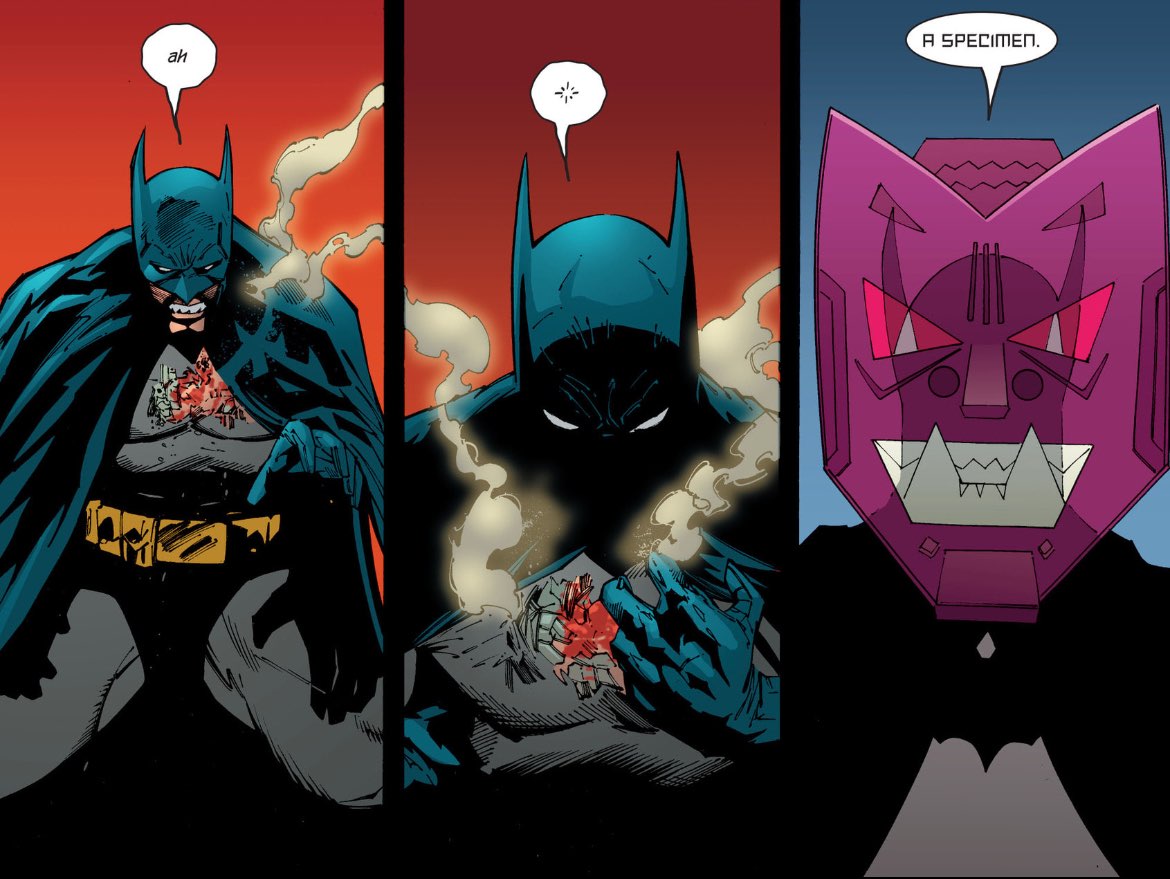
The Specimen


Let me make you a bundle


The Smithsonian’s National Museum of Natural History had been closed for hours, but Crawford had called ahead and a guard waited to let Clarice Starling in the Constitution Avenue entrance. The lights were dimmed in the closed museum and the air was still. Only the colossal figure of a South Seas chieftain facing the entrance stood tall enough for the weak ceiling light to shine on his face. 


Starling’s guide was a big black man in the neat turnout of the Smithsonian guards. She thought he resembled the chieftain as he raised his face to the elevator lights. There was a moment’s relief in her idle fancy, like rubbing a cramp. The second level above the great stuffed elephant, a vast floor closed to the public, is shared by the departments of Anthropology and Entomology. The anthropologists call it the fourth floor. The entomologists contend it is the third. A few scientists from Agriculture say they have proof that it is the sixth. Each faction has a case in the old building with its additions and subdivisions. 


Starling followed the guard into a dim maze of corridors walled high with wooden cases of anthropological specimens. Only the small labels revealed their contents. 


Thousands of people in these boxes,” the guard said. “Forty thousand specimens.” 


He found office numbers with his flashlight and trailed the light over the labels as they went along. Dyak baby carriers and ceremonial skulls gave way to Aphids, and they left Man for the older and more orderly world of Insects. Now the corridor was walled with big metal boxes painted pale green. 


“Thirty million insects—and the spiders on top of that. Don’t lump the spiders in with the insects,” the guard advised. “Spider people jump all over you about that. There, the office that’s lit. Don’t try to come out by yourself. If they don’t say they’ll bring you down, call me at this extension, it’s the guard office. I’ll come get you.” He gave her a card and left her. 


She was in the heart of Entomology, on a rotunda gallery high above the great stuffed elephant. There was the office with the lights on and the door open. 


“Time, Pilch!” A man’s voice, shrill with excitement. “Let’s go here. Time!” 


Starling stopped in the doorway. Two men sat at a laboratory table playing chess. Both were about thirty, one black-haired and lean, the other pudgy with wiry red hair. They appeared to be engrossed in the chessboard. If they noticed Starling, they gave no sign. If they noticed the enormous rhinoceros beetle slowly making its way across the board, weaving among the chessmen, they gave no sign of that either. Then the beetle crossed the edge of the board. 


“Time, Roden,” the lean one said instantly. The pudgy one moved his bishop and immediately turned the beetle around and started it trudging back the other way. 


If the beetle just cuts across the corner, is time up then?” Starling asked. 


Of course time’s up then,” the pudgy one said loudly, without looking up. “Of course it’s up then. How do you play? Do you make him cross the whole board? Who do you play against, a sloth?” 


“I have The Specimen Special Agent Crawford called about.” 


“I can’t imagine why we didn’t hear your siren,” the pudgy one said. “We’re waiting all night here to identify a bug for the FBI. Bugs’re all we do. Nobody said anything about Special Agent Crawford’s specimen. He should show his specimen privately to his family doctor. Time, Pilch!” 


“I’d love to catch your whole routine another time,” Starling said, “but this is urgent, so let’s do it now. Time, Pilch.” 


The black-haired one looked around at her, saw her leaning against the doorframe with her briefcase. He put the beetle on some rotten wood in a box and covered it with a lettuce leaf. When he got up, he was tall. “I’m Noble Pilcher,” he said. “That’s Albert Roden. You need an insect identified? We’re happy to help you.” Pilcher had a long friendly face, but his black eyes were a little witchy and too close together, and one of them had a slight cast that made it catch the light independently. He did not offer to shake hands. “You are …?” 


Clarice Starling.” 


“Let’s see what you’ve got.” Pilcher held the small jar to the light. 


Roden came to look. “Where did you find it? Did you kill it with your gun? Did you see its mommy?” It occurred to Starling how much Roden would benefit from an elbow smash in the hinge of his jaw. 


Shhh,” Pilcher said. “Tell us where you found it. Was it attached to anything — a twig or a leaf — or was it in the soil?” 


“I see,” Starling said. “Nobody’s talked to you.” 


“The Chairman asked us to stay late and identify a bug for the FBI,” Pilcher said. 


Told us,” Roden said. “Told us to stay late.” 


“We do it all the time for Customs and the Department of Agriculture,” Pilcher said. 


But not in the middle of the night,” Roden said. 


I need to tell you a couple of things involving a criminal case,” Starling said. “I’m allowed to do that if you’ll keep it in confidence until the case is resolved. It’s important. It means some lives, and I’m not just saying that. Dr Roden, can you tell me seriously that you’ll respect a confidence?” 


“I’m not a doctor. Do I have to sign anything?” 


“Not if your word’s any good. You’ll have to sign for the specimen if you need to keep it, that’s all.” 


“Of course I’ll help you. I’m not uncaring.” 


“Dr Pilcher?” 


“That’s true,” Pilcher said. “He’s not uncaring.” 


Confidence?” 


I won’t tell.” 


“Pilch isn’t a doctor yet either,” Roden said. “We’re on an equal educational footing. But notice how he allowed you to call him that.” 


Roden placed the tip of his forefinger against his chin, as though pointing to his judicious expression. “Give us all the details. What might seem irrelevant to you could be vital information to an expert.” 


This insect was found lodged behind the soft palate of a murder victim. I don’t know how it got there. Her body was in the Elk River in West Virginia, and she hadn’t been dead more than a few days.” 


“It’s Buffalo Bill, I heard it on the radio,” Roden said. 


“You didn’t hear about the insect on the radio, did you?” Starling said. 


“No, but they said Elk River — are you coming in from that today, is that why you’re so late?” 


Yes,” Starling said. 


You must be tired, do you want some coffee?” Roden said. 


“No, thank you.” 


Water?” 


“No.” 


A Coke?” 


“I don’t believe so. We want to know where this woman was held captive and where she was killed. We’re hoping this bug has some specialised habitat, or it’s limited in range, you know, or it only sleeps on some kind of  treewe want to know where this insect is from. I’m asking for your confidence because — if The Perpetrator put the insect there deliberately — then only he would know that fact and we could use it to eliminate false confessions and save time. He’s killed six at least. Time’s eating us up.” 


Do you think he’s holding another woman right this minute, while we’re looking at his bug?” Roden asked in her face. His eyes were wide and his mouth open. She could see into his mouth, and she flashed for a second on something else. “I don’t know.” A little shrill, that. 


I don’t know,” she said again, to take the edge off it. “He’ll do it again as soon as he can.” 


“So we’ll do this as soon as we can,” Pilcher said. “Don’t worry, we’re good at this. You couldn’t be in better hands.” He removed the brown object from the jar with a slender forceps and placed it on a sheet of white paper beneath the light. He swung a magnifying glass on a flexible arm over it. 


The insect was long and it looked like a mummy. It was sheathed in a semitransparent cover that followed its general outlines like a sarcophagus. The appendages were bound so tightly against the body, they might have been carved in low relief. The little face looked wise. 


In the first place, it’s not anything that would normally infest a body outdoors, and it wouldn’t be in the water except by accident,” Pilcher said. “I don’t know how familiar you are with insects or how much you want to hear.” 


“Let’s say I don’t know diddly. I want you to tell me the whole thing.” 


“Okay, this is a pupa, an immature insect, in a chrysalis — that’s the cocoon that holds it while it transforms itself from a larva into an adult,” Pilcher said. 


Obtect pupa, Pilch?” Roden wrinkled his nose to hold his glasses up. 


“Yeah, I think so. You want to pull down Chu on the immature insects? Okay, this is the pupal stage of a large insect. Most of the more advanced insects have a pupal stage. A lot of them spend the winter this way.” 


“Book or look, Pilch?” Roden said. 


“I’ll look.” Pilcher moved the specimen to the stage of a microscope and hunched over it with a dental probe in his hand. “Here we go : No distinct respiratory organs on the dorsocephalic region, spiracles on the mesothorax and some abdominals, let’s start with that.” 


“Ummhumm,” Roden said, turning pages in a small manual. “Functional mandibles?


 “Nope.” 


Paired galeae of maxillae on the ventro meson?” 


“Yep, yep.” 


“Where are the antennae?” 


“Adjacent to the mesal margin of the wings. Two pairs of wings, the inside pair are completely covered up. Only the bottom three abdominal segments are free. Little pointy cremaster — I’d say Lepidoptera.” 


That’s what it says here,” Roden said. “It’s the family that includes the butterflies and moths. Covers a lot of territory,” Pilcher said. 


“It’s gonna be tough if the wings are soaked. I’ll pull the references,” Roden said. “I guess there’s no way I can keep you from talking about me while I’m gone.” 


“I guess not,” Pilcher said. 


Roden’s all right,” he told Starling as soon as Roden left the room. 


“I’m sure he is.” 


Are you now?” Pilcher seemed amused. “We were undergraduates together, working and glomming any kind of fellowship we could. He got one where he had to sit down in a coal mine waiting for proton decay. He just stayed in the dark too long. He’s all right. Just don’t mention proton decay.” 


“I’ll try to talk around it.” 


Pilcher turned away from the bright light. “It’s a big family, Lepidoptera. Maybe thirty thousand butterflies and a hundred thirty thousand moths. I’d like to take it out of the chrysalis — I’ll have to if we’re going to narrow it down.” 


“Okay. Can you do it in one piece?” 


“I think so. See, this one had started out on its own power before it died. It had started an irregular fracture in the chrysalis right here. This may take a little while.” Pilcher spread the natural split in the case and eased the insect out. The bunched wings were soaked. Spreading them was like working with a wet, wadded facial tissue. No pattern was visible. 


Roden was back with the books. “Ready?” Pilcher said. “Okay, the prothoracic femur is concealed.” 


“What about pilifers?” 


No pilifers,” Pilcher said. 


“Would you turn out the light, Officer Starling?” She waited by the wall switch until Pilcher’s penlight came on. He stood back from the table and shined it on The Specimen. The insect’s eyes glowed in the dark, reflecting the narrow beam. 


Owlet,” Roden said. 


Probably, but which one?” Pilcher said. “Give us the lights, please. It’s a Noctuid, Officer Starling — a night moth. How many Noctuids are there, Roden?” 


“Twenty-six hundred and … about twenty-six hundred have been described.” 


“Not many this big, though. Okay, let’s see you shine, my man.” 


Roden’s wiry red head covered the microscope. 


“We have to go to chaetaxy now — studying the skin of the insect to narrow it down to one species,” Pilcher said. “Roden’s the best at it.” 


Starling had the sense that a kindness had passed in the room. Roden responded by starting a fierce argument with Pilcher over whether the specimen’s larval warts were arranged in circles or not. It raged on through the arrangement of the hairs on the abdomen. 


Erebus odora,” Roden said at last. 


Let’s go look,” Pilcher said. 


They took The Specimen with them, down in the elevator to the level just above the great stuffed elephant and back into an enormous quad filled with pale green boxes. What was formerly a great hall had been split into two levels with decks to provide more storage for the Smithsonian’s insects. They were in Neo-tropical now, moving into Noctuids. 


Pilcher consulted his notepad and stopped at a box chest-high in the great wall stack. “You have to be careful with these things,” he said, sliding the heavy metal door off the box and setting it on the floor. “You drop one on your foot and you hop for weeks.” He ran his finger down the stacked drawers, selected one, and pulled it out. In the tray Starling saw the tiny preserved eggs, the caterpillar in a tube of alcohol, a cocoon peeled away from a specimen very similar to hers, and the adult — a big brown-black moth with a wingspan of nearly six inches, a furry body, and slender antennae. 


“Erebus odora,” Pilcher said. “The Black Witch Moth.” 


Roden was already turning pages. “‘A tropical species sometimes straying up to Canada in the fall,’” he read. “‘The larvae eat acacia, catclaw, and similar plants. Indigenous West Indies, Southern US, considered a pest in Hawaii.’” 


Fuckola, Starling thought. 

Nuts,” she said aloud. “They’re all over.” 


“But they’re not all over all the time.” Pilcher’s head was down. 

He pulled at his chin. “Do they double-brood, Roden?” 


“Wait a second … yeah, in extreme south Florida and south Texas.” 


When?” 


May and August.” 


I was just thinking,” Pilcher said. “Your specimen’s a little better developed than the one we have, and it’s fresh. It had started fracturing its cocoon to come out. In the West Indies or Hawaii, maybe, I could understand it, but it’s winter here. In this country it would wait three months to come out. Unless it happened accidentally in a greenhouse, or somebody raised it.” 


“Raised it how?” 


In a cage, in a warm place, with some acacia leaves for the larvae to eat until they’re ready to button up in their cocoons. It’s not hard to do.” 


“Is it a popular hobby? Outside professional study, do a lot of people do it?” 


No, primarily it’s entomologists trying to get a perfect specimen, maybe a few collectors. There’s the silk industry too, they raise moths, but not this kind.” 


Entomologists must have periodicals, professional journals, people that sell equipment,” Starling said. 


“Sure, and most of the publications come here.” 


Let me make you a bundle,” Roden said. “A couple of people here subscribe privately to the smaller newsletters — keep ’em locked up and make you give them a quarter just to look at the stupid things. I’ll have to get those in the morning.” 


“I’ll see they’re picked up, thank you, Mr Roden.” 


Pilcher photocopied the references on Erebus odora and gave them to her, along with the insect. 


“I’ll take you down,” he said. 

They waited for the elevator. 


Most people love butterflies and hate moths,” he said. “But moths are more — interesting, engaging.” 


“They’re destructive.” 


Some are, a lot are, but they live in all kinds of ways. Just like we do.” Silence for one floor. “There’s a moth, more than one in fact, that lives only on tears,” he offered. “That’s all they eat or drink.” 


“What kind of tears? Whose tears?” 


The tears of large land mammals, about our size. The old definition of moth was ‘anything that gradually, silently eats, consumes, or wastes any other thing.’ It was a verb for destruction too … Is this what you do all the time — hunt Buffalo Bill?” 


“I do it all I can.” 


Pilcher polished his teeth, his tongue moving behind his lips like a cat beneath the covers. “Do you ever go out for cheeseburgers and beer or the amusing house wine?” 


“Not lately.”


“Will you go for some with me now? It’s not far.” 


“No, but I’ll treat when this is over — and Mr Roden can go too, naturally.” 


There’s nothing natural about that,” Pilcher said. And at the door, “I hope you’re through with this soon, Officer Starling.” 


She hurried to the waiting car. Ardelia Mapp had left Starling’s mail and half a Mounds candy bar on her bed. Mapp was asleep. Starling carried her portable typewriter down to the laundry room, put it on the clothes-folding shelf and cranked in a carbon set. She had organised her notes on Erebus odora in her head on the ride back to Quantico, and she covered that quickly. 


Then she ate the Mounds and wrote a memo to Crawford suggesting they cross-check the entomology publications’ computerised mailing lists against The FBI’s known-offender files and the files in the cities closest to the abductions, plus felon and sex-offender files of Metro Dade, San Antonio, and Houston, the areas where the moths were most plentiful. 


There was another thing, too, that she had to bring up for a second time : Let’s ask Dr Lecter why he thought the perpetrator would start taking scalps. She delivered the paper to the night duty officer and fell into her grateful bed, the voices of the day still whispering, softer than Mapp’s breathing across the room. On the swarming dark she saw the moth’s wise little face. Those glowing eyes had looked at Buffalo Bill. 


Out of the cosmic hangover the Smithsonian leaves came her last thought and a coda for her day : 

Over this odd world, this half of the world that’s dark now, I have to hunt a thing that lives on tears.


CHAPTER 59 


Jame Gumb was news for weeks after he was lowered into his final hole. 


Reporters pieced together his history, beginning with the records of Sacramento County : His mother had been carrying him a month when she failed to place in the Miss Sacramento Contest in 1948. The “Jame” on his birth certificate apparently was a clerical error that no one bothered to correct. When her acting career failed to materialise, his mother went into an alcoholic decline; Gumb was two when Los Angeles County placed him in a foster home. 


At least two scholarly journals explained that this unhappy childhood was the reason he killed women in his basement for their skins. 

The words crazy and evil do not appear in either article. 


The film of the beauty contest that Jame Gumb watched as an adult was real footage of his mother, but the woman in the swimming pool film was not his mother, comparative measurements revealed. 


Gumb’s grandparents retrieved him from an unsatisfactory foster home when he was ten, and he killed them two years later. Tulare Vocational Rehabilitation taught Gumb to be a tailor during his years at the psychiatric hospital. He demonstrated definite aptitude for the work. 


Gumb’s employment record is broken and incomplete. Reporters found at least two restaurants where he worked off the books, and he worked sporadically in the clothing business. It has not been proven that he killed during this period, but Benjamin Raspail said he did. He was working at the curio store where the butterfly ornaments were made when he met Raspail, and he lived off the musician for some time. It was then that Gumb became obsessed with moths and butterflies and the changes they go through. 


After Raspail left him, Gumb killed Raspail’s next lover, Klaus, beheaded and partially flayed him. Later he dropped in on Raspail in The East. Raspail, ever thrilled by bad boys, introduced him to Dr Lecter. This was proven in the week after Gumb’s death when the FBI seized from Raspail’s next of kin the tapes of Raspail’s therapy sessions with Dr Lecter. 


Years ago, when Dr Lecter was declared insane, the therapy-session tapes had been turned over to the families of the victims to be destroyed. But Raspail’s wrangling relatives kept the tapes, hoping to use them to attack Raspail’s will. They had lost interest listening to the early tapes, which are only Raspail’s boring reminiscences of school life. 


After the news coverage of Jame Gumb, the Raspail family listened to the rest. When the relatives called the lawyer Everett Yow and threatened to use the tapes in a renewed assault on Raspail’s will, Yow called Clarice Starling. The tapes include the final session, when Lecter killed Raspail. More important, they reveal how much Raspail told Lecter about Jame Gumb : Raspail told Dr Lecter that Gumb was obsessed with moths, that he had flayed people in the past, that he had killed Klaus, that he had a job with the Mr Hide leather-goods company in Calumet City, but was taking money from an old lady in Belvedere, Ohio, who had made linings for Mr Hide, Inc. One day Gumb would take everything the old lady had, Raspail predicted. 


“When Lecter read that the first victim was from Belvedere and she was flayed, he knew who was doing it,” Crawford told Starling as they listened together to the tape. “He’d have given you Gumb and looked like a genius if Chilton had stayed out of it.” 


“He hinted to me by writing in the file that the sites were too random,” Starling said. “And in Memphis he asked me if I sew. What did he want to happen?” 


“He wanted to amuse himself,” Crawford said. “He’s been amusing himself for a long, long time.” No tape of Jame Gumb was ever found, and his activities in the years after Raspail’s death were established piecemeal through business correspondence, gas receipts, interviews with boutique owners. When Mrs Lippman died on a trip to Florida with Gumb, he inherited everything—the old building with its living quarters and empty storefront and vast basement, and a comfortable amount of money. He stopped working for Mr Hide, but maintained an apartment in Calumet City for a while, and used the business address to receive packages in the John Grant name. He kept favored customers, and continued to travel to boutiques around the country, as he had for Mr Hide, measuring for custom garments he made in Belvedere. He used his trips to scout for victims and to dump them when they were used up—the brown van droning for hours on the Interstate with finished leather garments swaying on racks in the back above the rubberized body bag on the floor. He had the wonderful freedom of the basement. Room to work and play. At first it was only games—hunting young women through the black warren, creating amusing tableaux in remote rooms and sealing them up, opening the doors again only to throw in a little lime. 


Fredrica Bimmel began to help Mrs Lippman in the last year of the old lady’s life. Fredrica was picking up sewing at Mrs Lippman’s when she met Jame Gumb. Fredrica Bimmel was not the first young woman he killed, but she was the first one he killed for her skin. Fredrica Bimmel’s letters to Gumb were found among his things. Starling could hardly read the letters, because of the hope in them, because of the dreadful need in them, because of the endearments from Gumb that were implied in her responses: “Dearest Secret Friend in my Breast, I love you!—I didn’t ever think I’d get to say that, and it is best of all to get to say it back.” 


When did he reveal himself? Had she discovered the basement? How did her face look when he changed, how long did he keep her alive? Worst, Fredrica and Gumb truly were friends to the last; she wrote him a note from the pit. The tabloids changed Gumb’s nickname to Mr Hide and, sick because they hadn’t thought of the name themselves, virtually started over with the story. 


Safe in the heart of Quantico, Starling did not have to deal with the press, but the tabloid press dealt with her. From Dr Frederick Chilton, the National Tattler bought the tapes of Starling’s interview with Dr Hannibal Lecter. The Tattler expanded on their conversations for their “Bride of Dracula” series and implied that Starling had made frank sexual revelations to Lecter in exchange for information, spurning an offer to Starling from Velvet Talks : The Journal of Telephone Sex. People magazine did a short, pleasant item on Starling, using yearbook pictures from the University of Virginia and from the Lutheran Home at Bozeman. The best picture was of the horse, Hannah, in her later years, drawing a cart full of children. Starling cut out the picture of Hannah and put it in her wallet. It was the only thing she saved. 


She was healing.