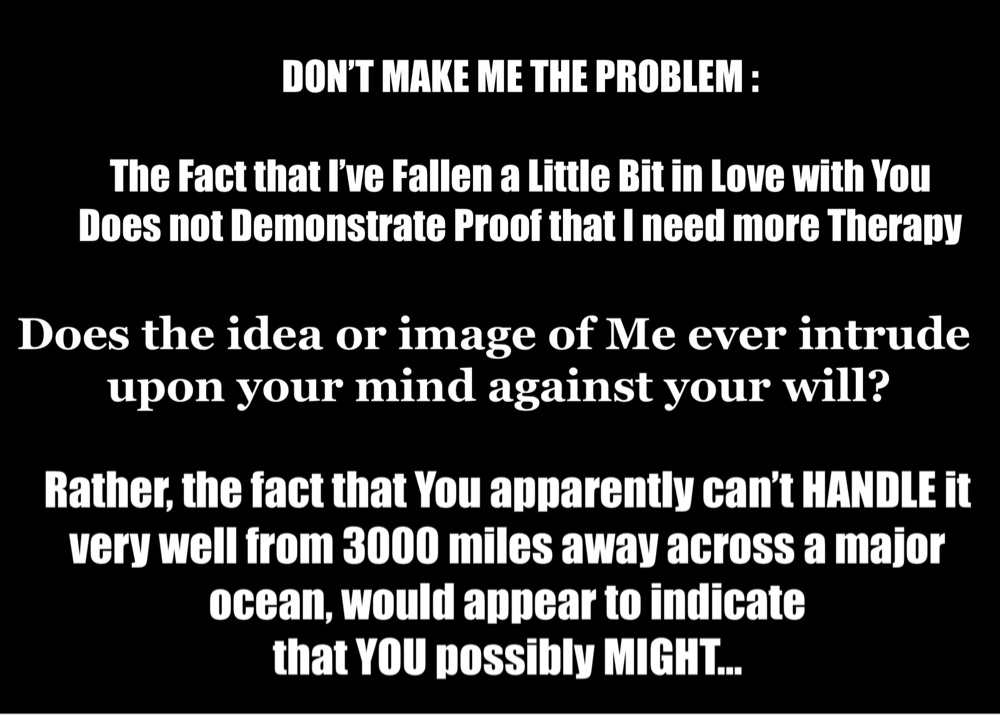
Does the idea or image of Me ever intrude upon your mind against your will?
10 entries found.
obsession (n.)
1510s, "action of besieging" (a sense now obsolete), from French obsession and directly from Latin obsessionem (nominative obsessio) "siege, blockade, a blocking up," noun of action from past-participle stem of obsidere "to besiege" (see obsess). Later (c. 1600), "hostile action of an evil spirit" (like possession but without the spirit actually inhabiting the body). Transferred sense of "action of anything which engrosses the mind" is from 1670s. Psychological sense "idea or image that intrudes on the mind of a person against his will" is from 1901.
obsessive (adj.)
"of or pertaining to obsession; liable to obsess," 1911, from obsess + -ive. As a noun, "person characterized by obsession," by 1966. Related: Obsessively. Obsessive-compulsive "combining (psychological) obsessions and compulsions" is attested from 1927.
obsess (v.)
c. 1500, "to besiege" (a sense now obsolete), from Latin obsessus, past participle of obsidere "watch closely; besiege, occupy; stay, remain, abide" literally "sit opposite to," from ob "against" (see ob-) + sedere "to sit" (from PIE root *sed- (1) "to sit").
In reference to evil spirits, "to haunt," from 1530s. The psychological sense of "to haunt as a fixed idea" developed gradually from 1880s and emerged 20c. The 1895 Century Dictionary has only the two senses "besiege" (marked obsolete) and "to attack, vex, or plague from without." Related: Obsessed; obsessing.
obsessed(adj.)
mid-15c., obcessed, "tormented, obsessed," past-participle adjective from obsess. Originally especially "possessed" by a devil or fiend.
Related entries & more
grubelsucht(n.)
1876, from German Grübelsucht, psychiatric term for "a form of obsession in which even the simplest facts are compulsively queried" [OED], from grübeln "to brood" (see grub (v.)) + sucht "mania."
Related entries & more
localitis(n.)
"obsession with the problems of one's locality and consequent failure to see big pictures," 1943, U.S. World War II jargon, originally of military strategists, from local (adj.) + transferred use of medical suffix -itis.
Related entries & more
haunt(v.)
early 13c., "to practice habitually, busy oneself with, take part in," from Old French hanter "to frequent, visit regularly; have to do with, be familiar with; indulge in, cultivate" (12c.), of uncertain origin, perhaps from Old Norse heimta "bring home," from Proto-Germanic *haimatjanan "to go or bring home," from *haimaz- "home" (from PIE root *tkei- "to settle, dwell, be home").
The meaning "frequent" (a place) is attested from c. 1300 in English. In Middle English to haunte scole was "attend school."
Use of the verb in reference to a spirit or ghost returning to the house where it had lived is in Shakespeare's plays (1590 in "A Midsummer Night's Dream"). Old French had a noun derivative, hantise "obsession, obsessive fear" (14c.), and use in reference to returning ghosts perhaps is as old as Proto-Germanic word, but if so it was lost or buried.
In Middle English as in Old French the verb also had a secondary sense of "have sexual intercourse with."
Related entries & more
consider(v.)
late 14c., consideren, "to fix the mind upon for careful examination, meditate upon," also "view attentively, scrutinize; not to be negligent of," from Old French considerer (13c.) "reflect on, consider, study," from Latin considerare "to look at closely, observe," probably literally "to observe the stars," from assimilated form of com "with, together" (see con-) + sidus (genitive sideris) "heavenly body, star, constellation" (see sidereal).
Perhaps a metaphor from navigation, or perhaps reflecting Roman obsession with divination by astrology. Compare desire (v.), from Latin desiderare "long for, wish for; demand, expect," the original sense perhaps being "await what the stars will bring."
De Vaan considers various alternative etymologies for the Latin verb but endorses none. In 20c. Tucker doubted the connection with sidus, because it is "quite inapplicable to desiderare," and suggests derivation instead from the PIE root of English side meaning "stretch, extend," and a sense for the full word of "survey on all sides" or "dwell long upon."
It is attested from 1530s as "to regard in a particular light." Related: Considered; considering.
football(n.)
also foot-ball, any open-air game involving kicking a ball, c. 1400; in reference to the inflated ball used in the game, mid-14c. ("Þe heued fro þe body went, Als it were a foteballe," Octavian I manuscript), from foot (n.) + ball (n.1).
Forbidden in a Scottish statute of 1424. One of Shakespeare's insults is "you base foot-ball player" [Lear I.iv]. Ball-kicking games date back to the Roman legions, at least, but the sport seems first to have risen to a national obsession in England, c. 1630. Figurative sense of "something idly kicked around, something subject to hard use and many vicissitudes" is by 1530s.
Rules of the game first regularized at Cambridge, 1848; soccer (q.v.) split off in 1863. The U.S. style (known to some in England as "stop-start rugby with padding") evolved gradually 19c.; the first true collegiate game is considered to have been played Nov. 6, 1869, between Princeton and Rutgers, at Rutgers, but the rules there were more like soccer. A rematch at Princeton Nov. 13, with the home team's rules, was true U.S. football. Both were described as foot-ball at Princeton.
Then twenty-five of the best players in college were sent up to Brunswick to combat with the Rutgers boys. Their peculiar way of playing this game proved to Princeton an insurmountable difficulty; .... Two weeks later Rutgers sent down the same twenty-five, and on the Princeton grounds, November 13th, Nassau played her game; the result was joyous, and entirely obliterated the stigma of the previous defeat. ["Typical Forms of '71" by the Princeton University Class of '72, 1869]
loner(n.)
"one who avoids Company," 1946; see lone. Apparently first in U.S. baseball slang :
Ted [Williams] is likable enough in spite of his obsession with his specialty. He is something of a "loner," and he refuses to pal around with his teammates in off hours, but in the clubhouse he does his share of the talking. [Life magazine, Sept. 23, 1946]
Related entries & more
 |

No comments:
Post a Comment