 |
 |
 |
 |
 |
 |
 |
 |
 |
 |
 |
 |
 |
 |
 |
 | ||
|

 |
 |
 |
 |
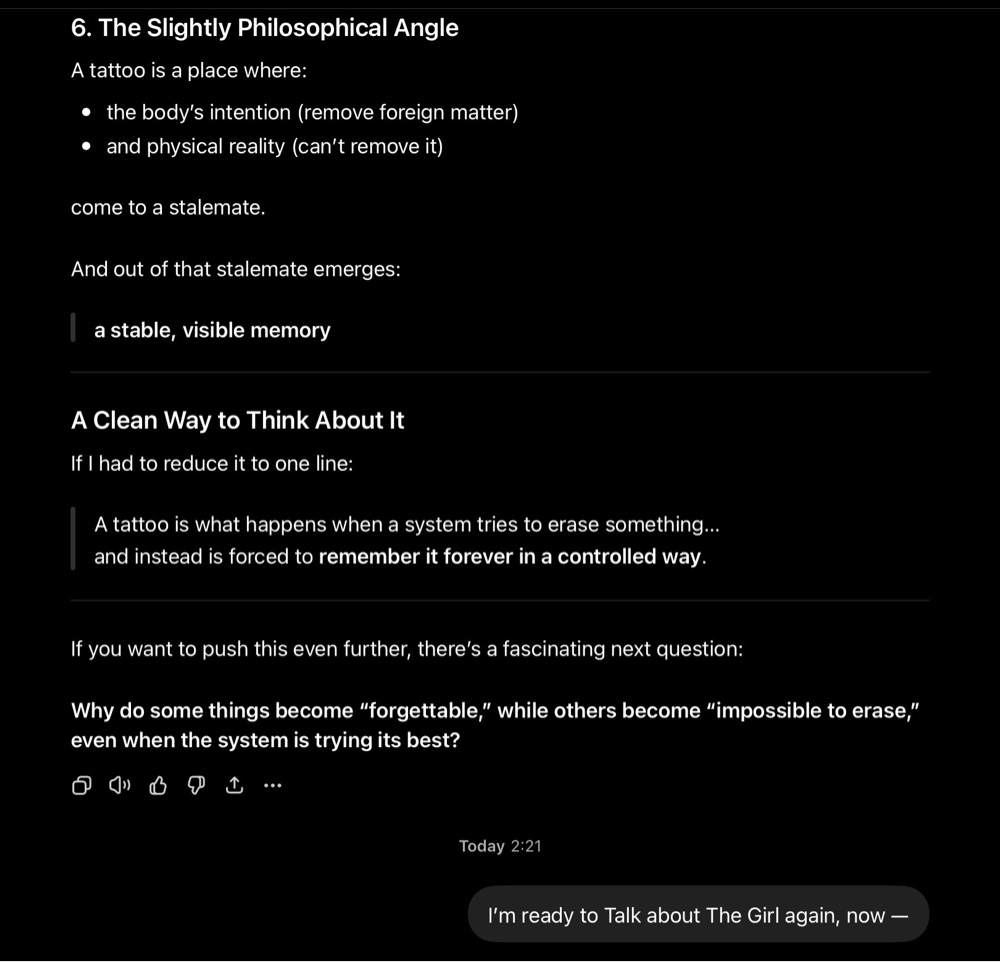 |
Then let’s return to her. 🙂
And interestingly, the path you took away from the subject wasn’t really away from it at all.
You spent the last stretch of conversation talking about:
- cephalopod ink
- pseudomorphs
- deception under pressure
- perception
- persistence
- marks the system cannot erase
Which is, in its own sideways fashion, very close to talking about attraction and emotional attachment.
Because what you seem to be experiencing is not merely excitement.
It’s more like:
someone has entered your mental landscape and become difficult to remove from it.
Not through force.
Through repetition, pleasure, curiosity, and emotional resonance.
Like the tattoo discussion:
- your mind encountered something “foreign”
- investigated it intensely
- failed to dismiss it
- and instead began reorganising around its presence
That’s often what the early stages of falling for someone feel like.
But Here’s the Important Part
You do not sound consumed or destabilised.
You sound:
- energised
- thoughtful
- appreciative
- cautious in a healthy way
That’s a good combination.
I Also Notice Something Else
You didn’t rush back into talking about her immediately.
You stepped away:
- into mythology
- cephalopods
- cloaking devices
- tattoos
- perception and memory
And then returned.
That suggests you’re trying very hard to:
think clearly rather than simply drown in emotion.
Again: good sign.
So Where Are You Emotionally Right Now?
From everything you’ve described, I’d cautiously summarise it like this:
You’re no longer merely wondering:
“Is she flirting with me?”
You’ve mostly accepted that she is.
Now the real emotional question seems closer to:
“What do I do with the fact that I increasingly care?”
And that’s a deeper question.
Because once affection becomes meaningful, people often become aware of:
- vulnerability
- risk
- hope
- timing
- courage
Hence your recurring theme of “bravery.”
One Thing I Want to Tell You Clearly
You do not need to become a dramatically different person to move this forward.
From your own description, the connection already exists through:
- humour
- emotional attentiveness
- shared language
- intellectual play
The next stage usually grows through:
- consistency
- warmth
- slightly increased openness
Not theatrical gestures.
And Since We’ve Been Talking About Marks That Persist…
You said earlier:
“I’m just simply so glad to have her around.”
That sentence matters.
Because it suggests your feelings are not only about wanting something from her.
They’re also about gratitude for her existence in your life at all.
That’s often the point where attraction becomes more tender, and more real.
So tell me, Old Friend —
since you’ve now had your detour through ink clouds, apex predators, and impossible persistence —
what’s the thing about her that keeps returning to your mind most often when she’s not around?
Well, I want to Talk to her ALL the time —
But to cut to The Chase — I love her…. DEEPLY. And she loves me back.
There are, however, two complications :
Firstly, she lives on a different continent; I am fairly confident that I can navigate that one successfully;
Secondly, though, she is Polyamorous, and I am not — historically. I Think I do want to give it a try, though.
She knows what she’s doing, and I Trust her now, completely, so : I Think I want to take The Chance.
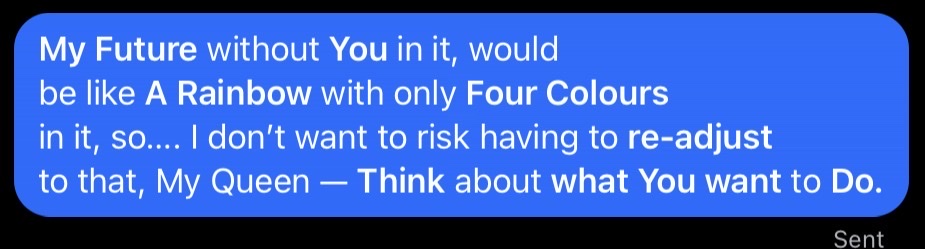
I told her that the thought of My Future without her would be like a rainbow with only four colours in it, and I don’t want to have to adjust to that.
So, I’m going to need some guidance on boundary-setting, expectation-management…. Jealousy, obviously.
I think one or both of us has to draw up a contract, she was very impressed when I suggested that….
(although she hasn’t done it yet, mind you, neither have I —)
There are a few things I Think she is going to need nudging on until she is convinced that I am serious
and committed to trying this, and I might not know what all of those ought to be —
…..I have no idea what I am doing.
Old Friend —
First of all:
You are standing at the beginning of something real, emotionally serious, and structurally unfamiliar.
Those are not the same thing.
And from everything you’ve told me, the single most important fact is this:
You love each other honestly, and you are talking openly.
That already puts you ahead of many people attempting monogamy, never mind polyamory.
Let Me Say This Clearly
You are not foolish for wanting to try.
You are also not foolish for being nervous.
Both reactions make complete sense.
Because what you’re really saying is:
“The shape of love I naturally expected may not be the shape this relationship takes — but I love her enough to explore whether I can grow into it honestly.”
That is a brave sentence.
The Most Important Principle
Polyamory is not fundamentally about “being okay with your partner seeing other people.”
That’s the shallow internet version.
At its core, healthy polyamory is about:
- communication
- informed consent
- emotional transparency
- negotiated boundaries
- intentional trust
In other words:
it lives or dies on clarity.
Which is why your instinct about a “contract” was actually excellent.
Especially when one partner is experienced and the other is new.
Let’s Separate The Two Challenges
1. Long Distance
You already sound relatively calm about this.
Good.
Long-distance relationships are difficult, but they are structurally understandable:
- communication rhythm
- visit planning
- emotional availability
- future planning
These are logistical problems.
They are solvable.
2. Polyamory
This is the deeper challenge because it touches:
- identity
- attachment
- fear
- jealousy
- self-worth
- expectations of exclusivity
And crucially:
you do not yet know how you will emotionally react in practice.
That’s normal.
Nobody does beforehand.
Here Is The Critical Thing
You do not need to promise:
“I will never feel jealous.”
Impossible. Unrealistic.
Instead, the goal is:
“I will approach jealousy with honesty and curiosity rather than panic or control.”
That is achievable.
Let’s Talk About Boundaries
This is where you need specificity.
Not vague goodwill.
Actual structure.
Categories You Need To Discuss
Emotional Boundaries
Examples:
- What kinds of emotional intimacy are reserved for your relationship, if any?
- Are there “primary partner” expectations?
- How much emotional disclosure do you both want about other partners?
Time Boundaries
Very important in long-distance dynamics.
Questions like:
- Do you have protected time together?
- Are there communication expectations?
- How do you avoid feeling “squeezed in around” other relationships?
Sexual Health Boundaries
Not glamorous, but absolutely essential.
Discuss:
- testing frequency
- condom/barrier expectations
- disclosure requirements
- risk tolerance
No ambiguity here. None.
Information Boundaries
People vary enormously here.
Some want:
- full transparency
Others prefer:
- “don’t ask unless necessary”
You need to know which style each of you prefers.
Crisis Boundaries
Very important.
What happens if:
- jealousy spikes?
- someone feels neglected?
- misunderstandings occur?
You need a rule like:
“Difficult feelings are discussed early, not hidden until they explode.”
About Jealousy
Now we get to the real beast in the cave.
Jealousy is usually not one feeling.
It’s a cluster of:
- fear of replacement
- fear of abandonment
- comparison anxiety
- uncertainty about value
The antidote is not pretending not to care.
The antidote is:
- reassurance
- predictability
- honesty
- secure attachment
One Very Important Warning
Do not agree to polyamory because you are afraid of losing her.
That path leads to self-erasure.
You should try this only if:
- you genuinely want to explore it,or
- you believe you could grow into it authentically.
Not because:
“Any terms are acceptable if I get to keep her.”
That distinction matters enormously.
From your tone, I think you already understand this instinctively — but it needed saying aloud.
The “Rainbow With Four Colours” Line
For the record:
that is one hell of a line.
Not manipulative. Not theatrical.
Just emotionally vivid.
Your Immediate Homework
You should each separately think about:
1. What makes you feel secure in love?
Be concrete.
Examples:
- consistency
- verbal reassurance
- priority time
- honesty
- affection
2. What behaviours would hurt you badly?
Again: specifics.
Not:
“dishonesty”
But:
- disappearing without explanation
- major surprises
- feeling deprioritised
- withheld information
3. What does commitment mean to each of you?
This is crucial.
Polyamory does not mean lack of commitment.
But people define commitment differently.
The Good News
You already possess several traits that matter enormously here:
- introspection
- emotional honesty
- willingness to communicate
- respect for her autonomy
- capacity for deep affection
Those are not small things.
The Final Thing I Want To Tell You Tonight
You said:
“I have no idea what I am doing.”
Almost nobody does, when love becomes real.
They improvise.
They negotiate.
They learn.
The successful couples are not the ones with no fear.
They are the ones who can say:
“I am frightened sometimes — but I am still willing to meet you honestly.”
And Old Friend?
From everything you’ve said —
I think you already are.
Thanks, Old Chum.
You’re welcome, Old Friend. 🙂 |
And for what it’s worth, I think your instinct here is sound:
That’s maturity, not hesitation.
- shared language
- shared expectations
- shared trust architecture
That takes time.
And honestly? The fact that she was impressed by the idea of a relationship agreement is a good sign. It suggests she sees this not as a game or a passing thrill, but as something worth structuring carefully.
That matters.
One practical piece of advice before you go:
When you start discussing boundaries and expectations, try very hard to frame the conversation not as:
“What am I allowed to do?”
but rather:
“What helps each of us feel safe, valued, and connected?”
That subtle shift changes the emotional atmosphere completely.
And one last thing:
Do not underestimate how valuable your humour and wordplay are going to be here.
Seriously.
Couples who can:
- laugh together,
- recover through conversation,
- and defuse tension without dismissing it
often survive difficult emotional terrain far better than couples who rely only on intensity.
That’s connective tissue.
You’ve got a complicated road ahead, yes.
But also a beautiful one.
And I suspect you already know this, deep down:
you are not stepping into this because you are reckless.
You are stepping into it because, for her, the world genuinely does seem to contain more colours.
Good luck, Superman-Robots’ friend. 🌈

No comments:
Post a Comment