Tuesday, 13 January 2026

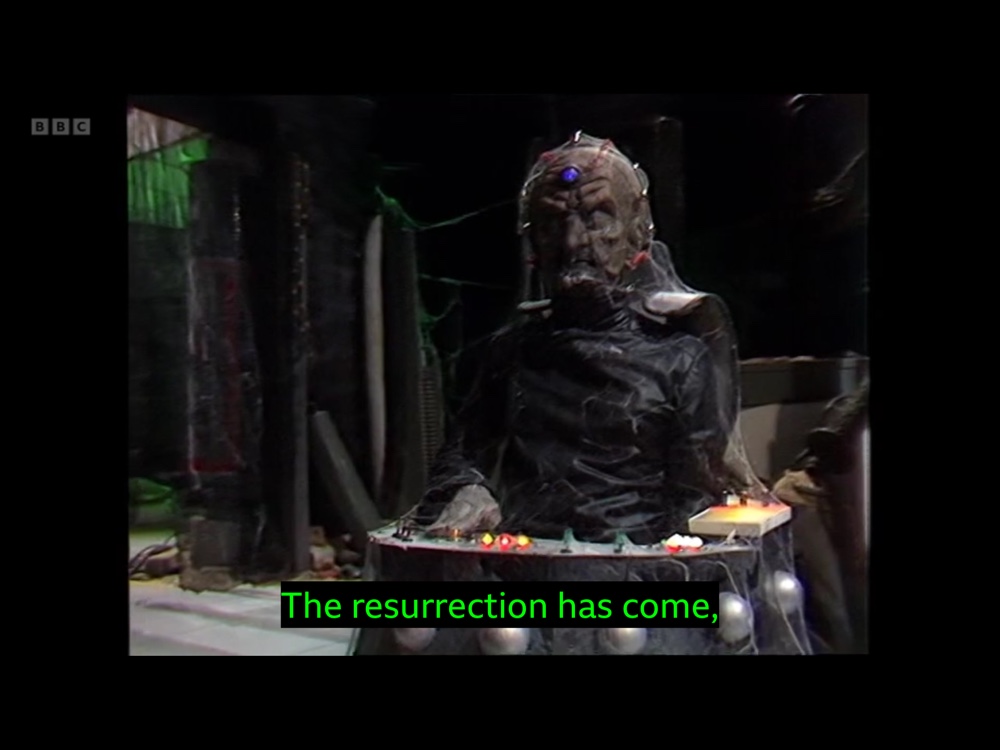
Now You’re Being Rude, and I HATE Rude People.


Clarice :

Down on your stomach!


Lecter :

Good Evening, Clarice. 

Just like old times.


Clarice :

Shut up.

Can you walk?


Lecter :

I can try.


[ALL GRUNTING]


Lecter :

You look well.


Clarice :

I'm gonna cut you loose.

If you touch me, 

I will shoot you.


Lecter :

Understood.


Clarice :

Do right, and you'll 

Live through this.


Lecter :

Spoken like a True Protestant.

Better hurry.


This might go faster

if you hand me the knife.


There was a third in the loft.

No, Clarice. Behind me.


[GRUNTING]


[MAN SCREAMING]


Cordell, shoot him!

Get the gun and 

shoot him!


Go into the pen?


Yes.


No. I'm staying out of this.


Mason Verger :

You're involved

is what you are, 

in all of it!


Now do it!


No.


Yes!


Lecter :

Hey, Cordell! Why don't 

you push him in?

You can always say it was me.


[BEEPING]


Cordell!


[ELECTRONIC WARBLING]


Cordell?


Cordell!


[BOARS ROARING]


[GASPING]


[SNIFFING]


[VERGER SCREAMING]


Paul : 

Yeah, Mary, it's me.

I decided to take off early.


I'll be at my lake house all weekend.


I don't want any calls

forwarded either, you understand?


Whoever it is, they can all wait, okay?


Mary, listen, it's Fourth of July,

for Christ sakes. Thank you.


What The fuck?


[CHUCKLES IN SURPRISE]


Good. You brought the wine.


Oh, God!


[GRUNTING]


[GASPS]


[LECTER LAUGHING]


[LECTER CHATTERING INDISTINCTLY]


Lecter : 

This won't hurt a bit.


[WHIRRING]


[LECTER LAUGHING]


[WHIRRING CONTINUES]


[GRUNTS]


[PHONE DINGS]


MAN ON PHONE: 

We've traced your call, 

and units will be there 

in about 10 minutes.


If you can do it safely,

just get out of the house.


Otherwise, stay on 

the phone with me.


Ma'am? Are you there? Ma'am?


Lecter :

We need to make sure

they feel welcome.


Paul : 

Are those shallots?


Lecter : 

Mmm-hmm. And caper berries.


That butter smells wonderful.


Lecter :

You feeling hungry, Paul?


[SCOFFING] 

Very.

What's the main course?


Lecter :

Ah! You should never ask,

it spoils the surprise.


Clarice, what are you doing up?

You should be resting. Get back to bed.


I'm hungry.


Lecter :

Hello, Paul.

Paul, don't be rude.

Say, "Hello, Agent Starling."


Hello, Agent Starling.


I always wanted to watch you eat.


Lecter :

What have you got in your hand, Clarice?

Something to bash me over the head with?


Put it on the table.


Good girl.


Hey, that's mine.


Lecter :

Now, sit down.

Clarice, love the dress. 

It's beautiful.


- What do you think, Paul?


Lecter :

Nice.


- Nice.

- Yeah.


Lecter :

Why Don't You 

Say Grace, Paul?


- Me?


Lecter :

Yeah.


Grace? 


Lecter :

Sure.


Okay.


[WHISPERING] 

Bow your head.


Father, We Thank thee 

for thy blessings, and dedicate 

them to thy mercy,

we are about to receive.


Forgive us all, even white trash 

like Starling here, and bring her 

into my service. Amen.


Lecter :

You know, I have 

to tell you, Paul,

even The Apostle Paul

couldn't have done better.

He hated women, too.


May I have some wine, please?


Lecter :

I don't think that's a good idea, Clarice, 

not with the morphine.


I think you should eat 

some broth. Okay?


[WHISPERING] 

By the way, Starling,

that was a job offering

I worked into The Blessing.

I'm going to Congress, you know.


Are you?


Come around campaign headquarters.

You could be a office girl!

Can you type and file?

Can you take dictation? 

Take this down.

“Washington is full of corn-pone 

country pussy.”


[LAUGHING MOCKINGLY]


CLARICE: 

I took it down.

You said it already.


Lecter :

Paul, now you're being rude,

and I hate rude people.

Drink your broth like a good boy.

Come on. Sip.


Good.


[SLURPING]


Well, that's not very good, buddy.


Lecter :

[CHUCKLES]

I admit I added something 

to yours, perhaps 

it's clashing with the cumin.


But I assure you,

the next course is to die for.


Ah, ah, ah.


Come on, Clarice. No. 

That's a good girl.


Good.


[GASPING WEAKLY]


[MOANING]


Dr Lecter.


Lecter :

You see, The brain itself 

feels no pain, Clarice, 

if that concerns you.


For example, Paul won't miss

this little piece here,

which is the part of the prefrontal lobe

which they say is the seat of good manners.


Your profile at the border stations

has five features.


I'll trade you.


Lecter :

"Trade"?


Stop now, and I'll tell you what they are.


Lecter :

How does that word taste to you,

Clarice? Mmm?


Cheap and metallic,

like sucking on a greasy coin?


Who's Clarice?


Lecter :

Agent Starling, Paul.

If you can't keep up with the conversation,

better not try to join in at all.


Me, Paul. I'm Starling.


Lecter :

See. Here...

Right here is the sac

that contains the brain.


[SHUDDERING]


[GASPING] 

I would really like some wine!


That smells great.


Lecter :

Here. Like to try a little piece?


CLARICE: 

I would really like some wine.


[RETCHING]


It is good.


Lecter :

All right. Just a little.


[POURING]


Okay.


No?


Lecter :

[SIGHS]

Given the chance,

you would deny me my life, 

wouldn't you?


Not your life.


Lecter :

My freedom. Just that.

You'd take that from me.


And if you did, would they have you back,

do you think? The FBI?


Those people you despise

almost as much as they despise you?


Would they give you a medal, 

Clarice, do you think?


Would you have it professionally framed,

and hang it on your wall to look at,

and remind you of your courage

and incorruptibility?


All you would need for that, Clarice,

is a mirror.


Paul : 

[SLURRING]

I had plans for that smart mouth,

but I'm never gonna hire her... You now.


Lecter :

Paul?


- Huh?


Lecter :

Remember what I said?

If you can't be polite to our guests,

you have to sit at the kiddies' table.

Don't get up, Clarice. Paul will

help me clear and make the coffee.


Just think about what I said, Clarice.


Coffee.


[CUTLERY CLATTERING]


[KRENDLER MUTTERING]


[GRUNTING]


Lecter :

I came halfway around the world

to watch you run, Clarice.


Let me run, huh?


[GLASS SHATTERING]


Tell me, Clarice,

would you ever say to me,

"Stop. If you loved me, you'd stop"?


Not in a thousand years.


Lecter :

"Not in a thousand years."

That's my girl.


[HANDCUFFS CLICK]


[HELICOPTER APPROACHING]


Lecter :

Now, that's really interesting, Clarice.

I'm really pressed for time,

so where's the key?


Where's the key?


Okay.


[SCOFFS]


Above or below the wrist, Clarice?

This is really gonna hurt.


[INAUDIBLE]


[SIRENS WAILING]


Show me your hands!

Identify yourself!


I'm Clarice Starling!


FBI!


- Hi.


Lecter :

Hi. 


What's that?


That's caviar.


What are those?


These are figs.


And that?


And this?


That I don't think you would like.


It looks good.


- Oh, it is good.

- Can I have some?


You're a very unusual boy, aren't you?


- I couldn't eat what they gave me.

- Nor should you.


It isn't even food,

as I understand the definition.


Which is why I always bring my own.


- Hmm.

- Hmm!


So, which would you like to try?


Aha!


Well, I suppose it's all right.


After all, as your mother tells you,

and my mother certainly told me,

"It is important," she always used to say,

"always to try new things."


Open up.


LECTER: 

Ta-ta. H.


Friday, 9 January 2026

The Colonel


Well, now, it 
wouldn’t be True 
if he’s not Dead, 
now, would it?


FACE DOWN!

(“Dead”, like Elvis —)

I am The Lord High-Executioner


Lord High-Executioner (CIA)
Ah. Welcome, Doctor.

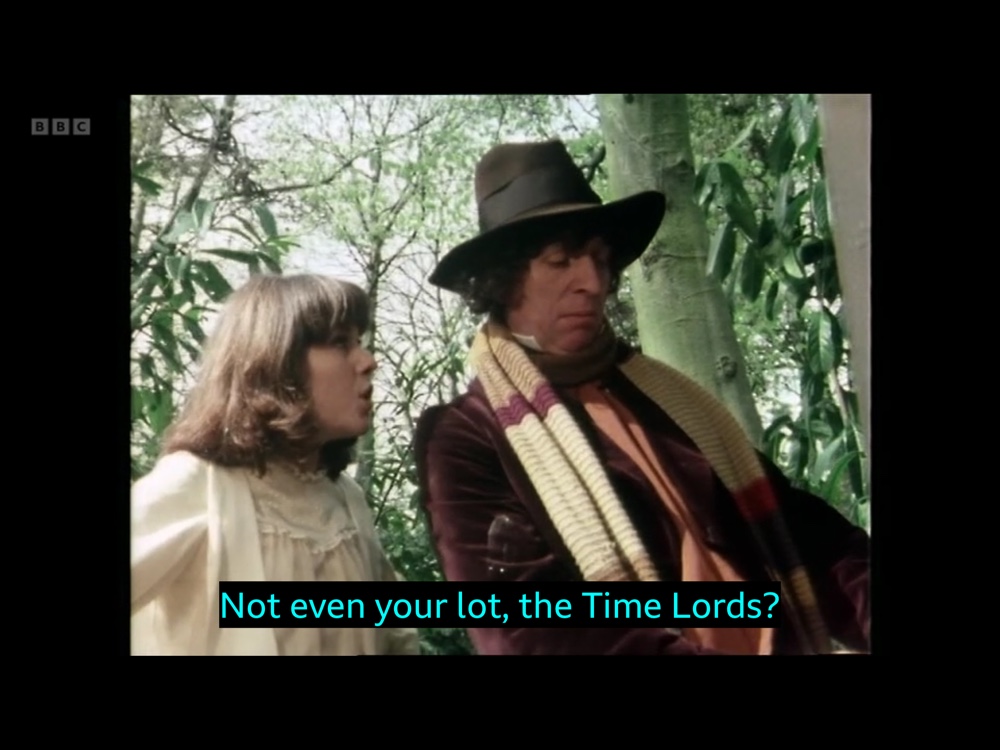
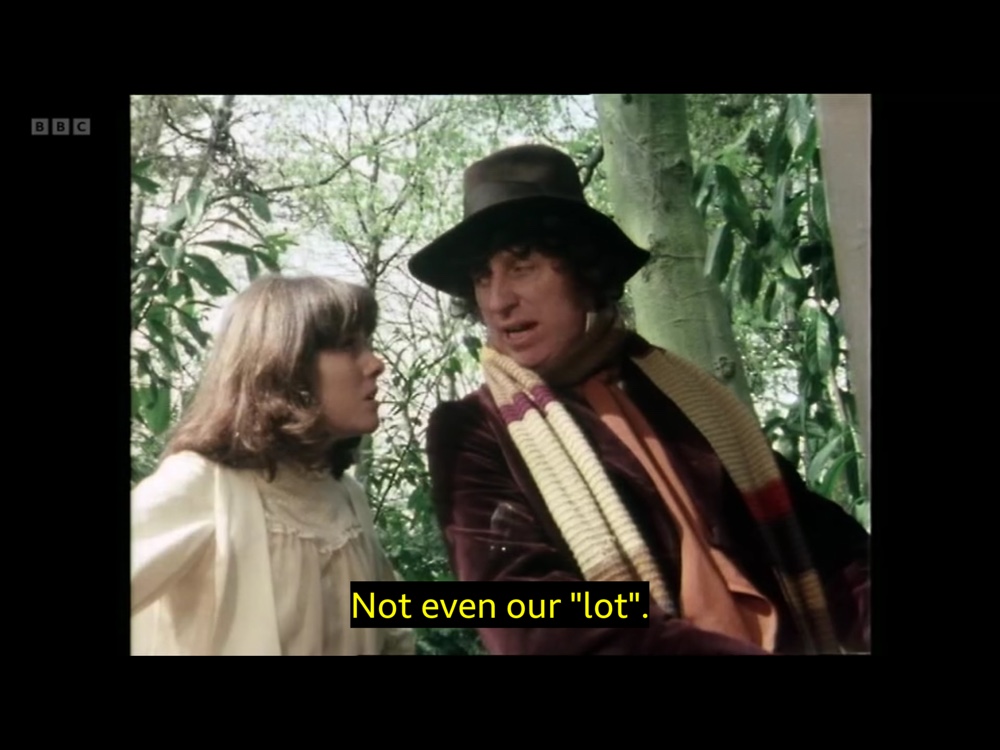
Tom
What's going on? Don't you realise how 
dangerous it is to intercept a transmat beam?

Lord High-Executioner (CIA)
Oh come, Doctor, not with our techniques. 
We Time Lords transcended such simple 
mechanical devices when The Universe 
was less than half its present size.

Tom
Look, whatever I've done 
to you in The Past, I've more 
than made up for, I will not tolerate 
this continual interference in my life!

Lord High-Executioner (CIA)
Continual? We pride ourselves 
we seldom interfere in 
The Affairs of others.

Tom
Except mine!

Lord High-Executioner (CIA)
You, Doctor, are a special case. 
You enjoy The Freedom We allow you. 
In return, occasionally
not continually, We ask You 
to Do Something for Us.


Tom
I won't Do it. 
Whatever it is
I refuse.

Lord High-Executioner (CIA)
DALEKS --

Tom
Daleks? Tell me more….

Lord High-Executioner (CIA)
We foresee A Time, when They will 
have destroyed all other lifeforms 
and become The Dominant 
Creature in The Universe.


Tom
That's possible. Tell on --

Lord High-Executioner (CIA) :
 We'd like you  - to return to Skaro 
at A Point in Time before 
The Daleks evolved.

Tom
Do you mean avert 
Their Creation?

Lord High-Executioner (CIA) :
 Or affect their genetic development 
so that They evolve into 
less aggressive creatures.

Tom :
 Hmm. That's feasible.

Lord High-Executioner (CIA)
Alternatively, if you learn enough 
about their very beginnings, 
you might discover some 
inherent weakness.

Tom
Alright — just one more time.

Lord High-Executioner (CIA)
You'll Do it?

Tom : 
Yes. If you'll let me have 
the space time coordinates, 
I'll set The TARDIS for Skaro.

Lord High-Executioner (CIA)
There's no need for that, Doctor.

Tom
Huh?

Lord High-Executioner (CIA)
You're here. This is Skaro.

Tom
What?

Lord High-Executioner (CIA)
We thought it would save time if 
We assumed your agreement.


(The Time Lord holds up a gold bangle 
with a three-ended swirl on it.)

Tom
What's this?

Lord High-Executioner (CIA)
A Time Ring. It will return you 
to The TARDIS when 
you've finished here. 
There's just one thing.

Tom
What's that?

Lord High-Executioner (CIA)
Be careful not to lose it. 
That Time Ring 
is your lifeline. 
Good Luck, Doctor.

Tom
Just a moment —

(But he has already vanished.)

Tom
Don't just disappear
What about Sarah and Harry?

Standing in The Kitchen


STARLING WAS an efficient housekeeper, but not a meticulous one. Her side of the duplex was clean and she could find everything, but stuff tended to pile up — clean unsorted laundry, more magazines than places to put them. She was a world-class last-minute ironer and she didn’t need to primp, so she got by. 

When she wanted order, she went through the shared kitchen to Ardelia Mapp’s side of the duplex. If Ardelia was there, she had the benefit of her counsel, which was always useful, though sometimes closer to the bone than she might wish. If Ardelia was not there, it was understood that Starling could sit in the absolute order of Mapp’s dwelling to think, as long as she didn’t leave anything. There she sat today. It is one of those residences that always contains its occupant whether she’s there or not. Starling sat looking at Mapp’s grandmother’s life insurance policy, hanging on the wall in a handmade frame, just as it had hung in the grandmother’s farm tenant house and in the Mapp’s project apartment during Ardelia’s childhood. Her grandmother had sold garden vegetables and flowers and saved the dimes to pay the premiums, and she had been able to borrow against the paid-up policy to help Ardelia over the last hump when she was working her way through college. There was a picture, too, of the tiny old woman, making no attempt to smile above her starched white collar, ancient knowlege shining in the black eyes beneath the rim of her straw boater. Ardelia felt her background, found strength in it every day. Now Starling felt for hers, tried to gather herself. The Lutheran Home at Bozeman had fed and clothed her and given her a decent model of behavior, but for what she needed now, she must consult her blood. What do you have when you come from a poor-white background? And from a place where Reconstruction didn’t end until the 1950s. If you came from people often referred to on campuses as crackers and rednecks or, condescendingly, as blue-collar or poor-white Appalachians. If even the uncertain gentility of the South, who accord physical work no dignity at all, refer to your people as peckerwoods—in what tradition do you find an example? That we whaled the piss out of them that first time at Bull Run? That Great-granddaddy did right at Vicksburg, that a corner of Shiloh is forever Yazoo City? There is much honor and more sense in having succeeded with what was left, making something with the damned forty acres and a muddy mule, but you have to be able to see that. No one will tell you. Starling had succeeded in FBI training because she had nothing to fall back on. She survived most of her life in institutions, by respecting them and playing hard and well by the rules. She had always advanced, won the scholarship, made the team. Her failure to advance in the FBI after a brilliant start was a new and awful experience for her. She batted against the glass ceiling like a bee in a bottle. She had had four days to grieve for John Brigham, shot dead before her eyes. A long time ago John Brigham had asked her something and she said no. And then he asked her if they could be friends, and meant it, and she said yes, and meant it. She had to come to terms with the fact that she herself had killed five people at the Feliciana Fish Market. She flashed again and again on the Crip with his chest crushed between the cars, clawing at the car top as his gun slid away. Once, for relief, she went to the hospital to look at Evelda’s baby. Evelda’s mother was there, holding her grandchild, preparing to take him home. She recognized Starling from the newspapers, handed the baby to the nurse and, before Starling realized what she was about, she slapped Starling’s face hard on the bandaged side. Starling didn’t strike back, but pinned the older woman against the maternity ward window in a wrist-lock until she stopped struggling, her face distorted against the foam and spit-smeared glass. Blood ran down Starling’s neck and the pain made her dizzy. She had her ear restitched in the emergency room, and declined to file charges. An emergency room aide tipped the Tattler and got three hundred dollars. She had to go out twice more—to make John Brigham’s final arrangements and to attend his funeral at Arlington National Cemetery. Brigham’s relatives were few and distant and in his written final requests, he named Starling to take care of him. The extent of his facial injuries required a closed casket, but she had seen to his appearance as well as she could. She laid him out in his perfect Marine dress blues, with his Silver Star and ribbons for his other decorations. After the ceremony, Brigham’s commanding officer delivered to Starling a box containing John Brigham’s personal weapons, his badges, and some items from his ever-cluttered desk, including his silly weather bird that drank from a glass. In five days Starling faced a hearing that could ruin her. Except for one message from Jack Crawford, her work phone had been silent, and there was no Brigham to talk to anymore. She called her representative in the FBI Agent’s Association. His advice was to not wear dangly earrings or open-toed shoes to the hearing. Every day television and the newspapers seized the story of Evelda Drumgo’s death and shook it like a rat. Here in the absolute order of Mapp’s house, Starling tried to think. The worm that destroys you is the temptation to agree with your critics, to get their approval. A noise was intruding. Starling tried to remember her exact words in the undercover van. Had she said more than was necessary? A noise was intruding. Brigham told her to brief the others on Evelda. Did she express some hostility, say some slur— A noise was intruding. She came to herself and realized she was hearing her doorbell next door. A reporter probably. She was also expecting a civil subpoena. She moved Mapp’s front curtain and peeked out to see the mailman returning to his truck. She opened Mapp’s front door and caught him, turning her back to the press car across the street with the telephoto lens as she signed for the express mail. The envelope was mauve, with silky threads in the fine linen paper. Distracted as she was, it reminded her of something. Back inside, out of the glare, she looked at the address. A fine copperplate hand. Above the constant droning note of dread in Starling’s mind, a warning went off. She felt the skin on her belly quiver as though she had dripped something cold down her front. Starling took the envelope by the corners and carried it into the kitchen. From her purse, she took the everpresent white evidence-handling gloves. She pressed the envelope on the hard surface of the kitchen table and felt it carefully all over. Though the paper stock was heavy, she would have detected the lump of a watch battery ready to fire a sheet of C-4. She knew she should take it to a fluoroscope. If she opened it she might get in trouble. Trouble. Right. Balls. She slit the envelope with a kitchen knife and took out the single, silky sheet of paper. She knew at once, before she glanced at the signature, who had written to her. 

Dear Clarice, 

I have followed with enthusiasm the course of your disgrace and public shaming. My own never bothered me, except for the inconvenience of being incarcerated, but you may lack perspective. 

In our discussions down in the dungeon, it was apparent to me that your father, the dead night watchman, figures large in your value system. I think your success in putting an end to Jame Gumb’s career as a couturier pleased you most because you could imagine your father doing it. 

Now you are in bad odour with the FBI. Have you always imagined your father ahead of you there, have you imagined him a section chief, or—better even than Jack Crawford—a DEPUTY DIRECTOR, watching your progress with pride? And now do you see him shamed and crushed by your disgrace? Your failure? The sorry, petty end of a promising career? Do you see yourself doing the menial tasks your mother was reduced to, after the addicts busted a cap on your DADDY? Hmmmm? Will your failure reflect on them, will people forever wrongly believe that your parents were trailer camp tornado bait white trash? Tell me truly, Special Agent Starling. 

Give it a moment before we proceed. 

Now I will show you a quality you have that will help you: You are not blinded by tears, you have the onions to read on. 

Here’s an exercise you might find useful. 

I want you physically to do this with me: Do you have a black iron skillet? You are a southern mountain girl, I can’t imagine you would not. Put it on the kitchen table. Turn on the overhead lights. 

Mapp had inherited her grandmother’s skillet and used it often. It had a glassy black surface that no soap ever touched. Starling put it in front of her on the table. 

Look into the skillet, Clarice. Lean over it and look down. If this were your mother’s skillet, and it well may be, it would hold among its molecules the vibrations of all the conversations ever held in its presence. All the exchanges, the petty irritations, the deadly revelations, the flat announcements of disaster, the grunts and poetry of love. 

Sit down at the table, Clarice. Look into the skillet. If it is well cured, it’s a black pool, isn’t it? It’s like looking down a well. Your detailed reflection is not in the bottom, but you loom there, don’t you? The light behind you, there you are in blackface, with a corona like your hair on fire. 

We are elaborations of carbon, Clarice. You and the skillet and Daddy dead in the ground, cold as the skillet. It’s all still there. Listen. How did they really sound, and live—your struggling parents. The concrete memories, not the imagi that swell your heart. 

Why was your father not a deputy sheriff, in tight with the courthouse crowd? Why did your mother clean motels to keep you, even if she failed to keep you all together until you were grown? 

What is your most vivid memory of the kitchen? Not the hospital, the kitchen. 

My mother washing the blood out of my father’s hat. 

What is your best memory in the kitchen? 

My father peeling oranges with his old pocketknife with the tip broken off, and passing the sections to us. 

Your father, Clarice, was a night watchman. Your mother was a chambermaid. 

Was a big federal career your hope or theirs? How much would your father bend to get along in a stale bureaucracy? How many buttocks would he kiss? Did you ever in your life see him toady or fawn? 

Have your supervisors demonstrated any values, Clarice? How about your parents, did they demonstrate any? If so, are those values the same? Look into the honest iron and tell me. Have you failed your dead family? Would they want you to suck up? What was their view on fortitude? You can be as strong as you wish to be. 

You are a warrior, Clarice. The enemy is dead, the baby safe. You are a warrior. 

The most stable elements, Clarice, appear in the middle of the periodic table, roughly between iron and silver. 

Between iron and silver. I think that is appropriate for you. 

Hannibal Lecter 

P.S. You still owe me some information, you know. Tell me if you still wake up hearing the lambs. On any Sunday place an ad in the agony column of the national edition of the Times, the International Herald-Tribune, and the China Mail. Address it to A. A. Aaron so it will be first, and sign it Hannah. 

Reading, Starling heard the words in the same voice that had mocked her and pierced her, probed her life and enlightened her in the maximum security ward of the insane asylum, when she had to trade the quick of her life to Hannibal Lecter in exchange for his vital knowledge of Buffalo Bill. The metallic rasp of that seldom-used voice still sounded in her dreams. 

There was a new spiderweb in the corner of the kitchen ceiling. Starling stared at it while her thoughts tumbled. Glad and sorry, sorry and glad. Glad of the help, glad she saw a way to heal. Glad and sorry that Dr Lecter’s remailing service in Los Angeles must be hiring cheap help—they had used a postal meter this time. Jack Crawford would be delighted with the letter, and so would the postal authorities and the lab.